

Main Facts: An Eclectic Dive into Automotive History
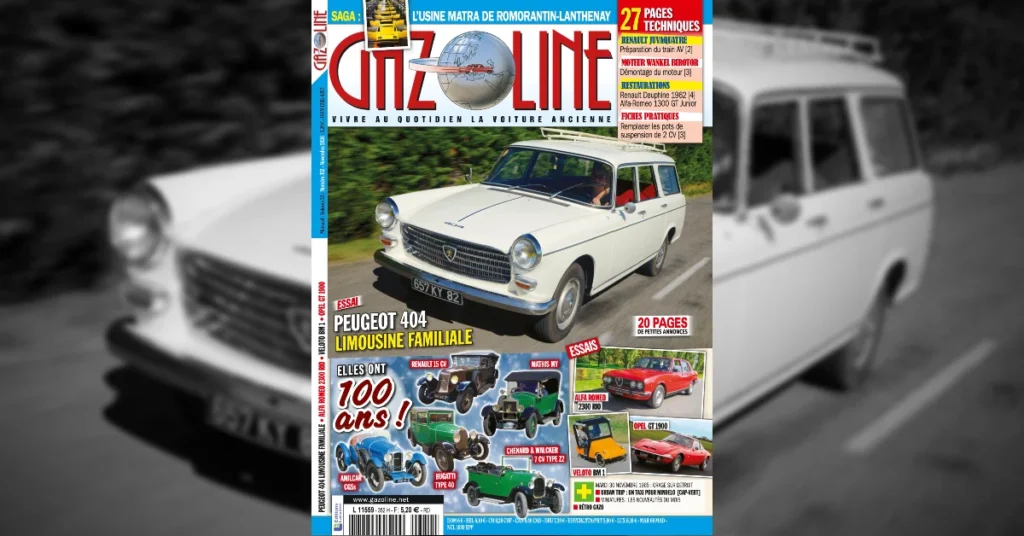
The release of Gazoline magazine’s November 2026 issue (Number 352) marks yet another milestone for enthusiasts of classic and vintage vehicles. Known for its deep-dive journalism, hands-on mechanical restoration guides, and affection for the unsung heroes of the tarmac, this edition takes readers on a sweeping transnational journey. From the utilitarian charm of French diesel-powered family haulers to Brazilian-built Italian exotics, strange micro-mobility oddities, and a monumental celebration of centenarian motorcars, Issue 352 offers a masterclass in automotive preservation and storytelling.
At the heart of this month’s publication is a brilliant re-discovery of the Peugeot 404 "Limousine Familiale" Diesel. Long celebrated for its role as the quintessential transporter of large French families, this specific model challenges enduring clichés regarding early diesel engines. Far from just being a slow, clattering workhorse, the featured car showcases the sophisticated engineering and reliable endurance that made the 404 a global icon.
Complementing the Peugeot are three distinctly unique test drives. The first is a beloved classic: the Opel GT 1900, a sleek, miniature Corvette-styled coupe that feels like an old friend to classic car aficionados. Next is the obscure and fascinating Alfa Romeo 2300 Rio—a vehicle known almost exclusively by hardcore brand purists and South American market historians. Finally, the editorial team pushes the boundaries of conventional mobility testing with the Véloto BM 1, a bizarre contraption that defies easy classification and firmly earns the title of an Unidentified Rolling Object (URO).
Beyond the road tests, Gazoline #352 looks back a full century to honor five legendary automobiles turning 100 years old. This stellar lineup includes the sporting Amilcar CGSs, the sophisticated Bugatti Type 40, the sensible Chenard & Walcker 7 CV Type Z2, the brilliantly engineered Mathis MY, and the majestic, six-cylinder Renault 15 CV.
Industrial heritage also takes center stage in this issue with a comprehensive historical saga dedicated to the legendary Matra factory in Romorantin-Lanthenay, tracking its monumental footprint in the Sologne region of France. Meanwhile, practical mechanics are thoroughly catered to through ongoing restoration series covering the Renault Juvaquatre, the Wankel Birotor engine, the Renault Dauphine, and an essential technical guide on replacing the suspension pots of a Citroën 2CV.
Chronology: A Journey Through Time
To fully appreciate the scope of Gazoline #352, one must look at the diverse temporal landscape it covers, stretching from the dawn of industrial motoring to pivotal mid-century milestones.
1926: The Centenarians
Five distinct machines represent the engineering philosophy of the Roaring Twenties, each turning 100 years old in 2026:
- Amilcar CGSs: Often dubbed the "poor man’s Bugatti," this lightweight cyclecar delivered accessible high performance and fierce racing pedigree.
- Bugatti Type 40: A masterpiece of design and mechanical architecture, functioning as a "savant puzzle" of Ettore Bugatti’s genius.
- Chenard & Walcker 7 CV Type Z2: A vehicle representing the rational, economical approach to family transportation in post-WWI France.
- Mathis Type MY: Known as the "overachiever," showcasing Emile Mathis’s advanced manufacturing techniques and brilliant output.
- Renault 15 CV: A grand tourer boasting a potent six-cylinder engine ("six gamelles") wrapped in the iconic diamond emblem.
1950s–1970s: The Golden Age of Innovation and Expansion
- 1951: The ongoing meticulous restoration of the Renault Juvaquatre AHG 2 reaches a critical phase, focusing on rebuilding and preparing the front axle.
- November 30, 1965: A thematic historical retrospective ("Storm over Detroit") looks back at a turbulent and transformative day in the American automotive capital, setting the socio-political backdrop for the era’s design choices.
- Late 1960s to 1970s: The Opel GT 1900 captures hearts with its wind-cheating fastback profile and pop-up headlights, becoming an affordable icon of 1960s style. Concurrently, the Peugeot 404 Familiale Diesel solidifies its reputation as the ultimate long-distance family cruiser across French provinces and taxi ranks worldwide.
- The Alfa Romeo 2300 Rio Era: Born out of Alfa Romeo’s Brazilian subsidiary (FNA), the Rio combined Italian styling cues with local adaptation, creating a rare cross-continental oddity.
Supporting Data: Summary of Gazoline Issue #352 (November 2026)
For readers seeking a complete overview of the articles, road tests, restorations, and regular features included in this comprehensive edition, the official table of contents outlines the publication:

- News & History: Tuesday, November 30, 1965: Storm over Detroit
- Re-discovery (Feature 1): Peugeot 404 Limousine Familiale Diesel (She doesn’t drink, she doesn’t smoke…)
- Re-discovery (Feature 2): Opel GT 1900 (The adorable coupe)
- Re-discovery (Feature 3): Alfa Romeo 2300 Rio (The Cariocalfa)
- Special Report: Véloto BM 1 (Sweet pedal power / Unidentified Rolling Object)
- Special Section – 100 Years Old (Coups de cœur):
- Amilcar CGSs (The poor man’s Bugatti)
- Bugatti Type 40 (A learned puzzle)
- Chenard & Walcker 7 CV Type Z2 (The path of reason)
- Mathis Type MY (The overachiever)
- Renault 15 CV (Six pots and a diamond)
- Industrial Saga: The Matra Factory in Romorantin-Lanthenay (An industrial epic in the heart of Sologne)
- Urban Trip: Cape Verde (A taxi for Mindelo)
- Restoration Chronicles:
- Renault Juvaquatre AHG 2 (1951) – Part 28: Front axle preparation [Part 2]
- Wankel Birotor Motor – Part 4: Engine disassembly [Part 3]
- Renault Dauphine – Part 4: Rediscovering the scent of newness
- Alfa Romeo 1300 GT Junior: Additional required mechanical works
- Practical Workshop Guide: Replacing the suspension pots on a Citroën 2CV [Part 3]
- Collectibles: The month’s new miniature releases
- Retrospective: RétroGazo
Official Perspectives and Editorial Insights
The editorial stance of Gazoline has always centered on democratizing automotive passion, proving that historic cars are meant to be driven, maintained, and understood rather than merely locked away in sterile museums.
In this month’s leading editorial, the focus on the diesel-powered Peugeot 404 Limousine Familiale serves a distinct philosophical purpose. Modern automotive discourse frequently demonizes older diesel technologies due to emissions concerns. However, Gazoline’s editorial team seeks to reframe the conversation around longevity, resource efficiency, and historical context. By demonstrating how the Indenor-powered Peugeot efficiently moved families across vast distances without demanding excessive fuel or fragile maintenance, the magazine challenges contemporary prejudices against early compression-ignition engines.
Furthermore, the inclusion of hyper-rare curiosities like the Alfa Romeo 2300 Rio and the eccentric Véloto BM 1 highlights the magazine’s commitment to widening the aperture of automotive journalism. Editorial reviews emphasize that automotive history is not written solely by mass-market blockbusters or multi-million-dollar supercar auctions; it is equally shaped by regional adaptations, ingenious localized failures, and niche mobility experiments designed to solve specific societal challenges.
Implications: Preserving Industrial Memory in a Fast-Changing World
The release of Gazoline #352 carries profound implications for the classic car community, industrial archaeology, and modern restoration culture.
1. Challenging Single-Narrative History
By bridging the gap between ultra-exclusive 1926 centenarians (like the Bugatti Type 40 and Amilcar CGSs) and humble 1970s working-class transporters (like the Peugeot 404 diesel), the publication reinforces the idea that all historical artifacts hold equal narrative weight. The story of industrial collapse and rebirth—exemplified by the in-depth look at the Matra factory in Romorantin-Lanthenay—reminds readers of the human stories, labor forces, and regional economies that built Europe’s automotive prowess.
2. The Practicality of Preservation
Through its rigorous step-by-step technical guides (such as rebuilding a Renault Juvaquatre front axle, stripping down a complex Wankel Birotor engine, or replacing Citroën 2CV suspension pots), Gazoline acts as a vital guardian of vanishing mechanical knowledge. As internal combustion engines face an uncertain regulatory future, the hands-on transmission of repair skills ensures that rolling heritage will remain operational for generations to come.
Ultimately, Issue #352 of Gazoline is much more than a magazine; it is a meticulously curated archive that honors the past, instructs the present, and ensures that the soulful machinery of yesterday continues to capture the imagination of tomorrow.
