

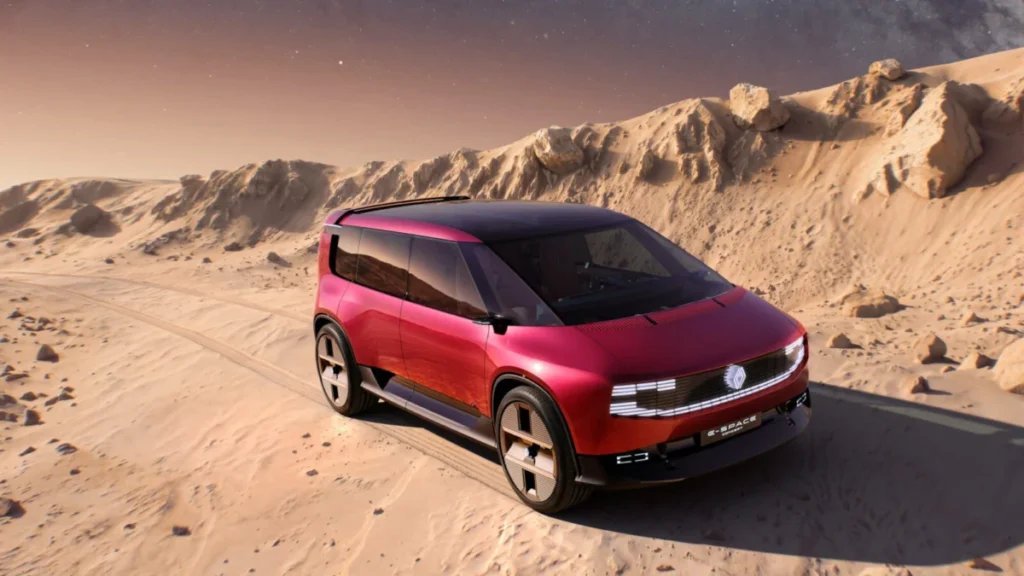
At the Paris Motor Show, while the global automotive industry continues to swell the ranks of two-ton, aerodynamically challenged crossovers to satisfy a fleeting consumer trend, Renault has dropped a bombshell. With the unveiling of the E-Space concept, the French automaker is effectively declaring war on the inefficient family SUV, choosing instead to reinvent the grand monospace (MPV) for the electric age. Under the design direction of Alexandre Malval, the E-Space is not merely a nostalgia trip for children of the 1980s; it is a calculated, high-tech manifesto for a more rational, efficient, and cost-effective future.
Built on the forthcoming 2028 RGVE (Renault Group Vehicle Electric) Medium 2.0 platform, the E-Space promises a radical departure from current manufacturing norms: an 800-volt architecture, up to 500 horsepower, and a staggering 750 kilometers of range powered by advanced Lithium Iron Phosphate (LFP) batteries. Perhaps most significantly, Renault claims this architecture will slash industrial production costs by 40%.
Main Facts: Reclaiming the "Voiture à Vivre"
The core heresy of the contemporary electric SUV lies in its abysmal ratio of exterior footprint to interior habitability. These vehicles often feature massive, horizontal hoods that waste cubic meters of space, cramped rear cabins, and frontal areas that decimate highway efficiency at speeds above 120 km/h.
The E-Space concept reclaims the "Voiture à Vivre" (Cars for Living) philosophy pioneered by Philippe Guédon at Matra in 1984. By erasing the artificial separation between the engine compartment and the cabin, Renault has maximized every square millimeter of interior volume. Contained within a length of exactly 4.70 meters—the size of a standard mid-size SUV—the E-Space offers six true individual seats across three rows.
The design is a masterclass in aerodynamic purity. A continuous line stretches from the front bumper to the peak of the tailgate, effectively slicing through the air with minimal drag. The front end pays homage to the original Espace I, while the abrupt, vertical termination of the rear window echoes the 2002 Espace IV. Inside, the cabin benefits from a perfectly flat floor and ultra-thin A-pillars. The seats, inspired by the ergonomic principles of designer Pierre Paulin, favor comfort and openness over complex folding mechanisms, bathed in natural light provided by a full-length panoramic glass roof.
Chronology: Forty Years of French Innovation
To understand the weight of the E-Space concept, one must look at the evolution of the MPV at Renault. The lineage is not just a history of models, but a history of engineering ambition.
- 1984 – The Genesis (Espace I): Born from a collaboration with Matra, the original Espace was a revolution in architecture. Using a composite body on a steel chassis, it utilized a modified Renault 18/Fuego platform to provide a modular interior that could seat five to seven people. It was the birth of a category.
- 2002 – The Peak (Espace IV): The first Espace developed entirely in-house by Renault, the fourth generation consolidated the brand’s industrial strength at the Sandouville factory. It featured a bold, angular design by Patrick Le Quément and offered high-performance V6 engines, setting the standard for the premium family hauler.
- 2026-2028 – The Electric Pivot (E-Space Concept): Renault is now moving to bridge the gap between its storied past and a carbon-neutral future. By leveraging the new RGVE 2.0 platform, the E-Space represents the first time an MPV architecture has been purpose-built for high-voltage, high-efficiency electric propulsion, moving away from the "SUV-as-default" design language.
Supporting Data: The 800V and LFP Revolution
The strategic stakes of the E-Space go far beyond its sleek silhouette. It serves as a rolling laboratory for the RGVE Medium 2.0 platform. Designed to succeed the current AmpR Medium architecture, this new foundation makes the critical leap to an 800-volt electrical system.
By doubling the nominal voltage, Renault’s engineers have successfully reduced thermal buildup and minimized the diameter of the copper wiring harnesses. This not only lightens the vehicle but also guarantees "express" charging times at ultra-fast stations. The modular traction chain is designed to accommodate either one or two motors, offering a performance spread from a modest 275 horsepower to a performance-oriented 500 horsepower with all-wheel drive.
The most aggressive target, however, is the 40% reduction in production costs. This is achieved through a bold shift in battery strategy: moving away from expensive Nickel-Manganese-Cobalt (NMC) chemistries in favor of next-generation LFP batteries integrated via "cell-to-pack" technology. Historically, LFP batteries were relegated to entry-level city cars due to their lower energy density. However, because the E-Space is so aerodynamically efficient—boasting a drag coefficient that pulverizes that of any current SUV—the vehicle can achieve its 750km range while consuming less than 15 kWh per 100km. This allows Renault to utilize cheaper, safer, and more durable batteries without the weight penalty typically associated with them.
Official Responses and Strategic Outlook
Renault’s leadership has framed the E-Space not as a niche product, but as a systematic response to the "SUV fatigue" they believe is brewing among consumers and regulators alike.
"We are moving past the era of aesthetic excess," a spokesperson for the project noted at the Paris reveal. "The industry has spent a decade building tanks because that was what the market asked for. But as electricity becomes the primary energy source, physics is reclaiming its rights. An electric car’s greatest enemy is drag, and an SUV’s greatest weakness is its frontal area. With E-Space, we are proving that you don’t need a massive, heavy, inefficient vehicle to provide luxury and range."
Industry analysts have praised the move, noting that Renault is uniquely positioned to lead this shift. By focusing on the "monospace" format, the company is effectively lowering the barrier to entry for long-range electric travel, making 750km of range affordable for the middle-class family—a feat currently impossible with the premium pricing of high-end electric SUVs.
Implications: The End of the Inefficient SUV?
The implications of the E-Space for the automotive landscape are profound. If Renault succeeds in bringing this platform to mass production by 2028, it could trigger a "race to efficiency" that would render the current generation of heavy, high-riding EVs obsolete.
- Manufacturing Resilience: The 40% cost reduction is a massive competitive advantage. It allows Renault to maintain profit margins while potentially undercutting competitors on price, or alternatively, reinvesting that capital into better software and autonomous driving features.
- Urban Integration: By maintaining a compact 4.70-meter footprint, the E-Space remains maneuverable in urban environments while offering interior space that rivals larger vans. This makes it a perfect candidate for the cities of tomorrow, which are increasingly hostile to oversized private vehicles.
- Safety and Durability: The adoption of LFP chemistry is a direct response to consumer concerns regarding battery longevity and safety. By moving to a chemistry that is inherently more stable and resistant to thermal runaway, Renault is positioning itself as the "sensible" choice for families.
Summary Table: A Technical Comparison
| Feature | Espace I (1984) | Espace IV (2002) | E-Space Concept (2028) |
|---|---|---|---|
| Length | 4.25m | 4.66m | 4.70m |
| Architecture | Steel/Composite | Steel/Alu | RGVE 2.0 (800V) |
| Seating | 5-7 (removable) | 5-7 (rails) | 6 (individual) |
| Powertrain | 2.0L Petrol | 2.0dCi / 3.5L V6 | 100% Electric |
| Range/Fuel | 63L Tank | 83L Tank (~1000km) | >750km (LFP) |
| Industrial Goal | Innovation/Niche | Scale | Cost reduction (-40%) |
As the Paris Motor Show concludes, the message from the Renault stand is clear: the future of family transport isn’t a higher-riding SUV; it’s a smarter, sleeker, and more efficient monospace. By returning to its roots, Renault may have just invented the future of the electric car all over again. The age of the "family tank" is reaching its expiration date; the era of the high-efficiency, long-range MPV is just beginning.
