

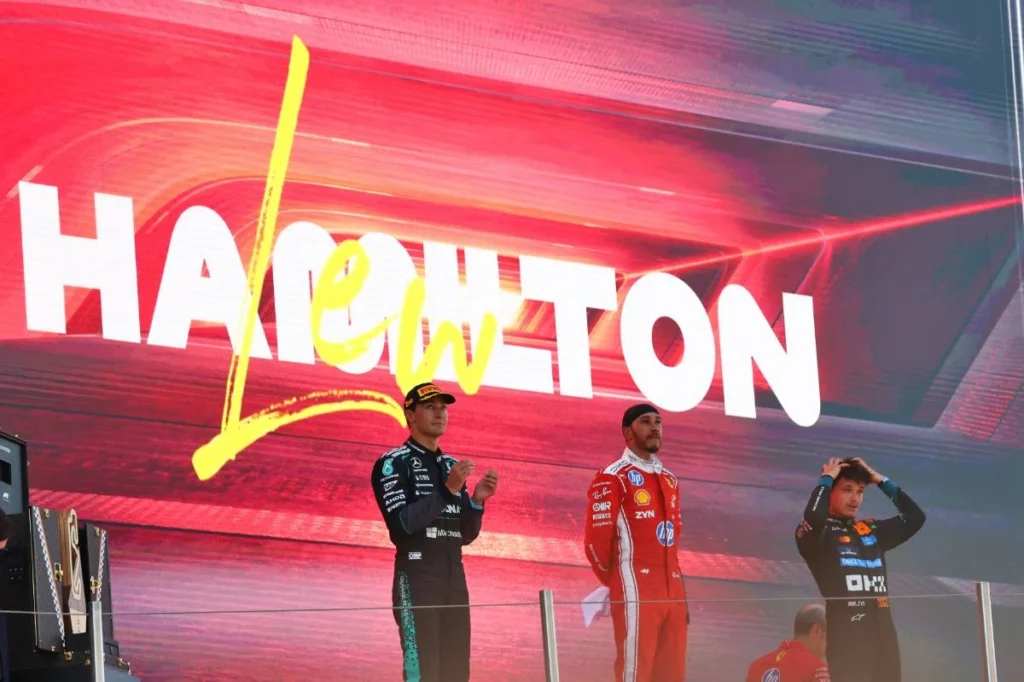
The Formula 1 paddock is buzzing as it descends upon the iconic Marina Bay Street Circuit. Fresh off a display of sheer grit and determination at the Malaysian Grand Prix, Lewis Hamilton arrives in Singapore with a renewed sense of purpose. Having fought his way from the depths of 18th position to a hard-earned podium finish in Sepang, the seven-time World Champion is no longer just competing; he is hunting for the top step of the rostrum. With the Ferrari SF-26 seemingly finding its rhythm, the stage is set for a narrative that could define the second half of the season.
Main Facts: The Momentum Shift
Lewis Hamilton’s performance in Malaysia was a masterclass in damage limitation and aggressive recovery. After a strategic miscalculation by the Ferrari pit wall—forcing the Briton to start on slicks while the track surface remained treacherous—Hamilton found himself at the back of the pack. Yet, his climb back to the third step of the podium was not merely a result of attrition; it was a testament to his unmatched race craft.
This momentum is critical as the team heads to Singapore. For Hamilton, this is not just another race; it is a homecoming of sorts to one of his most successful hunting grounds. As he prepares for his 17th Grand Prix on the unforgiving streets of Marina Bay, the statistics suggest that he is the man to watch. With four victories already under his belt at this venue, Hamilton enters the weekend as a formidable contender, buoyed by the confidence of a driver who knows exactly how to extract the maximum from a car that is finally beginning to suit his driving style.
Chronology: A Legacy of Brilliance in Singapore
To understand why Hamilton is so highly touted for this weekend, one must look at his historical relationship with the Singapore Grand Prix. Since the circuit’s debut in 2008, it has evolved into one of the most physically and mentally taxing events on the calendar.
The 2018 Masterpiece
The pinnacle of Hamilton’s Singapore tenure remains the 2018 season. In a campaign where Mercedes was arguably trailing the pace of the Ferrari SF71H, Hamilton produced a qualifying lap that still resonates in the history books today. While the car struggled for balance throughout the practice sessions, Hamilton delivered a pole position lap that defied logic—a lap that team principal Toto Wolff famously described as "stardust."
"That lap felt like magic," Hamilton recalled after the session. "I don’t know where it came from, but everything just came together." That weekend proved that when the pressure is at its peak, Hamilton’s ability to find the limit—and stay there—is unparalleled. It is this historical context that provides the foundation for the optimism surrounding his prospects this weekend.
The Sepang Catalyst
The narrative arc of the current season shifted in Sepang. The early-race strategic error regarding tire choice could have signaled a weekend of frustration. Instead, it served as a crucible for the Ferrari-Hamilton partnership. By navigating the changing grip levels of the Malaysian asphalt with precision, Hamilton proved that the Ferrari SF-26 is not just a fast car in dry conditions, but a reliable tool in the hands of a veteran who thrives in chaos.
Supporting Data: Why the SF-26 Suits Marina Bay
The technical characteristics of the Marina Bay Street Circuit provide a unique set of challenges that play directly into the strengths of the Ferrari SF-26.
Tackling the Technical Layout
Marina Bay is a circuit defined by its stop-start nature. It features 19 corners, many of which are tight, 90-degree turns that prioritize mechanical grip and traction over pure engine power. Historically, Ferrari’s power unit has struggled in high-speed, drag-heavy scenarios, often losing out to the straight-line speed of Mercedes and Red Bull. However, Singapore’s layout minimizes the importance of top speed.
The circuit rewards high-downforce setups, agility in slow-speed corners, and exceptional traction off the apex—areas where the SF-26 has consistently outperformed its rivals this year. The data gathered from simulations and previous high-downforce tracks suggests that the Ferrari is the most balanced car in the current field when it comes to low-speed rotation.
The Struggle of the Rivals
Conversely, the competition faces a complex weekend. McLaren’s recent updates, intended to propel them into a fight for the title, have yielded inconsistent results, leading to a degree of uncertainty within their garage. Mercedes, following a grueling weekend in Malaysia, is struggling to find a consistent operating window for their chassis. While Red Bull remains the benchmark for raw efficiency, their straight-line speed advantage—usually their greatest weapon—will be neutralized by the twisty, narrow nature of the Singapore track.
Official Responses and Team Dynamics
The mood within the Ferrari camp is one of cautious optimism. Ferrari team management has acknowledged that while the car has been a "work in progress," the lessons learned in the heat of the Malaysian race have been invaluable.
"Lewis’s ability to remain calm under pressure is a massive asset for us," a senior Ferrari engineer noted during the media briefing. "He didn’t panic when we put him on the wrong tires in Sepang. He just put his head down and drove. That type of leadership is what this team needed."
Toto Wolff, despite no longer working directly with Hamilton, has kept a close eye on his former protégé. "Lewis is the kind of driver who never stops evolving. Seeing him fight back in Sepang reminded everyone that he is still the best at reading a race. Singapore is a track that rewards the driver as much as the machine, and Lewis is a master of that track."
Implications: The Sprint Format and Variable Weather
The weekend in Singapore is further complicated by the inclusion of the final Sprint race format of the season. This places an immense burden on the teams, as they will have only one solitary free practice session to finalize their setups before the intensity of qualifying begins.
The Weather Variable
Singapore is notorious for its humidity and the threat of tropical thunderstorms. The unpredictable nature of the weather adds a layer of volatility that could strip away the strategic advantages of the top teams.
If the track is hit by rain, the advantage shifts heavily toward the driver. Hamilton’s wet-weather prowess is legendary, and his performance in Malaysia—where he mastered the drying track to climb through the field—serves as a warning to his rivals. In a race where one mistake against the unforgiving concrete walls can end a championship bid, having a driver who can adapt to changing conditions in real-time is the ultimate insurance policy.
Championship Stakes
As we enter the final third of the season, the standings remain tighter than ever. A win for Hamilton in Singapore would not only be a morale boost for Ferrari but would signal a genuine shift in the momentum of the championship. It would validate the technical direction the team has taken and prove that the Ferrari-Hamilton alliance is the most potent force in the closing stages of the year.
Conclusion: A New Dawn?
The ingredients for a classic weekend are all present: a track that demands perfection, a driver who thrives on history and legacy, and a car that is perfectly calibrated for the demands of the street. Whether Hamilton can capture his fifth victory in Singapore remains to be seen, but one thing is certain: he is no longer just a passenger in this championship fight. He is actively shaping its conclusion. As the lights go out at Marina Bay, the world will be watching to see if the "magician" can weave his spell one more time in the heart of Singapore.
