

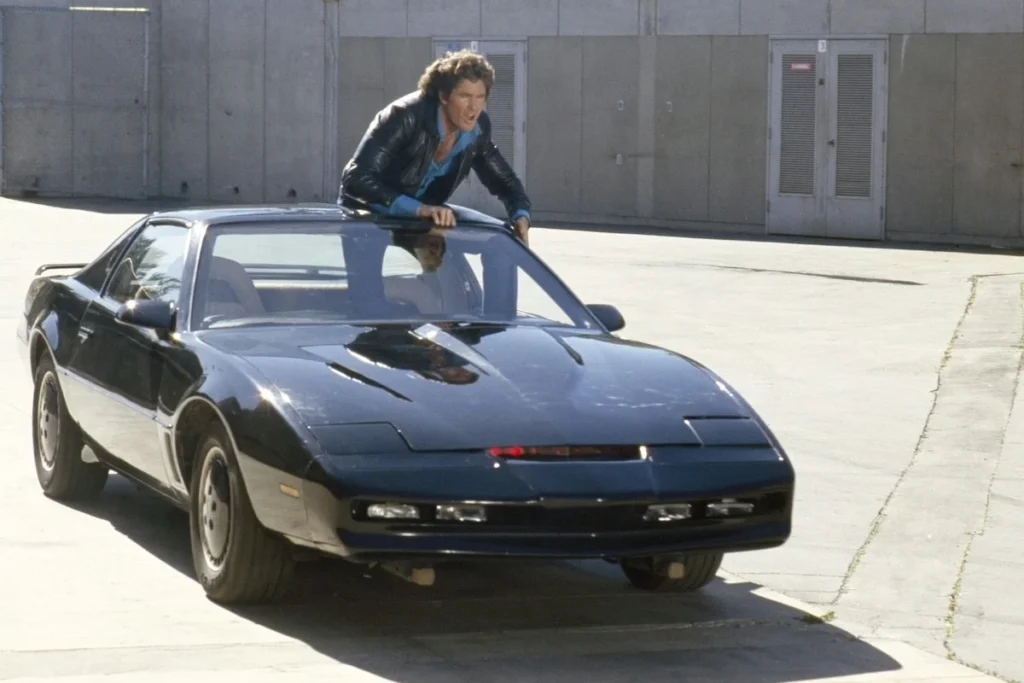
To a generation of viewers in the 1980s, the Knight Industries Two Thousand (KITT) represented the pinnacle of automotive evolution. With the velvety, disembodied voice of William Daniels, a pulsating red scanner bar that scanned the horizon with sentient intent, and the promise of a "molecular bonded shell" capable of surviving anything, KITT was more than a car—it was a miracle of engineering.
Yet, the reality behind the cameras on the Universal Studios lot in North Hollywood during the spring of 1982 was far removed from the polished sheen of the screen. Beneath the sleek fiberglass nose and the jet-black paint of the third-generation Pontiac Firebird Trans Am, the machine was an industrial underdog, a victim of its era’s restrictive environmental regulations, and the subject of a desperate, high-stakes improvisational circus.
The Mechanical Underdog: A V8 in Distress
When producer Glen A. Larson selected the 1982 Pontiac Firebird Trans Am as the platform for his high-tech hero, he was betting on aesthetics. However, the automotive landscape of the early 80s was a bleak period for performance enthusiasts. Crippled by stringent federal smog-control regulations, the GM 5.0-liter (305 ci) V8 engine—equipped with the dreaded "Cross-Fire" throttle-body injection—was a far cry from the muscle cars of the previous decade.
On a dyno, the powerplant struggled to produce a meager 145 horsepower. For the show’s cinematographers, tasked with capturing the "blistering" accelerations of David Hasselhoff’s character, Michael Knight, across the Mojave Desert, the reality was a logistical nightmare. To make the car appear fast, crews frequently under-cranked their cameras to 20 frames per second, accelerating the film playback to simulate speeds that the engine simply could not achieve. The car was, in essence, a performance illusion—a slow-motion reality disguised by clever editing.
The Genesis of an Icon: Plaster, Resin, and Galactica Scraps
The creation of KITT was a masterclass in "guerilla engineering." Tasked with a near-impossible turnaround of three weeks before the first day of filming, designer Michael Scheffe was given a shoestring budget to transform a stock Trans Am into a futuristic marvel.
Scheffe, operating out of a makeshift workshop, was forced to improvise. To accommodate the iconic front-end scanner requested by Larson—who famously recycled the visual aesthetic of the Cylon robots from his previous series, Battlestar Galactica—Scheffe extended the nose of the car by several inches using plaster molds and polyester resin.
The "quantum processor" behind the red light was equally humble: it was essentially a sequence of eight halogen bulbs controlled by a mechanical relay box, synced to a simple frequency synthesizer. To hide the stock aluminum wheels and give the car its aerodynamic, "ground-effect" look, the production team fitted the wheels with flat, black thermoformed plastic covers.
Inside, the "sci-fi cockpit" was an ergonomic disaster. The dashboard, a dizzying array of multicolored LEDs and two miniature cathode-ray tube (CRT) televisions connected to VCRs hidden in the trunk, consumed so much power that the car’s battery would drain in twenty minutes of idling. Furthermore, the "aerodynamic" U-shaped steering wheel—designed to look like a fighter jet yoke—was nearly impossible to maneuver. Technicians were eventually forced to install a highly sensitive, quick-ratio steering rack just to prevent the stunt drivers from suffering wrist injuries during tight turns.
Chronology of the Crisis: From Set to Showroom
The transition from the backlots of Hollywood to the American public’s consciousness was instantaneous and violent. The premiere of Knight Rider in the fall of 1982 created a cultural earthquake that caught the Pontiac brand entirely off guard.
- Pre-production (Spring 1982): Pontiac provides three pre-production Trans Ams that had been damaged during rail transport for the nominal fee of $1 per car. The studio views these as disposable props.
- The Premiere (September 1982): The show becomes a surprise hit. NBC sees massive viewership numbers, and the public falls in love with the car.
- The Dealer Inundation (1983): Thousands of customers flock to Pontiac dealerships across the United States, demanding the "KITT package." Salesmen are bombarded with requests for the non-existent digital dashboard, the voice-control module, and the signature light bar.
- The Detroit Veto (1984): Facing a public relations headache and mounting pressure from confused consumers, General Motors executives in Detroit take drastic action. They issue a formal "cease and desist" order to Universal Studios regarding the brand’s identity.
The Corporate Iron Fist: The Pontiac Veto
The commercial success of Knight Rider became a double-edged sword for General Motors. While the show provided invaluable exposure for the Firebird line, it also created a "gap of expectation." The general public, unable to distinguish between Hollywood fiction and automotive reality, felt misled by the lack of high-tech options at their local dealership.
The corporate response was swift and uncompromising. General Motors’ legal department demanded that Universal Studios cease all verbal mentions of "Pontiac" or "Firebird" within the show’s dialogue. Furthermore, they mandated the removal of all exterior branding. If the public could not buy the car seen on screen, they were not to be reminded that the car was a product of the Pontiac division. This "de-branding" of KITT remains one of the most famous examples of a manufacturer distancing itself from its own successful product placement.
The Stuntman’s War: Destruction and the Huissier
Behind the scenes, the "Turbo Boost" feature was a violent, expensive affair. Stunt coordinator Jack Gill managed a clandestine workshop that prepared up to 20 cars per season, each tailored for specific, brutal tasks.
For the "autonomous driving" shots, where Hasselhoff would sit in the passenger seat with his arms crossed, a special Firebird was constructed. The steering column and pedals were relocated to the floorboards of the rear seat. A stunt driver, often of short stature to maintain a low profile, would crouch in the back, blind to the road ahead, navigating the car using a five-inch monitor mounted between their knees.
The destruction of the cars was even more extreme. To perform the iconic jumps, the fiberglass bodies were lightened, and lead weights were added to the trunk to prevent the cars from "nosing over" during take-off. Despite these modifications, every landing was a mechanical catastrophe. Upon hitting the dirt, the unibody frames would twist, the engine mounts would tear, and the front cradles would shatter.
To ensure that no damaged KITT parts or "unauthorized" vehicles made it onto the secondary market, GM enforced a strict protocol. A court-appointed representative or an official GM auditor was required to be present at the end of each filming session. Once a car was deemed too damaged for further use, it was crushed under the watchful eye of the representative before being sent directly to the smelter.
Implications: The Legacy of a Hollywood Lie
The survival rate of the original KITT cars is incredibly low. Four decades after the series finale in 1986, only a handful of authenticated, high-profile cars remain. The vast majority were sacrificed to the furnaces of Universal, their scrap metal repurposed into nameless steel.
The success of Knight Rider was not a triumph of technological foresight, but a triumph of narrative conviction. It was a testament to the power of cinema to elevate the mundane into the extraordinary. By utilizing a 145-horsepower V8 and a few sheets of resin, the production team created a cultural icon that, for millions of children, felt more real than the cars parked in their own driveways.
The history of Knight Rider serves as a poignant reminder of the "smoke and mirrors" that define the entertainment industry. While we marvel at the legacy of KITT, we must acknowledge the labor, the mechanical failures, and the corporate litigation that occurred in the shadows. The show did not just predict the future of the automobile; it demonstrated that in Hollywood, the future is never about what is under the hood—it is entirely about what you can make the audience believe is there.
