

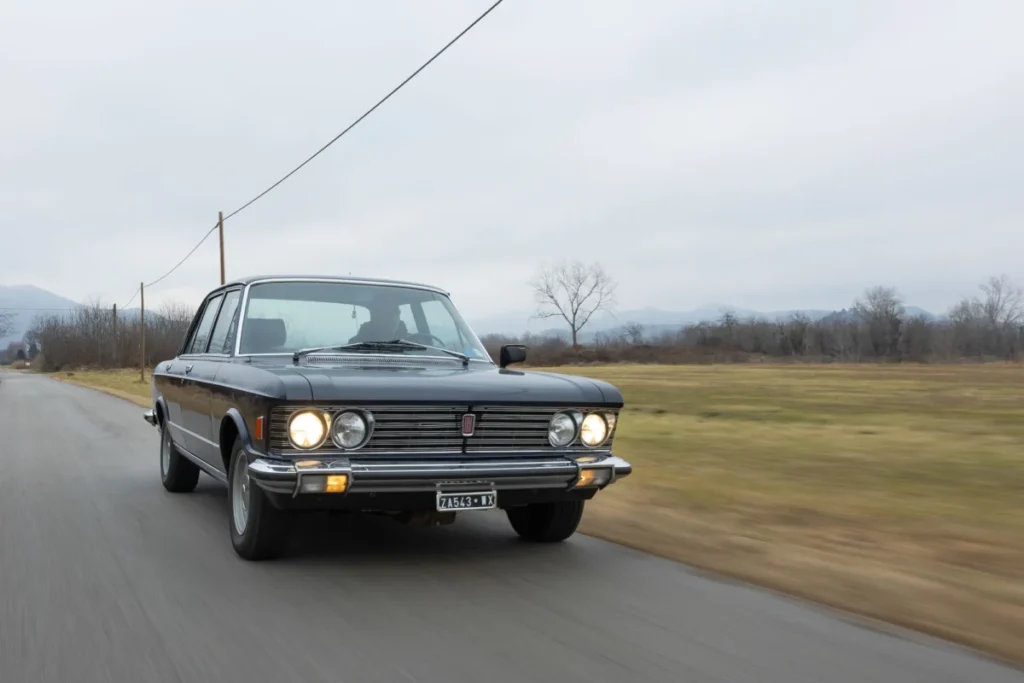
By Marco Visani | Photography by Domenico Fuggiano
At the end of the 1960s, Fiat set out to challenge Mercedes-Benz head-on. The Italian automotive giant sought to replace its aging 2300 model with a far more ambitious flagship, vastly superior in both physical dimensions and engine displacement. At the same time, Turin aimed to fill a looming vacuum in the upper echelons of government transport, as historic rivals Lancia and Alfa Romeo prepared to exit the luxury sedan market relied upon by high-ranking state officials.
Yet, this grand vision was fraught with misfortune. The slightly more powerful second series of the flagship would ultimately find itself pulverized by the 1973 oil crisis. This is a journey behind the scenes of an ambitious, ill-fated project that became forever intertwined with one of the darkest days in modern Italian history.
1. Main Facts: The Genesis of the Project X1/3
To understand the rise and fall of the Fiat 130, one must look back to the mid-1960s. In 1965, the Technical Directorate at Mirafiori began pondering how to replace the aging straight-six family comprising the 1800 B and the 2300 Lusso. Originally launched as the 1800 and 2100 in 1959, these cars had received mechanical and stylistic updates in 1961 and 1963.
While undeniably elegant and comfortable, these vehicles were growing increasingly obsolete. Their styling—characterized by prominent, pointed rear fenders—felt stuck in a bygone era. Although the 2300 Lusso offered an impressive array of luxury options for the time, including an overdrive, automatic transmission, a sunroof, and air conditioning (introduced in July 1966), it remained a niche player. Italy’s punitive tax structure penalized both large engine displacements and high cylinder counts, restricting these models primarily to government fleet sales.

Initially, legendary chief engineer Dante Giacosa was skeptical. He saw little economic sense in investing time and capital into developing a new six-cylinder sedan whose market fate he believed was already sealed. However, the corporate landscape shifted dramatically in April 1966 when Gianni Agnelli succeeded Professor Vittorio Valletta as company president.
Agnelli accelerated the development of Project X1/3—the future Fiat 130—for two compelling reasons. First, buoyed by Fiat’s booming economic success, Agnelli believed the company could no longer shy away from challenging Mercedes-Benz on its home turf: the executive luxury sedan market. Second, he recognized that Lancia and Alfa Romeo were retreating from the segment. Their respective flagships, the Lancia Flaminia and the Alfa Romeo 2600 (both dating back to 1957), were nearing the end of their lifecycles without direct replacements in sight.
Agnelli saw an unmissable opportunity: provide the Italian state with a prestigious new domestic official car while using the resulting high-profile exposure to offset development costs.
2. Chronology: From State Aspirations to the Via Fani Tragedy
The timeline of the Fiat 130 is defined by lofty corporate debuts, rapid engineering shifts, and a profound national tragedy.
- 1965–1966: Mirafiori technical teams conceptualize Project X1/3. Gianni Agnelli takes the presidency and champions the challenge against German dominance in the luxury sector.
- March 1969: The Fiat 130 Berlina makes its official debut at the Geneva Motor Show. Sporting crisp, modern lines penned under the oversight of Centro Stile Fiat, it features an all-new 2,866 cc V6 engine and independent suspension all around.
- 1971: Recognizing that the initial 2.8-liter engine feels underpowered given the car’s substantial weight, Fiat introduces the second series. Displacement is bored out to 3,235 cc (the 3200), boosting power and improving low-end torque. Shortly after, the striking Fiat 130 Coupe, styled by Pininfarina, joins the lineup.
- October 1973: The Yom Kippur War breaks out, triggering the first global oil crisis. Fuel prices skyrocket, and demand for large-displacement, heavy-drinking luxury cars evaporates overnight.
- March 16, 1978 (8:45 AM): A fateful morning in Rome. Parliament is set to vote on confidence for the fourth Giulio Andreotti government—the historic first administration backed directly by the Italian Communist Party (PCI).
- March 16, 1978 (9:00 AM): Christian Democracy leader Aldo Moro steps out of his home at Via del Fronte Trionfale 79. He climbs into his unarmored Fiat 130 Berlina (registration Roma L59812), put into service in April 1973.
- March 16, 1978 (9:02 AM): At the intersection of Via Fani and Via Stresa, a staged collision orchestrated by the Red Brigades traps Moro’s vehicle. Five police officers in the escort vehicles are gunned down, and Moro is abducted. This event initiates 55 days of national crisis ending in Moro’s assassination, forever linking the Fiat 130 to Italy’s "Years of Lead."
- 1977–1975 (Decline & End of Production): Sales dwindle as fuel costs and economic stagnation bite. Fiat quietly terminates production of the 130 Berlina in 1976, followed by the Coupe in 1977, without a direct successor.
3. Supporting Data: Technical Specifications and Market Performance
To truly comprehend why the Fiat 130 struggled against its Teutonic rivals, one must examine the engineering choices and raw market data that dictated its fate.

Engine Evolution: From 2800 to 3200
Designed by Aurelio Lampredi—the legendary engine builder previously associated with Ferrari—the Fiat 130 engine was a 60-degree V6 featuring a belt-driven single overhead camshaft per bank.
-
First Series (1969–1971):
- Displacement: 2,866 cc
- Power Output: 140 horsepower at 5,600 rpm
- Torque: 22.4 kgm at 3,400 rpm
- Top Speed: ~180 km/h (112 mph)
- Criticism: Widely panned by automotive journalists for feeling sluggish when hauling the car’s two-ton curb weight, especially when paired with the standard Borg-Warner 3-speed automatic transmission.
-
Second Series (1971–1976):
- Displacement: 3,235 cc (The "3200")
- Power Output: 165 horsepower at 5,400 rpm
- Torque: 25.4 kgm at 3,400 rpm
- Top Speed: ~190 km/h (118 mph)
- Improvements: Larger displacement resolved the dynamic sluggishness of the first series, making the car significantly more responsive and refined on Italian autostradas.
Production Run and Market Reach
Unlike mass-market hatchbacks like the Fiat 127 or 128, the 130 was built in modest numbers at the Stura plant in Turin.
- Fiat 130 Berlina (Sedan): Approximately 15,093 units produced between 1969 and 1976.
- Fiat 130 Coupe (Pininfarina): Approximately 4,493 units produced between 1971 and 1977.
- Special Variants: A handful of station wagon variants (Maremma) and four-door saloons were built as design studies or commissioned specials (such as the operational wagons used by Fiat executives), but they never entered mainstream serial production.
4. Official Responses and Industry Reception
Upon its debut at the 1969 Geneva Motor Show, the Fiat 130 Berlina drew immense praise for its modern, clean-cut aesthetic. Eschewing the flamboyant fins of the past, its geometry was austere, elegant, and unmistakably authoritative. It looked every bit the state vehicle.

However, industry analysts and contemporary motoring press were quick to point out the car’s structural Achilles’ heel: fuel consumption. Even before the 1973 oil shock, the V6 engine struggled with thermal efficiency and fuel burn rates that lagged behind Mercedes-Benz’s fuel-injected powerplants.
Mercedes-Benz, firmly entrenched with its W108 and subsequently W116 S-Class series, offered superior build quality, extensive dealer networks, diesel alternatives, and bulletproof engineering prestige that Fiat simply could not match outside of Italy.
Domestically, the Italian government and public administration embraced the vehicle. Ministries, prefectures, and high-ranking magistrates adopted the Fiat 130 as their default institutional transport. Yet, this reliance proved double-edged. While it cemented the car’s status as the definitive "State Limousine," it also stigmatized the vehicle in the eyes of private private-sector executives and wealthy industrialists, who increasingly preferred imported German luxury or sports sedans over what they perceived as a bureaucratic machine.
5. Implications: Legacy of an Unlucky Flagship
The discontinuation of the Fiat 130 in the mid-1970s marked the end of an era for Fiat. It was the last time the mass-market manufacturer seriously attempted to build a large, prestige V6 luxury sedan to compete directly with Mercedes-Benz and BMW.
The scars left by the 1973 oil crisis forced Turin to recalibrate its strategy, pivoting away from large-displacement domestic flagships and focusing instead on efficient mid-sized cars, hot hatches, and mass-market volume drivers. When Fiat subsequently needed a large sedan offering in the 1980s and 1990s, it relied on platform sharing via the Alfa Romeo 164 or the Lancia Thema, rather than developing an independent executive architecture.

Furthermore, the shadow cast by the Via Fani kidnapping of Aldo Moro forever etched the Fiat 130 into the collective memory of the Italian republic. For generations of citizens, the sight of a dark-colored Fiat 130 Berlina evokes not just the sleek design ethos of early-1970s Italian motoring, but the profound political trauma of the Years of Lead.
Today, surviving examples of the Fiat 130—particularly the stunning Pininfarina-styled Coupe and the rare, velvety smooth 3200 Berlinas—are increasingly sought after by classic car collectors. Far removed from the political turbulence and economic crises of their birth, these machines are finally appreciated for what they truly were: technologically sophisticated, beautifully styled testaments to an era when Italian industrial ambition dared to challenge the best in the world.
Find the complete, unabridged feature article in Gazoline magazine issue #351, available for order on the official Gazoline online store.
