

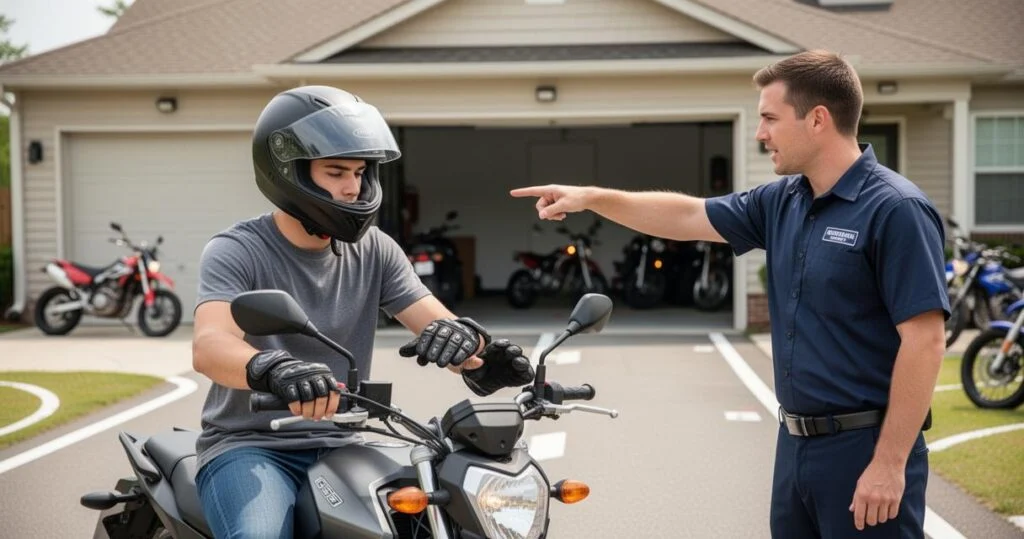
Embarking on the journey to obtain a motorcycle license is a rite of passage that blends the raw thrill of freedom with the disciplined necessity of road safety. Whether you are seeking the agility of a light commuter bike or the commanding presence of a high-performance machine, the path to becoming a licensed rider is governed by a rigorous regulatory framework. For many, the process is shrouded in complexity—from understanding the nuances of the A1, A2, and A license categories to selecting a reputable training center that aligns with both professional standards and personal learning styles.
This guide provides an in-depth analysis of the current motorcycle training landscape, offering a comprehensive roadmap to help you make an informed decision and approach your formation with the confidence required for success.
I. Main Facts: Understanding the Regulatory Framework
Before you even step into a motorcycle school, it is vital to demystify the alphabet soup of licensing. In many jurisdictions, specifically within the European framework, the licensing system is tiered to ensure that riders gain experience on progressively more powerful machinery.
The Tiered License Structure
- Permit A1: Designed for the younger demographic (starting at 16 years old), this license allows for the operation of "light" motorcycles. The technical threshold is set at a maximum power output of 11 kW, generally equating to a 125 cm³ engine. It is the perfect entry point for urban commuting and developing fundamental balance and control.
- Permit A2: This is the most common entry point for adults (aged 18 and over). The A2 license authorizes the operation of motorcycles with a power output of up to 35 kW. It strikes a balance between performance and accessibility, serving as the bridge to full motorcycle mastery.
- The "Passerelle" (Bridge) A: For those who have held an A2 license for at least two years, the transition to the full "A" license is streamlined. Accessible from age 20, this seven-hour supplementary training removes the need for a full re-examination, providing a pathway to unrestricted power for experienced riders.
Key Terminologies
To succeed, a candidate must familiarize themselves with the core components of the curriculum:
- ETM (Examen Théorique Moto): The specialized motorcycle theory test. Unlike the standard car theory, this exam focuses on the specific dynamics of two-wheeled vehicles, physics, and road sharing.
- Plateau: The "off-road" or private circuit training. This is where the technical mastery of the motorcycle—braking, low-speed maneuvers, and emergency avoidance—is honed.
- Circulation: The final phase where the candidate applies skills in real-world traffic, demonstrating situational awareness and adherence to the Highway Code.
II. Chronology of Training: From Enrollment to Examination
The path to a license is not a singular event but a structured progression. Understanding this chronology helps in managing expectations and scheduling.
1. The Assessment and Theory (Phase One)
The process begins with an assessment of the candidate’s initial skill level. Once enrolled, the student focuses on the ETM. To pass, a candidate must correctly answer 35 out of 40 questions. This theoretical foundation is critical; it is the mental framework that supports every physical decision made on the road.
2. Technical Mastery on the Plateau (Phase Two)
The mandatory 20-hour minimum (for A1/A2) is heavily weighted toward the "plateau." During these sessions, instructors focus on:
- Manual handling: Moving the bike without the engine.
- Low-speed maneuvering: The art of clutch and throttle control.
- High-speed maneuvers: Mastering counter-steering and emergency braking.
3. Real-World Application (Phase Three)
Once the plateau skills are validated, the student transitions to the open road. This phase is about defensive riding: anticipating the actions of other motorists, positioning oneself correctly within the lane, and managing "blind spots."
4. The Final Examination
The practical exam is bifurcated. The first part is the plateau test (maneuvers), followed by the circulation test. Passing both is the final hurdle to earning the right to ride independently.
III. Supporting Data: Choosing the Right Institution
The quality of your training is the single greatest predictor of your future safety as a rider. When selecting a school, one must look beyond the glossy marketing brochures.
The "Quality Indicator" Checklist
- Student-to-Instructor Ratio: A school that crams six or eight students onto a single plateau session is not offering personalized instruction. Seek out schools that limit the number of students per instructor, ensuring that you receive real-time feedback during your training hours.
- Fleet Maintenance: An institution’s fleet is a mirror of its management. Are the bikes well-maintained? Are they appropriate for the license you are seeking? A bike with worn-out tires or a sticky clutch is not just a nuisance; it is a detriment to your learning process.
- Private Track Access: Does the school have exclusive access to a training plateau? Relying on public spaces or shared, crowded tracks significantly limits the time you spend actually practicing your maneuvers.
Evaluating Success Rates
While pass rates are a common metric, they should be interpreted with caution. A high pass rate may indicate excellent teaching, or it may simply mean the school only puts forward "ready-made" students who have already spent significantly more than the minimum hours. Look for schools that prioritize competency-based progression over speed-to-license.
IV. Official Responses and Industry Standards
Regulatory bodies and industry experts emphasize that the motorcycle license is not just a bureaucratic requirement—it is a life-saving education.
Recent updates to the curriculum have placed a greater emphasis on "Defensive Riding" and the "Physics of the Motorcycle." Official bodies argue that a rider’s mindset is as important as their technical skill. Consequently, modern training programs are increasingly incorporating "risk perception" exercises, forcing students to analyze hazards in videos and simulated environments before they ever touch a handlebar.
Furthermore, the introduction of the CPF (Compte Personnel de Formation) in various regions has allowed for broader access to funding for motorcycle training, acknowledging that mobility is a key factor in professional and personal development. This has led to a more diverse applicant pool, requiring schools to adapt their pedagogical methods to suit a wider range of learning styles and age groups.
V. Implications: Why Your Choice Matters
Choosing a motorcycle school is a commitment to your future safety. The implications of choosing a sub-par provider are severe: poor training leads to bad habits, and bad habits on a motorcycle are often fatal.
The Value of Professional Mentorship
A quality instructor does more than teach you how to pass an exam; they instill a "motorcycle culture." This includes:
- Protective Gear Advocacy: A serious school will insist that you wear proper gear (helmet, jacket, gloves, boots) from day one, not just during the exam.
- Situational Awareness: They will teach you to scan intersections, predict car door openings, and manage your distance from other vehicles.
- Longevity: The best riders are those who recognize that the learning process continues long after the license is in your pocket. A good school teaches you how to learn, ensuring you remain a student of the road for life.
Conclusion: The Road Ahead
For those in densely populated areas like Île-de-France, the density of motorcycle schools can be overwhelming. Establishments such as Easy Monneret serve as benchmarks for the industry by offering a mix of intensive courses and flexible scheduling, while maintaining a strict limit on the number of students per instructor.
Whether you choose a local, family-run school or a larger institution, the criteria for selection remain universal: transparency, quality of the fleet, pedagogical rigor, and the prioritization of safety over speed.
The journey to your motorcycle license is an investment in your personal freedom. Approach it with the seriousness it deserves, choose your mentors wisely, and remember that the goal is not merely to obtain a plastic card, but to master a machine and ensure that every ride you take is a safe one. As you look toward the horizon, remember that the quality of your training will be the silent passenger on every mile you travel. Choose well, ride responsibly, and enjoy the unparalleled perspective that only two wheels can provide.
