

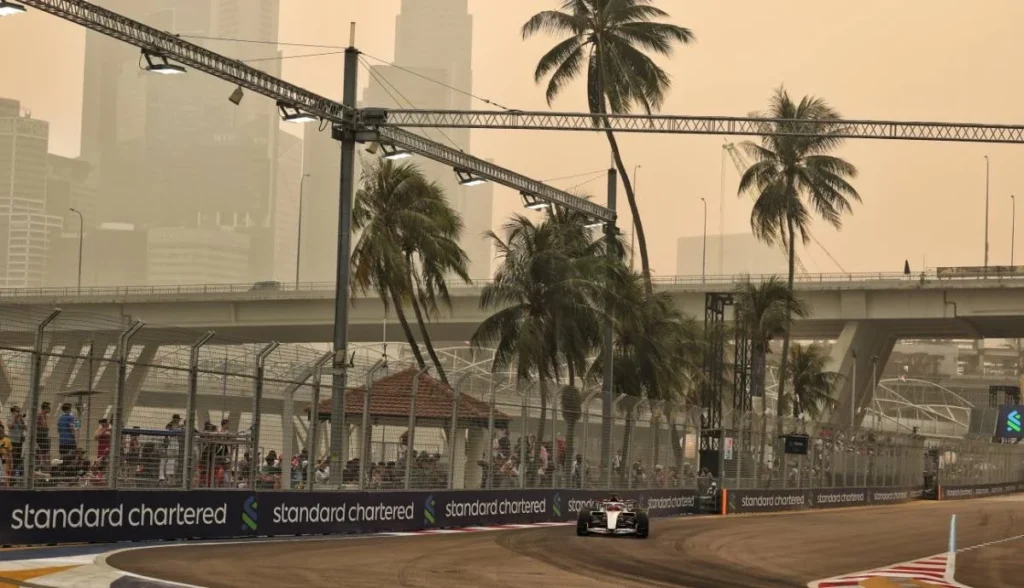
The glitz and glamour of the Singapore Grand Prix, typically defined by the dazzling floodlights of the Marina Bay Street Circuit and the relentless tropical heat, face an unexpected antagonist this year. A thick, acrid shroud of haze, drifting across the Malacca Strait from forest fires in neighboring Indonesia, has enveloped the city-state. As the Formula 1 circus descends upon the island, the standard battle against humidity and exhaustion has evolved into a more complex struggle against poor air quality, casting a shadow of uncertainty over the weekend’s proceedings.
While the FIA continues to monitor the situation with granular precision, the consensus remains that the race will proceed as scheduled. However, for the drivers, engineers, and thousands of fans, the atmosphere in Singapore has become as much about public health as it is about motorsport excellence.
The Meteorological Crisis: A Smoke-Filled Horizon
The current air quality index (AQI) in Singapore has plummeted to levels categorized as "unhealthy," a recurring seasonal phenomenon caused by "slash-and-burn" agricultural practices in Indonesia. For the Formula 1 community, this represents a significant deviation from the norm. Unlike the usual challenges of a street circuit—where tight walls and bumpy surfaces dictate the rhythm—the current threat is invisible yet pervasive.
The particulate matter (PM2.5) concentrations have risen sharply, leading to reduced visibility and a persistent smell of burnt wood that hangs over the Marina Bay area. For a sport that relies on split-second reactions and high-speed visual acuity, the atmospheric degradation is not merely a discomfort; it is a potential performance variable.
Chronology of the Haze
The arrival of the haze was not immediate, but rather a creeping encroachment that caught many travelers off guard.
- Early Week: Reports of regional forest fires began to emerge from the Indonesian provinces of Sumatra and Kalimantan. Prevailing winds shifted, pushing the plume directly toward the Malay Peninsula.
- Tuesday: Pilots arriving in Singapore reported difficulty during descent, with visibility significantly impaired by a gray, hazy layer covering the island.
- Wednesday: As the paddock began its setup, the air quality index hit a threshold that prompted local authorities to issue health warnings.
- Thursday: Media day saw drivers fielding as many questions about air filters and breathing as they did about downforce and tire degradation. The FIA confirmed they are in constant communication with local health authorities but have not initiated any contingency protocols to halt or postpone sessions.
Supporting Data and Medical Implications
To understand the severity of the situation, one must look at the physiological strain already placed on an F1 driver. A race at Singapore typically sees a driver lose between 2.5 and 3.5 kilograms of body weight through perspiration. Heart rates frequently hover between 170 and 190 beats per minute for nearly two hours. Adding respiratory distress—the act of drawing in particulate-heavy air while performing at peak anaerobic capacity—is a variable that sports medicine experts view with concern.
Dr. Aris Thorne, a specialist in environmental health, notes: "When you combine high-intensity physical exertion with elevated PM2.5 levels, the inflammatory response in the lungs is exacerbated. Drivers are not just breathing; they are hyperventilating. This increases the total volume of toxins entering the bloodstream, which can lead to rapid fatigue, cognitive fog, and increased recovery times post-race."
Driver Perspectives: Between Concern and Stoicism
The reaction from the paddock has been a mix of professional pragmatism and mild, localized concern.
Carlos Sainz: The GPDA Perspective
As a leading voice in the Grand Prix Drivers’ Association (GPDA), Carlos Sainz has been the most vocal regarding the health implications. "I’ve been reading up on the air quality reports," the Williams driver admitted during Thursday’s press conference. "It’s clearly not the healthiest air to be breathing. We trust the authorities, but there is a lingering question as to whether this is an environment where you would usually recommend high-intensity outdoor exercise."
Sainz pointedly noted the irony of the situation: "We are already used to breathing in fumes from the cars in front of us during a race, but this is a different scale. It’s an extra burden on a body that is already being pushed to the absolute limit."
Lewis Hamilton: The Recovery Struggle
Seven-time world champion Lewis Hamilton, usually a beacon of composure, focused his concerns on the logistical nightmare of the Singapore schedule. "I haven’t noticed much on track, to be honest, other than the landing into the city, which was quite difficult due to the haze," Hamilton noted.
His primary worry, however, is the biological cost of the "Singapore shift." Because the race takes place at night, drivers remain on European time. "The air quality makes it harder to sleep, especially when you are already struggling with the time zone shift," he explained. "My recovery data—my sleep scores—usually plummet when we are forced to go to bed at 4:00 AM. This extra atmospheric stress isn’t helping anyone’s recovery."
Fernando Alonso: The Veteran’s Stoicism
Two-time world champion Fernando Alonso remains characteristically unbothered. "The cars will be fine," the Aston Martin driver stated. "They breathe through sophisticated filters, and the engines are robust. As for the drivers, we are professionals. We train for extreme heat and humidity; this is just another element to manage. It’s not ideal, but it’s part of the challenge of this circuit."
Valtteri Bottas: A Direct Witness
Valtteri Bottas, known for his love of cycling, provided a first-hand account of the degradation. Having cycled from Malaysia to Singapore, he observed the air quality worsening in real-time. "You could feel the air getting heavier and more bitter as we approached the border," he said. Despite this, the Finn remains steadfast in his refusal to wear a mask, viewing it as an unnecessary distraction from his race preparation.
Official Responses and Implications
The FIA’s stance is one of "cautious observation." In a statement released Thursday, the governing body confirmed: "We are monitoring the air quality index in conjunction with the Singaporean authorities. At present, the levels do not necessitate a change in the event schedule. We have medical personnel on standby and are prepared to escalate our response should the air quality reach a level that poses an immediate risk to the safety of participants."
The implications of this situation are twofold:
- Performance Variability: If the haze persists or worsens, we may see a higher rate of driver error. When the body is struggling to oxygenate properly, cognitive decline is the first symptom. In a race where a single mistake results in a heavy shunt against a concrete barrier, this is a genuine safety concern.
- The Future of the Calendar: This episode reignites the debate regarding the environmental impact of F1 and its vulnerability to climate-related events. As forest fires become more frequent due to regional climate shifts, the sport may need to develop more robust protocols for environmental hazards, moving beyond just rain and heat, to include air quality as a core component of the "Safety First" mandate.
Conclusion: A Test of Endurance
As the lights go out on Sunday, the focus will inevitably shift from the haze to the asphalt. However, the background radiation of this event—the smoke, the discomfort, and the debate over health—serves as a reminder that Formula 1, for all its technological mastery, is still subject to the whims of the natural world.
The drivers will undoubtedly push to the limit, pushing through the smog as they have pushed through the heat for years. But as the cars tear through the Marina Bay streets, the spectators and the teams will be watching the sky as much as the track, hoping that the air clears enough for the spectacle to remain what it was intended to be: a celebration of speed, not a test of respiratory endurance.
