

Introduction: A Polar Afternoon in Montreal
October 8, 1978. The thermometer on the Île Notre-Dame barely registered five degrees Celsius at dawn. A biting, sub-polar wind swept across the dark, churning waters of the St. Lawrence River, whistling beneath the skeletal tubular grandstands and chilling the seventy thousand spectators huddled in thick ski parkas. In the makeshift garages, exposed to the relentless gusts, the mechanics of Scuderia Ferrari had hands stained violet by the cold.
Having traveled two weeks prior from the relatively temperate Emilia-Romagna region of Italy, these men were now blowing on numb fingers just to grip the air-powered impact wrenches. The Quebec asphalt, laid in haste upon the remnants of the 1967 World’s Fair, was as unforgiving as a block of industrial ice. To get racing slicks up to an operational temperature on a surface resembling a skating rink required either a madman or a virtuoso. Gilles Villeneuve was, in the truest sense of the sport, both.
The Technical Crucible: Michelin’s Steel-Carcass Struggle
The 1978 season had been a laboratory for Ferrari, which had switched to French radial tires. While the Michelin rubber had proven its endurance in the blistering heat of mid-summer circuits, it met its match in the Montreal frost. The technicians from Clermont-Ferrand were dismayed during early practice sessions: the steel-cased tires refused to generate internal pressure. The tread remained as hard as timber for the first fifteen laps of any stint.
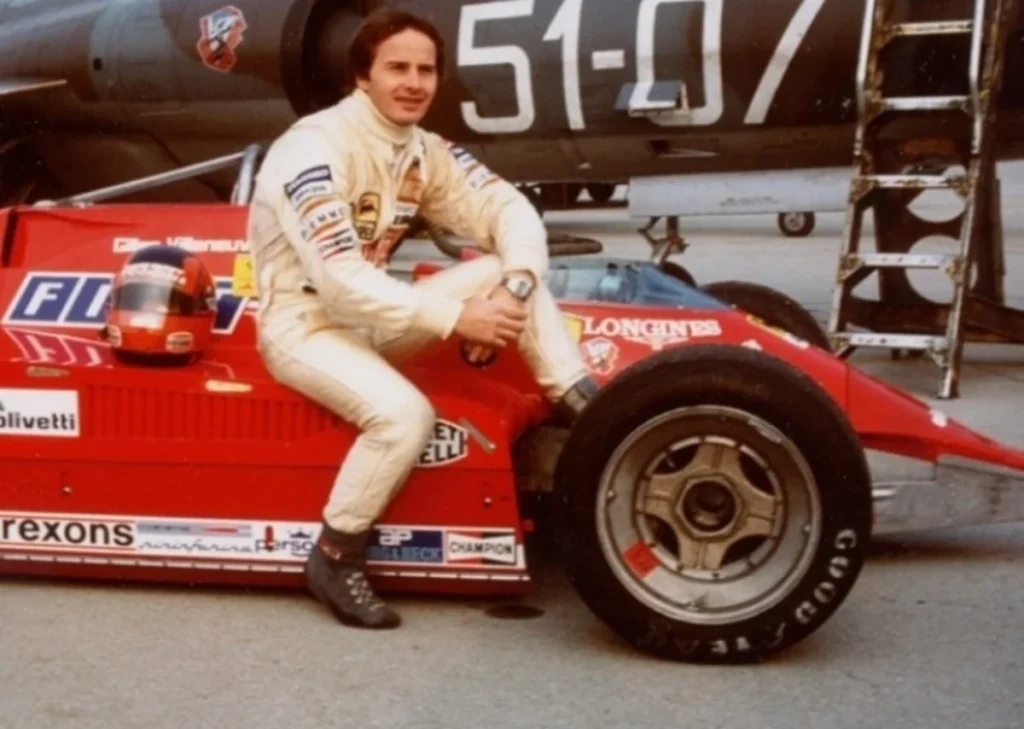
While the titans of the championship fought a losing battle against destructive understeer, Villeneuve employed a technique that defied conventional racing logic. He made his 312 T3 pivot through corners as if he were pulling an invisible handbrake. The three-liter, flat-12 engine screamed in the dense, oxygen-rich air, providing the raw torque necessary to break traction at will. While his teammate, Carlos Reutemann, struggled to keep his car pointed straight, Villeneuve danced, throwing the Ferrari into controlled drifts from one concrete barrier to the next without ever lifting his foot from the accelerator.
Chronology of a Masterpiece
The race began with the grid looking more like a survival mission than a Grand Prix. Villeneuve, starting third, kept a watchful eye on the man of the hour: Jean-Pierre Jarier. Stepping in at the eleventh hour to replace the late Ronnie Peterson at Lotus, Jarier was in a league of his own. Piloting the ground-effect Lotus 79—a car that had revolutionized aerodynamic grip—Jarier carved through the field with surgical precision.
By the 40th lap, the Frenchman had built an insurmountable forty-second lead. The victory seemed all but secured for the Lotus garage. However, the Montreal circuit was notoriously bumpy, and the constant vibration acted like a hammer against the delicate components of the mid-70s machines.
On the 49th lap, disaster struck for Jarier. An oil line ruptured, forcing him to kill the engine to prevent a catastrophic fire. As he steered the silent Lotus to the side of the track and began the long, lonely walk back to the pits with his helmet tucked under his arm, the crowd’s roar shifted from frustration to a fever pitch. Villeneuve, signaled by his pit board, inherited the lead with twenty-one laps to go.
Instead of playing it safe to preserve his tires or engine, the Canadian continued to flirt with the concrete walls. He compensated for the lack of tire grip by applying sharp bursts of throttle, ensuring the rear end remained in a constant state of "positive drift," keeping the car balanced on the edge of adhesion. At the 70th lap, the checkered flag fell, greeted by a deafening chorus of ship horns echoing from the river.
Supporting Data: The Anatomy of a Legend
To understand the magnitude of this performance, one must look beyond the timing sheets. The 312 T3 was a formidable machine, but it was notoriously temperamental in cold conditions. Villeneuve’s success was not a byproduct of superior equipment, but of superior sensory input.
Data from the era suggests that the surface temperature of the track rarely exceeded 8 degrees Celsius throughout the race. In such conditions, modern physics suggests the coefficient of friction drops by nearly 40%. Villeneuve’s ability to maintain a pace within a second of his qualifying time while the field slowed by three to four seconds is a testament to his unique training. He had developed a "throttle-steer" reflex that transformed a technical disadvantage into a competitive weapon, effectively using the car’s engine as a steering device on corner entry.
Official Responses and The Podium Atmosphere
The scenes following the race were a stark departure from the champagne-soaked glamour of Monaco. At the foot of the podium, Prime Minister Pierre Elliott Trudeau presented the trophy to the "kid from Berthierville." Villeneuve, shivering in his sweat-soaked, fireproof overalls, looked less like a conqueror and more like a survivor.
There was no vintage French bubbly to spray; the protocol dictated a giant jeroboam of local Labatt 50 beer. Villeneuve, grinning, shook the bottle of icy foam over his freezing Italian mechanics. As the cameras flashed, the Ferrari’s exhaust collectors continued to tick and smoke in the cooling air, a final reminder of the mechanical violence that had occurred over the previous two hours.
"I didn’t think about the cold," Villeneuve told reporters in the post-race scrum. "When the car starts to slide, you stop feeling the temperature and you start feeling the rhythm."
Implications: The Legacy of the Snowmobile School
The 1978 Canadian Grand Prix was more than just a maiden victory; it was a watershed moment for Formula 1. It proved that the "European style" of smooth, geometric cornering was not the only way to win.
Villeneuve’s secret lay in his formative years. Before he entered the world of single-seaters, he financed his racing career through the high-stakes world of professional snowmobile racing. He won the World Championship at Eagle River in 1974, a discipline where machines lacked differentials and front brakes, requiring the pilot to use weight transfer and precise throttle management to navigate ice-polished tracks at speeds exceeding 160 km/h.
"If you didn’t know how to make the rear end break loose to turn, you ended up in a snowbank," Villeneuve famously noted. This "snowmobile intuition" gave him a reaction time to loss of traction that his European counterparts, raised on the predictable tarmac of karting circuits, could not fathom.
This victory forced teams to rethink driver recruitment. For the first time, the "natural ability" developed in extreme, low-grip environments was seen as a premium asset. Villeneuve’s performance in Montreal set a precedent for the "all-weather" driver, a archetype that would eventually define the likes of Ayrton Senna and Michael Schumacher.
The 1978 win at Île Notre-Dame remains the most poignant snapshot of the Gilles Villeneuve mythos: a man who felt more comfortable on the edge of a catastrophe than anyone else in the history of the sport. He did not just win a race; he conquered a climate, turning a frozen, unforgiving island into his own private playground, leaving behind a legacy that continues to define the spirit of Canadian motorsport.
