

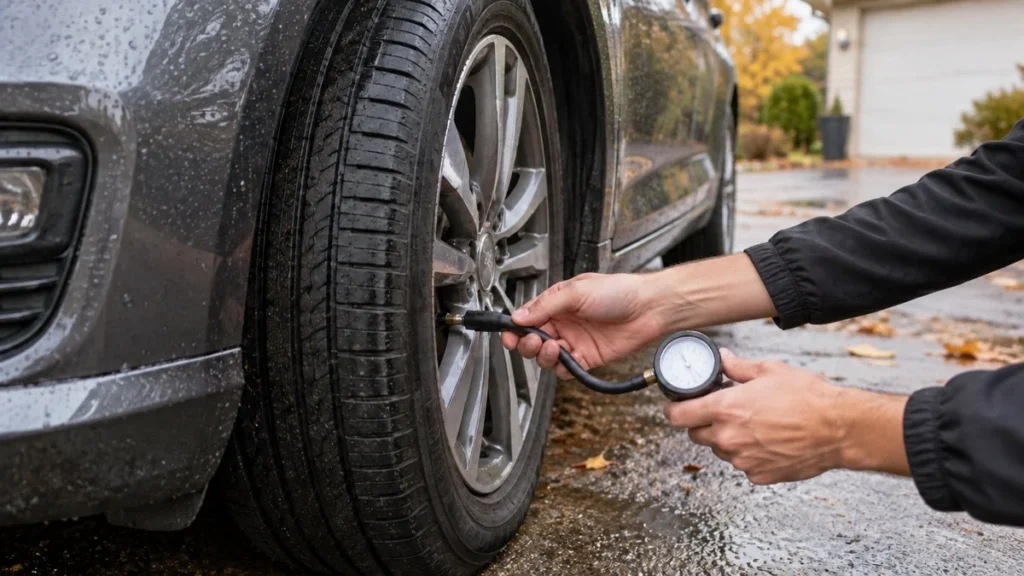
As autumn weather brings slippery roads, persistent downpours, and sudden visibility drops, a casual glance at your vehicle’s tires is no longer enough. A drop in pressure can easily go unnoticed, just like asymmetrical wear along the outer edges of the tread. To ensure optimal road safety, automotive experts recommend three fundamental checkpoints: measuring tire pressure, examining wear indicators, and thoroughly inspecting the structural integrity of the rubber.
Main Facts
When precipitation blankets the roads, the interface between your vehicle and the asphalt shrinks to a patch roughly the size of a postcard per tire. Consequently, the condition of your tires dictates your braking distance, cornering grip, and resistance to hydroplaning.
Recent automotive safety briefs emphasize that drivers must look beyond the obvious. A tire can be severely underinflated without appearing visibly flat. Similarly, deep grooves in the center of a tread can create a false sense of security while the shoulders are completely bald.
To safeguard against sudden traction loss, vehicle operators should perform a comprehensive inspection focusing on three core areas:
- Pression Accuracy: Verifying cold inflation pressures against manufacturer specifications.
- Tread Depth & Wear Patterns: Monitoring legal limits and identifying uneven wear vectors.
- Structural Integrity: Detecting sidewall bulges, cuts, punctures, and impact damage.
Executing these checks on a flat, stable surface prior to venturing out into wet weather conditions significantly diminishes the risk of road accidents.
Chronology and Preparation: Step-by-Step Inspection Protocol
Before launching into a journey under threatening skies, proper preparation is vital. Mechanics advise parking the vehicle on a flat, level surface well away from active traffic lanes. Turn off the engine, engage the parking brake firmly, and systematically work your way around all four wheels (and the spare, if applicable).
Phase 1: Measuring Cold Tire Pressure
A tire naturally loses air over time, and temperature drops during autumn and winter accelerate this pressure loss. However, a tire can be critically under-inflated without showing outward signs.
- Use the Right Tools: Utilize a reliable handheld pressure gauge or a digital inflator. Compare your readings against the values specified by the vehicle manufacturer, which are typically located on a placard inside the driver’s door jamb, inside the fuel filler flap, or within the owner’s manual.
- Understand Custom Metrics: There is no universal pressure setting applicable to all automobiles. Furthermore, required pressures frequently vary between the front and rear axles, as well as according to the vehicle’s load capacity.
- Measure "Cold": Industry leaders, including major manufacturers like Michelin, strongly recommend checking tire pressure when the tires are cold—meaning the vehicle has not been driven for at least three hours, or has traveled less than a mile at low speeds. Driving generates friction and heat, which expands the air inside the tire and artificially inflates pressure readings.
- Never Bleed Hot Tires: If you measure warm tires and find the pressure is high, do not release air to bring it down to the cold specification. The pressure will normalize downward as the tires cool.
- Frequency: Experts recommend performing this check on a monthly basis. If a specific tire repeatedly loses air, consult a certified technician to locate the root cause, such as a slow leak or a damaged valve stem.
Phase 2: Analyzing Wear Indicators and Tread Depth
The presence of visible grooves does not automatically mean a tire is safe for extended use. Modern tires feature small, raised rubber bars embedded at the base of the primary longitudinal rain channels—these are known as Tread Wear Indicators (TWIs).
- The TWI Threshold: When the surface of the surrounding tread wears down until it is flush with these indicators, the tire has reached the end of its legal and functional lifespan.
- Legal Requirements: In most jurisdictions, including across Europe, the minimum legal tread depth for passenger car tires is 1.6 mm. Below this threshold, water evacuation becomes drastically impaired, dramatically increasing stopping distances on wet pavement.
- Scan Multiple Zones: Do not rely solely on a quick glance at the center of the tread. A well-maintained center can easily mask severe, premature wear along the inner or outer shoulders—a common symptom of poor wheel alignment or suspension issues. Utilizing a dedicated tread depth gauge provides precise measurements across multiple points of the tire’s width.
- Address the Root Cause: If you discover irregular wear patterns, simply replacing the tires without rectifying the underlying mechanical issue (such as misaligned geometry or worn shock absorbers) will only cause the new tires to degrade prematurely.
Phase 3: Inspecting Sidewalls and Surface Damage
The final phase of a pre-trip inspection requires a tactile and visual scan of the tire’s sidewalls—the vertical exterior surfaces connecting the tread to the wheel rim.
- Scan for Physical Trauma: Look closely for cuts, deep gouges, surface cracking, or protruding bulges.
- The Danger of Hernias: Striking a deep pothole or scraping a concrete curb can rupture the internal fabric cords of the tire casing, resulting in a localized bubble or "hernia." A tire featuring a sidewall bulge has suffered catastrophic structural damage and is at an extremely high risk of a sudden blowout.
- Zero Tolerance for Compromised Sidewalls: Never drive on a tire with a bulging sidewall. Re-inflating the tire will not repair the damaged internal structure. Contact professional roadside assistance immediately for a replacement.
- Recognize Limitations: External visual inspections have inherent boundaries. They cannot reveal internal structural fatigue or damage hidden inside the tire casing. If you strike a severe hazard on the road, schedule a professional internal inspection even if the exterior appears undamaged.
Supporting Data and Technical Overview
To contextualize the importance of these preventative measures, industry safety organizations and tire manufacturers have compiled comprehensive data matrices detailing best practices for wet-weather driving.
| Inspection Domain | Critical Parameter | Recommended Action / Professional Best Practice |
|---|---|---|
| Tire Pressure | PSI / Bar Metrics | Measure exclusively on cold tires monthly; adhere strictly to vehicle placard metrics, adjusting for heavy cargo loads. |
| Tread Health | 1.6 mm Minimum Depth | Inspect tread wear indicators (TWIs) across multiple zones; use a depth gauge to check shoulder vs. center wear. |
| Structural State | Sidewall Integrity | Scan for cuts, cracks, and localized bulges (hernias); immediately replace any tire with internal casing deformations. |
Official Guidelines and Industry Responses
Major international tire manufacturers and highway safety authorities continually update their public guidance to emphasize proactive maintenance over reactive repairs.
According to technical briefs published by Michelin’s safety engineering divisions, road users frequently underestimate how drastically environmental factors alter tire performance. Industry advisories stress that driver complacency remains the leading contributor to weather-related traffic incidents.
Furthermore, automotive safety advocacy groups point out that consumer education campaigns must bridge the gap between basic legal compliance and optimal safety margins. While 1.6 mm is the absolute legal floor for tread depth, many safety bodies recommend replacing summer and all-season tires when they reach 3 mm to maintain high-level water dispersion capabilities on saturated highways.
Insurance statistics consistently demonstrate that vehicle maintenance neglect—specifically under-inflation and worn tread—exponentially multiplies accident rates during autumn storms and winter squalls. Consequently, transport ministries across various regions are stepping up public awareness initiatives urging motorists to treat tire checks as a fundamental monthly routine rather than an afterthought reserved for annual vehicle inspections.
Implications for Drivers and Road Safety
The implications of maintaining—or neglecting—your vehicle’s tires extend far beyond personal convenience; they touch upon broader questions of public safety, legal liability, and economic efficiency.
1. Enhanced Safety Margins
Even the most advanced electronic stability control systems, Anti-lock Braking Systems (ABS), and modern traction controls cannot compensate for tires that lack adequate grip. When water blankets a roadway, tires must channel hundreds of liters of fluid per minute away from the contact patch. Well-maintained tread depths and correct inflation pressures ensure that this continuous fluid displacement occurs efficiently, keeping the rubber firmly planted on the pavement.
2. Mitigating Aquaplaning Risks
Proper tire maintenance is the primary defense against aquaplaning (or hydroplaning), a terrifying phenomenon where a wedge of water builds up beneath the tire contact patch, lifting the vehicle completely off the road surface. When this occurs, steering input, braking power, and acceleration become entirely unresponsive.
To complement well-maintained tires, drivers must drastically alter their behavior when heavy rain hits:
- Reduce Speed: Slow down significantly to give tread patterns adequate time to evacuate water.
- Increase Following Distances: Double or triple the gap between your vehicle and the car ahead to account for expanded stopping distances.
- Anticipate Standing Water: Steer clear of puddles pooling in fast lanes or highway ruts, and avoid sudden, aggressive steering or braking maneuvers that can break traction.
3. Economic and Environmental Impact
Beyond safety, proper tire care yields substantial financial dividends. Under-inflated tires increase rolling resistance, forcing the engine to work harder and burning significantly more fuel. Furthermore, under-inflation causes excessive flexing of the tire carcass, generating internal heat that accelerates wear and increases the risk of structural failure. By keeping tires properly inflated and aligned, motorists reduce fuel consumption, lower carbon emissions, and extend the lifespan of their investment.
Conclusion
The ultimate takeaway for the autumn driving season is clear: proactive prevention is infinitely safer—and more cost-effective—than emergency reaction. By integrating regular pressure checks, thorough tread evaluations, and careful physical inspections into your routine before heading out into the rain, you protect yourself, your passengers, and your fellow motorists from preventable highway hazards. Don’t wait for a dashboard warning light or a frightening skid to remind you of the rubber meeting the road. Take control of your vehicle’s safety today.
