

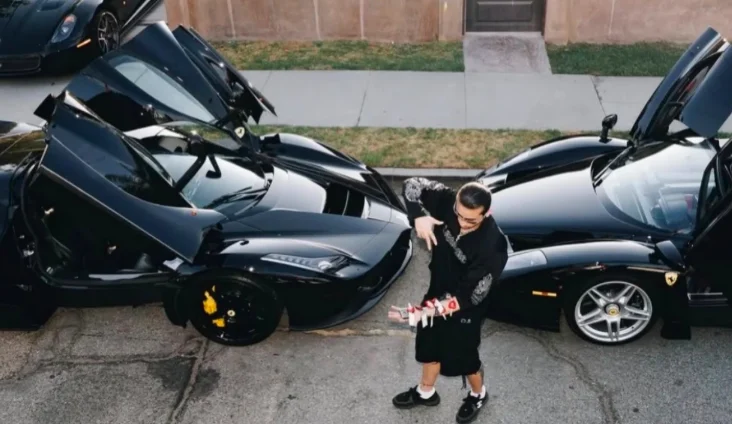
SAN BERNARDINO, California — In a quiet, unassuming residential neighborhood in San Bernardino, the ordinary rhythm of daily life was recently shattered by a low, mechanical growl. A synchronized fleet of Italian supercars, gleaming under the California sun, slowly rolled down the asphalt to occupy a modest suburban street.
At the center of this surreal automotive spectacle stood Jesús Ortíz Paz, universally known as "JOP"—the charismatic frontman of Fuerza Regida, one of the most commercially successful regional Mexican bands on the planet. Returning to the very neighborhood where he spent his formative years, JOP did not just visit his childhood home; he brought with him a staggering $20 million (approximately €17 million) collection of rare Ferraris.
Captured on video and subsequently shared via the official Instagram account of Fuerza Regida, the scene instantly went viral, sparking fierce online debates. To his supporters, it is the ultimate cinematic symbol of social revenge and immigrant resilience—a living testament to the American Dream conquered through relentless hard work. To critics, however, it borders on ostentatious provocation, a blinding display of hyper-wealth parked squarely in front of working-class doorsteps.
As the dust settles on San Bernardino’s most expensive traffic jam, this article examines the anatomy of JOP’s homecoming, tracing his meteoric rise, analyzing the multi-million-dollar fleet that accompanied him, and evaluating the cultural impact of modern regional Mexican stardom colliding with old-school roots.
Main Facts: The $20 Million Fleet Meets the Working-Class Block
The core of the story lies in the juxtaposition of extreme, uncompromising luxury against a backdrop of modest, working-class Americana. During a momentary pause in their massive “This Is Our Dream” tour, Fuerza Regida made a strategic, deeply personal detour to San Bernardino.
The vehicle convoy was not merely a casual gathering of car enthusiasts; it was a mobile museum of automotive engineering valued at an estimated $20 million. Among the low-slung, crimson and carbon-fiber masterpieces were several crown jewels of Maranello’s legacy, fundamentally altering the visual landscape of a street better known for parked pickup trucks and basketball hoops.
- The Protagonist: Jesús Ortíz Paz (JOP), lead singer and creative engine of Fuerza Regida.
- The Location: San Bernardino, California—JOP’s childhood hometown and the birthplace of his musical aspirations.
- The Fleet: A collection of ultra-rare Ferraris valued at roughly $20 million (€17 million).
- The Core Paradox: The stark visual contrast between a humble, working-class neighborhood and multimillion-dollar Italian supercars bearing the iconic Cavallino Rampante (Prancing Horse) emblem.
This deliberate display forces observers to confront a profound socioeconomic reality: the immense, globalized wealth generated by contemporary Latin music genres, brought back to the physical coordinates of humble beginnings.
Chronology: From Backyard Parties to Global Stardom
To understand why JOP’s Ferrari homecoming carries such emotional and cultural weight, one must trace the rapid, almost cinematic trajectory of his life and career.
Phase 1: The San Bernardino Roots
Long before filling arenas across the United States and Mexico, Jesús Ortíz Paz was a local kid navigating the realities of San Bernardino. Like many children of immigrants, his early life was defined by financial constraints and cultural balancing acts. Music was an early outlet, but success was far from guaranteed. In his youth, JOP cut his teeth performing at local backyard parties, quinceañeras, and neighborhood gatherings—playing traditional sounds for modest tips, far from the flashbulbs of the paparazzi or the cockpit of a supercar.
Phase 2: The Birth and Rise of Fuerza Regida
Founded in San Bernardino in 2015, Fuerza Regida began as an underground música mexicana outfit. However, JOP and his bandmates—including Samuel Jaimez, Khrystian Ramos, and José Garcia—refused to remain bound by traditional formulas. They pioneered a modern subgenre, fusing traditional corridos with raw urban influences, heavy hip-hop beats, and trap production values.
The gamble paid off spectacularly. Tracks detailing street life, ambition, and heartbreak resonated deeply with a new generation of bicultural Latinos in the U.S. and across Latin America. Hits began accumulating millions of streams, translating underground credibility into mainstream dominance.
Phase 3: Awards, Wealth, and the Ferrari Obsession
As Fuerza Regida’s streaming numbers exploded, so did their financial capital. Over the past few years, the group has secured an astonishing array of accolades, including multiple Billboard Music Awards (four total) and Billboard Latin Music Awards (eleven total). They transformed from an indie regional act into a global touring powerhouse capable of selling out massive venues like crypto.com Arena in Los Angeles and Foro Sol in Mexico City.
With unprecedented wealth pouring in, JOP indulged a deep-seated passion for high-end automobiles, rapidly transitioning into a serious collector of elite Italian supercars—with a distinct preference for the rarest models produced by Ferrari.
Phase 4: The Homecoming (The Full Circle)
The culmination of this journey occurred during the “This Is Our Dream” tour. Deciding to bridge the chasm between his past and present, JOP orchestrated the $20 million convoy back to his childhood street. By parking the fruits of his labor directly outside his old front door, the singer closed a powerful psychological and geographical loop.
Supporting Data: Inside the Garage of a Supercar Collector
JOP’s vehicular collection is not merely about accumulating expensive toys; it represents a calculated acquisition of automotive history and extreme rarity. Among the fleet that descended upon San Bernardino, one vehicle towers above the rest in terms of both financial value and cultural mythology: the Ferrari Enzo.
The Crown Jewel: The Black-on-Red Ferrari Enzo
At the heart of JOP’s collection sits a 2003 Ferrari Enzo, finished in a breathtaking and extraordinarily rare Nero D.S. exterior paired with a striking red interior.
- Rarity: Automotive historians note that only three known examples of this specific color configuration exist worldwide, making it a holy grail for elite collectors.
- Valuation: This specific Enzo commanded a staggering price tag of around $10.7 million (roughly €10 million) during acquisition, underscoring the hyper-inflation of the collector car market for rare, low-mileage Maranello masterpieces.
- Legacy: Named after the company’s legendary founder, Enzo Ferrari, the car utilizes Formula 1-derived technology, a naturally aspirated V12 engine, and carbon-composite bodywork, making it a fitting metaphor for an artist who engineered his own ascent from the ground up.
The Formula Behind the Fortune
According to automotive and lifestyle publications like Supercar Blondie, JOP’s ability to finance such an extravagant fleet stems directly from the seismic shift in the music industry. As Supercar Blondie aptly summarizes:
"By mixing regional Mexican sounds with hip-hop, trap, and modern production, Fuerza Regida captured a massive, underserved global audience, propelling JOP straight to the top of the charts—and straight into a multi-million-dollar supercar collection."
Official Responses and Public Reaction: Revanche vs. Provocation
The viral dispersion of the San Bernardino homecoming video instantly fractured public opinion, generating heated debates across social media platforms like Instagram, TikTok, and X (formerly Twitter).
The Defense: Social Revenge and Immigrant Pride
For millions of fans and members of the working-class Latino community, JOP’s stunt is far from offensive—it is a triumphant display of revanche sociale (social revenge).
- The American Dream Realized: Supporters argue that in a society where systemic barriers often block upward mobility, seeing a child of immigrants return to his humble origins draped in the ultimate symbols of capitalist success is deeply inspiring.
- Authenticity: Fans emphasize that JOP does not hide his past or sanitize his origins. By bringing the wealth back to the block, he acknowledges where he came from rather than abandoning his roots for gated communities in Beverly Hills or Miami.
The Critique: Flashy Provocation and Tone-Deafness
Conversely, a vocal segment of critics and even some local residents expressed discomfort with the display.
- Economic Disparity: Critics pointed out the jarring insensitivity of rolling tens of millions of dollars in luxury assets through a neighborhood where families grapple with everyday economic anxieties, inflation, and housing costs.
- Ostentatious Overkill: Some commentators labeled the convoy an act of unnecessary egoism—a piece of "flex culture" designed strictly for social media clout rather than genuine community reinvestment.
Neither JOP nor Fuerza Regida’s management issued a formal press release addressing the controversy, choosing instead to let the visceral imagery speak for itself—a tactic entirely consistent with the bold, unfiltered persona that built their brand.
Implications: What JOP’s Ferrari Parade Means for Culture and Hip-Hop/Regional Crossover
The sight of twenty million dollars worth of Ferraris parked on a San Bernardino street carries implications that extend far beyond celebrity gossip or car culture. It serves as a cultural watershed moment for several intersecting reasons.
1. The Globalization and Elevation of Música Mexicana
For decades, regional Mexican music—including corridos, norteño, and banda—was marginalized in mainstream American media, often stereotyped as working-class music for older generations. JOP and Fuerza Regida, alongside peers like Peso Pluma and Natanael King, have completely dismantled these boundaries. By infusing the genre with urban trap aesthetics and luxury lifestyle signifiers (comparable to American hip-hop culture), they have proven that regional Mexican artists can command the same financial heights, chart dominance, and material opulence as pop and rap icons.
2. The Evolution of the "Humble Roots" Narrative
Historically, artists who achieve sudden wealth often sanitize their origin stories, preferring to highlight their current mansions and luxury vehicles while distancing themselves from their impoverished pasts. JOP’s approach is radically different. By dragging his multi-million-dollar garage back to the exact street that birthed his struggles, he merges his past identity with his present empire. It is a visual declaration that wealth does not erase origin; rather, origin amplifies the magnitude of the achievement.
3. The Intersection of Car Culture and Modern Fame
In contemporary music, luxury automobiles have long served as extensions of an artist’s brand. From Jay-Z to Travis Scott, hip-hop artists have used cars to signal arrival. JOP’s adoption of ultra-rare Ferraris—culminating in a nearly $11 million Enzo—signals that the upper echelon of música mexicana stars has officially entered the global elite collector market, rubbing shoulders with tech billionaires, professional athletes, and legacy celebrities.
Conclusion
Jesús Ortíz Paz driving a $20 million fleet of Ferraris down his childhood street in San Bernardino is much more than a viral Instagram moment. It is a complex cultural artifact.
Whether viewed as a profound narrative of immigrant triumph and social revenge, or criticized as an unapologetic, hyper-wealthy provocation, the scene forces us to look at the distance one can travel through talent, disruption, and ambition. JOP took the sounds of the San Bernardino streets, remixed them for a global digital generation, and drove the profits right back to where it all began. In doing so, he left an indelible mark on both asphalt and musical history—proving that sometimes, the only way to truly honor your past is to blind it with the headlights of a Prancing Horse.
