

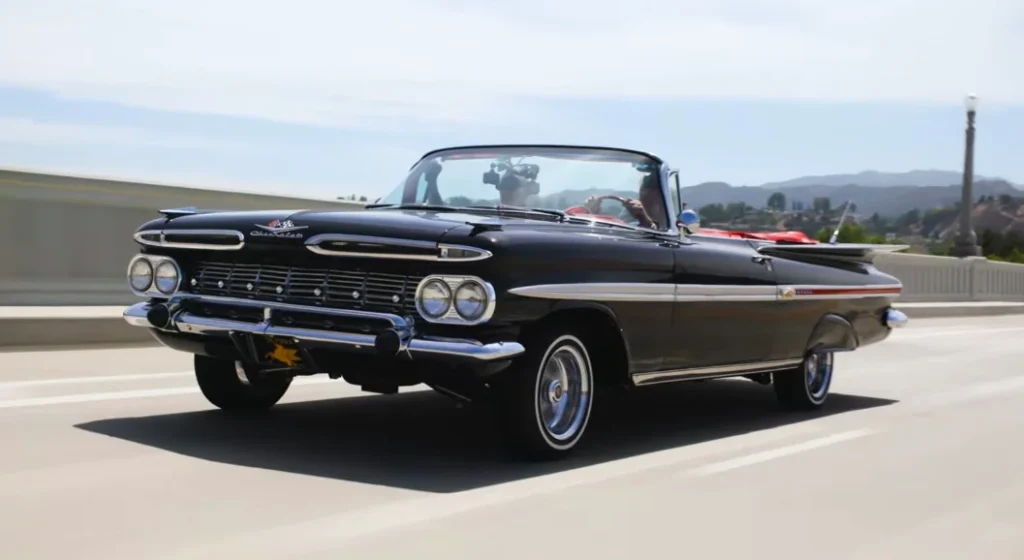
When Travis Barker, the legendary drummer of Blink-182, rolled onto the set of Jay Leno’s Garage in a sleek, obsidian-black 1959 Chevrolet Impala convertible, the initial impression was predictable. To the untrained eye, it appeared to be a quintessential piece of Southern California automotive history—a "land yacht" designed for slow-motion boulevard cruising, air-ride suspension dropped to the asphalt, and chrome glistening under the Burbank sun.
However, as the legendary host and automotive connoisseur Jay Leno quickly discovered, this was no mere Sunday cruiser. Beneath the vintage silhouette lies a deeply personal, high-performance mechanical beast. This project, dubbed "Gloria" by Barker, represents a masterclass in the art of the restomod: a vehicle that pays homage to the past while utilizing cutting-edge engineering to deliver modern, adrenaline-fueled performance.
The Genesis of an Obsession: A Personal Journey
To understand the significance of this build, one must look beyond the gleaming paintwork and into the history of its owner. Travis Barker’s love for American iron is not a newfound hobby; it is a legacy inherited from his father. Growing up in Fontana, California, Barker spent his formative years surrounded by the sounds and smells of his father’s garage, where the elder Barker spent his spare time wrenching on domestic classics and Harley-Davidsons.
"My father would come home every day, and I’d be in the garage playing the drums," Barker recounted during his appearance on the show. "He’d open the garage door, pull in his Harley, and I’d be making ten times more noise than the bike." This symbiotic relationship between rhythm and horsepower forged a lifelong appreciation for machines that possess both soul and volume.
The Impala, however, serves a deeper purpose in Barker’s life. Following his traumatic survival of a 2008 plane crash, Barker struggled for years with a crippling fear of flying—a phobia that redefined his professional and personal boundaries. For nearly a decade, the drummer lived grounded, turning to his car collection as a way to process his journey toward recovery. He described the period leading up to 2017 as a time of uncertainty, where his inability to fly felt like a closed door. "It was like a beautiful light at the end of the tunnel, the fact that I could finally share my story," he explained. The Impala, meticulously restored and upgraded, acts as a physical manifestation of that progress: a vehicle built to move forward, regardless of the terrain.
A Cultural Icon: The 1959 Impala
The 1959 Chevrolet Impala occupies a singular space in the pantheon of American automotive design. It was the year Chevrolet separated the Impala from the Bel Air line, creating an identity defined by excess, optimism, and the "Space Age" aesthetic that dominated the late 1950s.
Design and Rarity
The 1959 model is instantly recognizable by its horizontal "cat’s eye" taillights and massive, flat rear fins that seemed to defy the wind. Jay Leno, an expert in the historical context of such vehicles, noted the performative nature of these design choices. "I remember when it came out, Chevy claimed the aero-fins helped stabilize the car at high speeds," Leno remarked with a chuckle. "It was all marketing—it was purely a styling exercise."
Despite the "baroque" styling, the 1959 Impala remains a collector’s holy grail. Out of the 1,528,592 vehicles produced by Chevrolet that year, only 72,765 were Impala convertibles. When new, these machines were priced between $2,849 and $2,967 depending on the powertrain—a significant sum for the era, but a bargain for the cultural impact they would go on to have in the lowrider scene. Barker’s specimen, a former Texas car, serves as a pristine canvas for his vision, pairing the classic red interior with a menacing black-on-black exterior.
The Engineering Behind "Gloria": A Modern Heart
If the aesthetic is pure 1959, the soul is entirely 21st-century. Barker entrusted the build to SoCal Autoworks, with a mandate to balance daily reliability with aggressive performance.
The LS3 Powerplant
The original 348-cubic-inch "Big Block" V8—while historically significant—was never intended to provide the kind of power a modern enthusiast expects. In its place, the team dropped in a GM "Crate" LS3 V8 engine. Capable of producing 495 horsepower, this engine transforms the Impala from a lumbering cruiser into a genuine "bruiser." The power is managed by a 4L60E automatic transmission and a robust Currie 9-inch rear end, ensuring that the torque is delivered reliably to the pavement.
Chassis and Handling
The challenge with putting 500 horsepower into a 65-year-old chassis is the risk of the car becoming undriveable. To mitigate this, the Impala was outfitted with a comprehensive suite of modern upgrades:
- Suspension: A RideTech pneumatic system allows the driver to adjust the ride height instantly, enabling the car to sit flush with the ground for shows while maintaining clearance for the uneven roads of Los Angeles.
- Braking: Four-wheel Wilwood disc brakes provide the stopping power necessary to haul down a vehicle of this size and speed, a vital safety upgrade over the original drum brakes.
- Interior Comforts: While the dashboard retains its period-correct aesthetic, the team integrated a "Vintage Air" climate control system hidden behind the original factory controls, and swapped the oversized original steering wheel for a more ergonomic, compact version.
- Aesthetics: The car rolls on 14-inch Dayton wire wheels with thin-whitewall tires, a hallmark of the classic lowrider aesthetic, complemented by a Continental kit that extends the rear profile.
The Moment of Truth: Jay Leno’s Reaction
The true test of any restomod is how it performs on the open road. As Leno took the wheel, the skepticism of a veteran collector was palpable. He navigated the car through the streets, initially commenting on the sheer size of the vehicle. However, as soon as he depressed the accelerator, the narrative shifted.
The LS3 engine roared to life, delivering a deep, resonant exhaust note curated by a custom MagnaFlow stainless steel exhaust system. The car didn’t just move; it surged. The stability provided by the modern suspension and the biting power of the Wilwood brakes left Leno visibly impressed. He noted that the car felt balanced, modern, and surprisingly agile for its dimensions.
"It’s like it has two personalities: a cruiser and a bruiser," Barker observed. This duality is exactly what makes the project so successful. It preserves the romance of a bygone era while eliminating the frustrations of 1950s mechanical fragility.
Implications for the Restomod Community
Travis Barker’s Impala is more than just a celebrity toy; it is a signal of the shifting values within the collector car market. For decades, the debate between "purists" (who believe in preserving original parts) and "modders" (who prioritize performance) has been contentious. Barker’s build suggests a middle ground: respect for the original design, but a refusal to be limited by its technological shortcomings.
By utilizing a "crate engine" and modern chassis components, Barker has ensured that the car can be driven frequently, not just tucked away in a climate-controlled museum. This approach extends the lifespan of these cultural icons, allowing them to remain relevant in a world of high-performance electric vehicles and hyper-efficient engineering.
Conclusion: A Rolling Testament to Resilience
When viewed as a whole, the 1959 Impala is a metaphor for Travis Barker’s own life. It is a machine that was once relegated to the past, brought back to life through intense dedication, and infused with the power to overcome obstacles. By marrying the aesthetic optimism of 1959 with the precision of modern automotive engineering, Barker has created a vehicle that is not only a work of art but a testament to the idea that with the right foundation and a bit of innovation, anything can be restored to its full, powerful potential.
As the sun sets on Jay Leno’s Garage and the black Impala glides out of the lot, it leaves behind a clear message: the future of classic car culture isn’t just about preserving what was—it’s about giving it the power to keep running for generations to come.
