

From the upper tiers of the Volkswagen Arena, the horizon offers no pastoral relief. Less than five hundred meters from the manicured pitch, four gargantuan chimneys of the thermal power plant belch gray plumes of smoke into the Lower Saxon sky, casting long shadows over the Mittelland Canal. Behind this wall of red brick lies a sprawling concrete fortress—an industrial necropolis three times the size of the Principality of Monaco, webbed with private railway tracks and deafening stamping halls where hydraulic presses dictate the rhythm of existence.
For three-quarters of a century, this enclave functioned as a "worker’s principality" under a glass bell, sustained by the paternalistic security of the Volkswagen social model and the quiet arrogance of Deutsche Qualität. But by the summer of 2026, the illusion shattered with the force of a structural collapse. A brutal restructuring plan on the assembly lines has converged with the unthinkable: the relegation of the VfL Wolfsburg football club. The dual crisis reveals an intangible, biting truth: when Volkswagen suffers, all of Wolfsburg disintegrates.
The Anatomy of a Symbiosis: From KdF-Stadt to Corporate Feudalism
To grasp the magnitude of the current shock, one must understand the unique, almost organic bond between the city and the corporation. Founded in 1938 upon marshes and forests specifically chosen by the Nazi regime to birth the "People’s Car"—the Beetle—the city was originally named Stadt des KdF-Wagens bei Fallersleben. Following the liberation in 1945, it adopted the name of the nearby medieval castle, Wolfsburg.
Since the post-war era, the factory and the city have shared a circulatory system. In Wolfsburg, 120,000 residents live by the clock of the factory sirens. They drive exclusively local models, baptize their children in the St. Christopher Church—funded by the brand and dedicated to the patron saint of motorists—and sustain themselves in the cafeteria with the legendary Volkswagen Currywurst, a culinary staple that carries its own official spare-part number in the group’s logistics catalog.
This Rhenish-style capitalism provided a standard of living disconnected from the economic realities of the rest of Germany. In 2021, Wolfsburg boasted one of the highest GDPs per capita in the country, reaching a staggering 158,749 euros. Ehme de Riese, a local optician, often cited the local paradox: a forklift operator with minimal qualifications could earn more than a master craftsman in other regions simply by moving parts on the Golf line. It was an El Dorado that attracted thousands of Italian guest workers in the 1960s, a golden era built on the absolute certainty that the group could never lose.
Chronology of a Slow-Motion Derailment
The decline of the Wolfsburg empire did not happen overnight. It is a story of compounding errors, political miscalculations, and global shifts.
- 1938–1945: Foundation of the factory and the city under the KdF (Strength Through Joy) initiative.
- 1945–1970: Post-war reconstruction; the rise of the Beetle as a global icon of the "Economic Miracle" (Wirtschaftswunder).
- 2015: The "Dieselgate" scandal breaks, coinciding with VfL Wolfsburg winning the DFB-Pokal. The scandal forces a massive, expensive pivot toward electric vehicles (EVs).
- 2021–2023: Global supply chain crises, rising energy costs following the cutoff of Russian gas, and the rise of aggressive Chinese EV competitors (BYD, Geely).
- May 25, 2026: VfL Wolfsburg loses the relegation playoff against Paderborn, marking the end of 28 years in the Bundesliga.
- Late 2026: Volkswagen announces a radical "Save the Group" plan, including the closure of domestic plants and the relocation of the Golf production line to Mexico.
Supporting Data: The Erosion of the Competitive Edge
The financial metrics paint a sobering picture. The "Dieselgate" scandal, which saw the company pay over 32 billion euros in fines and legal settlements, drained the treasury at the exact moment the industry required a massive capital injection for the transition to electric mobility.
Volkswagen’s pivot to the MEB (Modular Electric Drive Matrix) platform was ambitious but fraught with software failures and bloated production costs. As Berlin abruptly terminated EV subsidies and energy prices skyrocketed, the group found itself trapped.
Economic Indicators:
- Operating Margins: The core VW brand has seen its margins plummet below 1%, a catastrophic figure for a high-volume manufacturer.
- Market Pressure: Washington’s implementation of new trade barriers has crippled access to the U.S. market, once the most profitable destination for high-end German exports.
- Salary Disparity: While Wolfsburg wages remain among the highest in Europe, the cost-to-production ratio is no longer sustainable compared to competitors in Mexico, Eastern Europe, and China.
Official Responses and the "Club in Plastic"
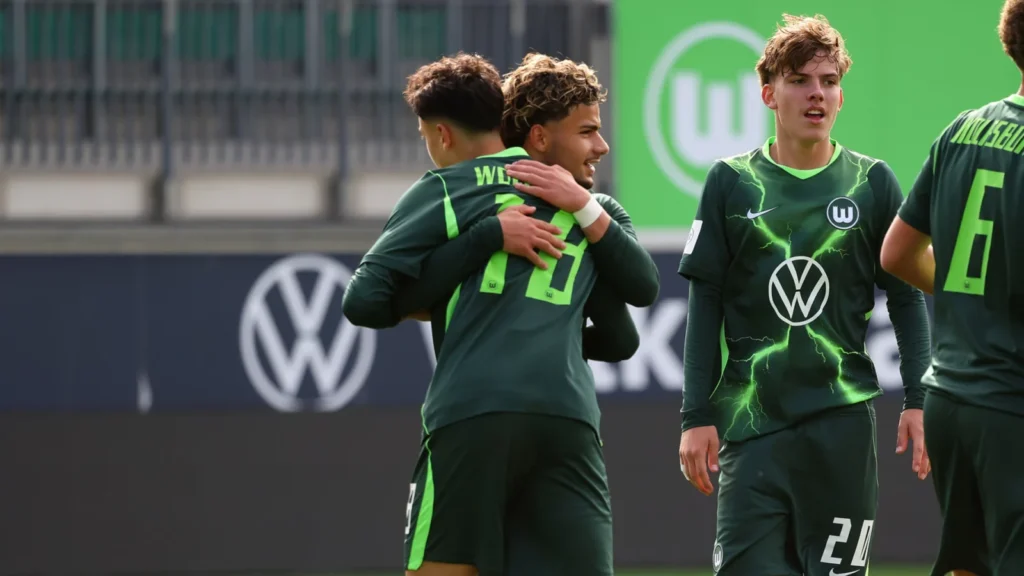
In the German football landscape, which strictly adheres to the "50+1" rule—ensuring members hold the majority of voting rights—VfL Wolfsburg has long been viewed as an anomaly. Critics call it a "plastic club," a corporate entity 100% owned by the manufacturer, kept alive by corporate millions without the grassroots fervor of traditional clubs like Dortmund or Schalke.
With an annual operating budget of 80 million euros and over 150 million invested in transfers over three seasons, the club maintained a wage bill that would be considered astronomical even in the top flight. Now, in the 2. Bundesliga, they spend more than their seventeen league opponents combined.
Young coach Tobias Strobl recently attempted a "shock therapy" session for his squad, forcing millionaire players—including French talents like Saël Kumbedi and Mathys Angély—to visit the assembly lines at dawn. The intended lesson was to ground the players in the reality of the workers who fund their lifestyle. Instead, the spectacle only highlighted the widening chasm: the workers do not see their struggles reflected in the team’s lackluster performance, and the factory can no longer afford to buy championships.
The Social Implications: A City Without a Future?
At the executive level, CEO Oliver Blume has signaled the end of the "social holiday." The current restructuring plan, which aims to cut up to 100,000 jobs across the group by 2030, is not just a spreadsheet correction; it is a structural dismantling of the German social contract.
The most visceral blow to local morale is the decision to move the production of the Golf—the vehicle that built the city’s schools, roads, and museums—to the Puebla plant in Mexico. For the people of Wolfsburg, this is viewed as a betrayal.
"We are a one-company town," says municipal councilor Immacolata Glosemeyer. "If the parent company wobbles, the entire city is threatened with economic extinction."
The union IG Metall, representing over 90% of the workforce, is in a state of open revolt. Spokesperson Jan Mentrup captures the bitterness: "For years, management believed customers would buy any electric family car we built, no matter how soulless or expensive. They ignored every red light until we reached the point of total asphyxiation."
Conclusion: The Myth of the Eternal Bastion
As the red bricks of the Mittelland Canal look out over the quieted machinery of the factory, the residents of Wolfsburg are forced to confront a reality they once thought impossible. The departure of the Golf production line and the decline of their football club into the lower tiers of the German league are not separate incidents; they are symptomatic of the same malaise.
The "worker’s principality" is discovering that in the hyper-competitive global market of the 21st century, no industrial bastion is eternal. The arrogance of Deutsche Qualität has been humbled by the reality of global trade, software-driven disruption, and the fading loyalty of a generation that no longer views a Volkswagen as a birthright. For Wolfsburg, the glass bell has been shattered, and the cold wind of the outside world is finally blowing through the halls of the factory.
