

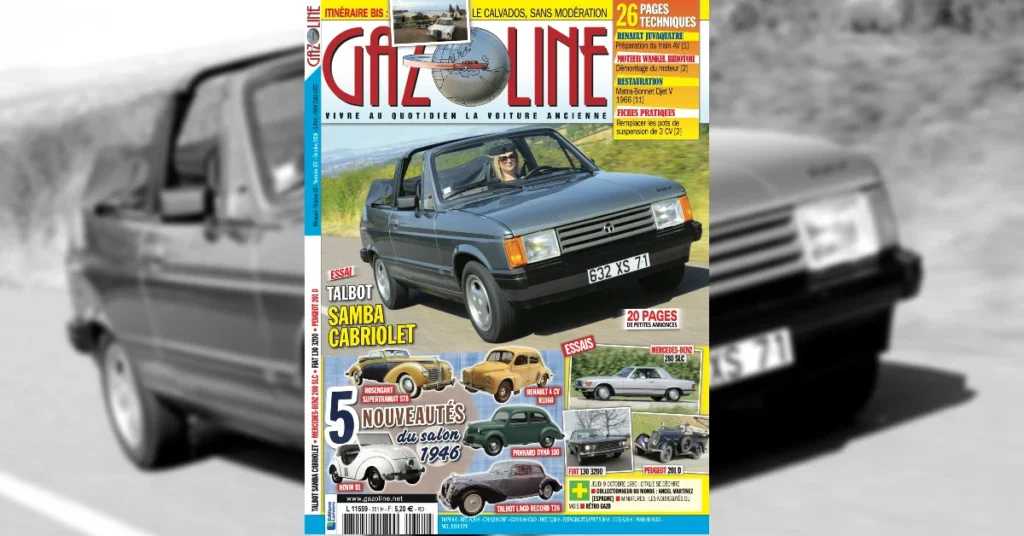
Main Facts: A Diverse Tapestry of Automotive Heritage
Automotive journalism is rarely just about horsepower, 0-to-60 times, or modern creature comforts. For enthusiasts of classic and vintage iron, it is an archeological pursuit—a way to touch the past, understand the socio-economic conditions of bygone eras, and preserve engineering art forms that time threatens to erase. In its October 2026 edition (Issue No. 351), Gazoline magazine delivers a masterclass in this philosophy, offering an eclectic mix of rediscoveries, pre-war treasures, post-war reconstruction icons, and deep-dive technical restorations.
At the forefront of this month’s lineup is a charming French drop-top heavily inspired by its German contemporary, the Volkswagen Golf Cabriolet: the Talbot Samba Cabriolet. Representing the late production phase of a wonderfully preserved, highly original example, the Samba proves that open-air motoring does not require a massive engine or a six-figure budget to capture the imagination.
However, the editorial scope of Issue No. 351 stretches far beyond economical French sunshine. Readers are treated to the velvety smoothness of a Mercedes-Benz 280 SLC and its legendary inline-six powerplant, the ambitious yet misunderstood luxury of a rare Fiat 130 sedan, and a genuinely ultra-rare piece of automotive history: a Peugeot 201 D Commercial Torpedo.
Embracing the spirit of October, the magazine also dedicates its core historical feature to a watershed moment in automotive chronology: the 1946 Paris Motor Show. As the very first post-war exhibition, it captured a shattered continent attempting to rebuild itself through innovation, utilizing highly unpredictable resources. Five distinct vehicles from this pivotal era—the Panhard Dyna 100, the Renault 4 CV R1060, the Rosengart SuperTrahuit ST8, the Rovin D1, and the Talbot-Lago Record T26—take center stage. Finally, to bid farewell to the warmer months, the magazine’s final Itinéraire bis road trip of the season takes readers along the historic beaches of the Calvados department, blending French motoring heritage with profound historical remembrance.
Chronology and Historical Context: From 1946 Rebuilding to 1980s Realities
To fully appreciate the contents of Gazoline No. 351, one must trace the chronological threads that bind the featured vehicles together. The magazine brilliantly spans decades of geopolitical and industrial shifts, using the automobile as a witness to history.
The Crucible of 1946: The First Post-War Paris Motor Show
October historically evokes the grand traditions of the Paris Motor Show (Mondial de l’Automobile). In October 2026, Gazoline looks back exactly 80 years to the momentous 1946 exhibition. Europe was emerging from the catastrophic rubble of World War II. Industrial infrastructure was decimated, raw materials like steel and aluminum were strictly rationed, and consumer purchasing power was virtually non-existent.
Yet, ingenuity flourished. Manufacturers displayed prototypes and early production models that would dictate the recovery of European mobility:
- Panhard Dyna 100: Showcased how intensive use of aluminum could circumvent steel shortages while maximizing fuel economy.
- Renault 4 CV R1060: Represented the democratization of the French automobile, becoming a symbol of post-war recovery and mass motorization.
- Rosengart SuperTrahuit ST8: Strove to capture the luxury market in an era of austerity.
- Rovin D1: Answered the desperate need for ultra-cheap, minimalist micro-mobility.
- Talbot-Lago Record T26: Maintained the proud, fiery tradition of French high-performance coachbuilding despite the economic odds.
The Turning Point of October 1980
Leap forward nearly three and a half decades to Thursday, October 9, 1980. While French motorists were enjoying everyday automotive evolution, the broader European landscape was fraught with tension. As documented in the issue’s news segment, Italy was undergoing a period of intense socio-political turmoil—a backdrop that contextualizes the industrial pressures faced by manufacturers like Fiat during the development of vehicles like the Fiat 130.

Supporting Data: Detailed Breakdown of Issue No. 351
For collectors, restorers, and automotive historians, Gazoline provides meticulous coverage across its standard pillars: rediscoveries, pre-war machines, technical restorations, and international collector profiles.
Feature Vehicles Under the Microscope
| Vehicle Model | Category | Defining Characteristics & Significance |
|---|---|---|
| Talbot Samba Cabriolet | Rediscovery | Late-production, highly original condition. Heavily influenced by the VW Golf Cabriolet, marking the return of affordable French drop-tops. |
| Mercedes-Benz 280 SLC | Rediscovery | Features a velvety inline-six engine; showcases the grand touring luxury and "stretching" design philosophy of Stuttgart. |
| Fiat 130 3200 | Rediscovery | A high-end Italian executive sedan bearing a heavy, ambitious heritage in the face of changing market demands. |
| Peugeot 201 D Torpéo Commercial | Pre-War | A quasi-unique utility variant utilizing the famous "201" moniker, serving as a lucky charm for Peugeot’s pre-war commercial fleet. |
| Panhard Dyna 100 | 1946 Salon Spotlight | Pioneered lightweight aluminum construction to "set the world on fire" amidst post-war material scarcity. |
| Renault 4 CV R1060 | 1946 Salon Spotlight | Swept up by the masses, this little rear-engined sedan motorized a recovering France. |
| Rosengart SuperTrahuit ST8 | 1946 Salon Spotlight | Dubbed the "other 22," representing bold, unorthodox engineering in the upper-middle class segment. |
| Rovin D1 | 1946 Salon Spotlight | A cheerful microcar that practically embodies the cheerful phrase "Go on, Oui-Oui!" |
| Talbot-Lago Record T26 | 1946 Salon Spotlight | Poured high-performance fever directly into the veins of post-war luxury buyers. |
Technical Restoration Chronicles
Beyond static road tests, the October 2026 issue delivers critical hands-on guidance for DIY mechanics and restoration specialists:
- Renault Juvaquatre AHG 2 (1951) [Part 27]: Focuses heavily on the meticulous overhaul and preparation of the front axle system [Part 1].
- Moteur Wankel Birotor [Part 3]: Continues the fascinating and complex teardown of the rotary engine, offering invaluable insights for Wankel enthusiasts.
- Matra-Bonnet Djet V (1966) [Part 11]: Proves that perseverance pays off as this fiberglass mid-engine sports car breezes through its Contrôle Technique (MOT/inspection) without a hitch.
Global Collector Spotlight & Travel
- Angel Martinez (Spain): Featured in the Collectionneur du Monde series, showcasing a passionate Spanish collector deeply influenced by the Renault diamond (le losange).
- The Calvados Department: The final Itinéraire bis journey of the season maps out a scenic, emotional route following the footsteps of history across Normandy’s famous D-Day landing beaches.
Editorial Perspective and Official Insights
Gazoline has long established itself as more than a magazine; it is a vital community hub for the preservation of rolling automotive heritage. In an era where digital screens and autonomous driving concepts dominate modern automotive media, publications like Gazoline anchor the enthusiast community in tangible, mechanical reality.
While traditional press releases from corporate manufacturers focus strictly on electrification, autonomous tech, and quarterly financial margins, independent enthusiast journals provide a vital counter-narrative. The editorial stance of Issue No. 351 champions authenticity. Whether examining a pristine, untouched Talbot Samba Cabriolet or painstakingly documenting the step-by-step teardown of a complex Wankel rotary motor, the underlying message is clear: automotive history is a living, breathing craft.
The focus on the 1946 Paris Motor Show further underscores a philosophical resilience. By highlighting how designers and engineers overcame post-war scarcity with brilliant innovations—such as Panhard’s use of aluminum or Renault’s accessible 4 CV—the editorial team implicitly reminds modern readers of the human spirit’s capacity to innovate through crisis.
Implications for the Classic Car Community
The release of Gazoline Issue No. 351 carries several significant implications for collectors, restorers, and the broader classic car market:
- The Rise of 1980s "Youngtimers": By dedicating prime rediscoveries to vehicles like the Talbot Samba Cabriolet and the Mercedes 280 SLC, the magazine validates the continuing market maturation of 1980s automobiles. Cars once dismissed as everyday commuter hatchbacks are now rightfully recognized as collectible design statements.
- Appreciation for Rare Pre-War and Post-War Artifacts: Features on quasi-unique models like the Peugeot 201 D Commercial Torpedo and the 1946 Salon pioneers remind collectors that automotive history extends far beyond mainstream sports cars. Utility vehicles and post-war economic experiments hold equal, if not greater, historical weight.
- The Importance of Practical Restoration Documentation: With ongoing challenges in sourcing rare replacement parts for vintage vehicles, step-by-step technical guides—such as the Juvaquatre front axle overhaul and the Wankel engine teardown—remain indispensable resources. They empower a new generation of hobbyists to keep rolling history alive in their own garages.
As autumn settles in, Issue No. 351 of Gazoline successfully bridges the gap between reflective historical storytelling and hands-on mechanical passion, ensuring that the wheels of the past continue to turn for generations to come.
