

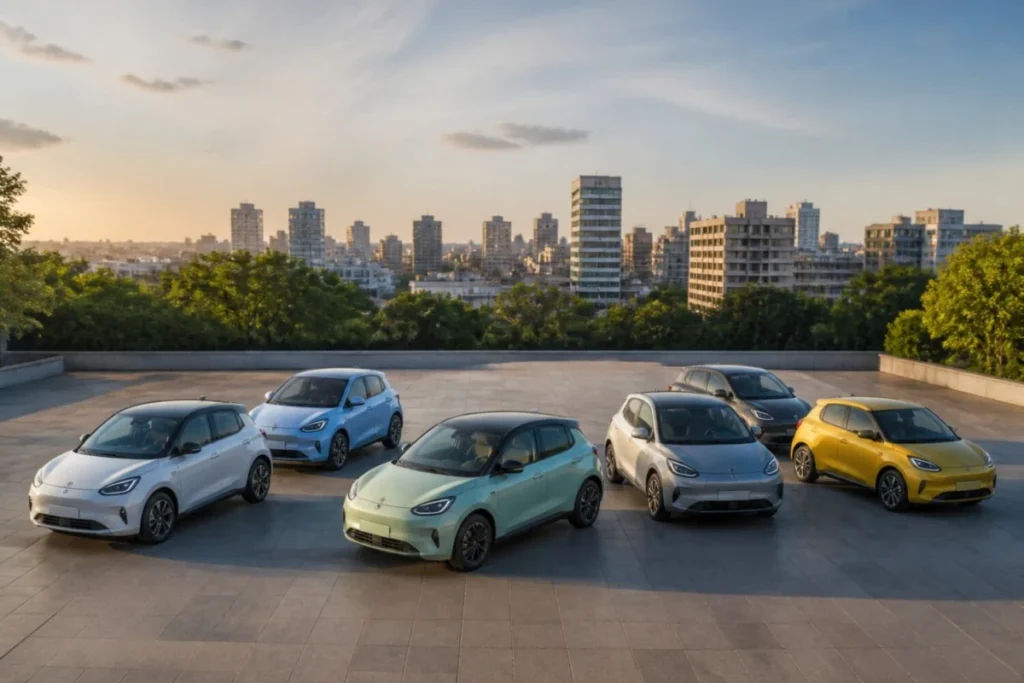
The landscape of personal mobility is undergoing a tectonic shift. As urban centers implement increasingly stringent low-emission zones (LEZs) and consumer demand for compact, efficient, and sustainable vehicles surges, the market for electric city cars has never been more competitive. For the modern driver—who needs a vehicle capable of navigating tight urban corridors during the week while remaining versatile enough for weekend getaways—the choice has become complex.
To determine which small electric vehicle (EV) truly stands out, we must look beyond mere aesthetics. Three key performance indicators serve as the ultimate benchmarks for these vehicles: WLTP range, rapid charging capacity, and cargo volume.
In our latest analysis of five key models—the Volkswagen ID. Polo, Peugeot e-208, Renault 5 E-Tech, Citroën ë-C3, and Dacia Spring—one nameplate emerges as the technical benchmark: the Volkswagen ID. Polo. By balancing high-capacity storage with superior charging speeds and range, it sets a new standard for the segment.
The Core Metrics: Defining the Modern City Car
When evaluating small EVs, the "city car" designation often masks a wide spectrum of utility. While a mini-city car boasting 250 km of WLTP range may suffice for purely urban commutes, it quickly becomes a liability once the driver ventures into peri-urban environments or highway transit.
To serve as a true "polyvalent" vehicle—a car capable of being the primary household vehicle—experts recommend a minimum threshold:
- Range: Over 300 km (WLTP) to account for efficiency losses during winter months.
- Charging: A minimum of 80 kW DC fast-charging capacity to minimize downtime on longer trips.
- Utility: A functional cargo capacity that can accommodate weekly groceries, sports equipment, or luggage for a short trip.
Comparative Analysis: The Five Contenders
The following table summarizes the technical performance of our top five contenders, ranked by their maximum WLTP range.
| Rank | Model | Max WLTP Range | Max DC Charging | Cargo Capacity |
|---|---|---|---|---|
| 1 | VW ID. Polo | 453 km (52 kWh) | 105 kW | 435 L |
| 2 | Peugeot e-208 | 433 km (54 kWh) | 100 kW | 309 L |
| 3 | Renault 5 E-Tech | 430 km (52 kWh) | 100 kW | 326 L |
| 4 | Citroën ë-C3 | 322 km (44 kWh) | 100 kW | N/A |
| 5 | Dacia Spring | 250 km (27.5 kWh) | 50 kW (Opt.) | 337 L |
A Deep Dive into Model Performance
1. Volkswagen ID. Polo: The New Benchmark
The ID. Polo is currently the most complete package in this segment. Built on the sophisticated MEB+ platform, it offers an impressive 453 km of range in its 52 kWh configuration. Perhaps more importantly, it offers the fastest charging in this group at 105 kW, capable of a 10% to 80% charge in just 24 minutes. With a massive 435-liter trunk, it outperforms its rivals by a significant margin in terms of raw utility. Even its entry-level 37 kWh version is highly capable, offering over 320 km of range.
2. Peugeot e-208: The Stylish Contender
The Peugeot e-208 remains a fan favorite for its design and driving dynamics. With a 54 kWh battery providing 433 km of range, it sits neck-and-neck with the top of the leaderboard. While its cargo capacity of 309 liters is more modest, its interior ergonomics and build quality keep it firmly in the premium tier of city cars.
3. Renault 5 E-Tech: The Nostalgic Innovator
The Renault 5 E-Tech is a masterclass in retro-modern design, but its performance is thoroughly contemporary. Offering 430 km of range with the 52 kWh battery, it provides a compelling alternative to the German and French incumbents. With 326 liters of cargo space, it is a practical choice for those who value style without sacrificing daily utility.
4. Citroën ë-C3: Accessibility and Efficiency
The Citroën ë-C3 focuses on the "everyman" approach. Its 44 kWh battery provides a respectable 322 km, which is sufficient for most suburban commutes. By maintaining a 100 kW charging rate, Citroën ensures that even this more affordable option remains capable of medium-distance travel without long wait times at charging stations.
5. Dacia Spring: The Urban Specialist
The Dacia Spring occupies a unique niche. It is the most affordable and smallest option, optimized primarily for urban environments. With 250 km of range, it is perfect for city dwellers who have access to home or workplace charging. While its 50 kW charging speed is the slowest in this group, its footprint is the easiest to park, making it the king of tight city streets.
Chronology of the Electric Transition
The evolution of these vehicles did not happen overnight. The transition can be viewed in three distinct phases:
- The Early Phase (2015–2019): EVs were largely seen as secondary "city-only" cars. Range was limited (often under 200 km), and fast charging was a rarity.
- The Transition Phase (2020–2023): Manufacturers began standardizing batteries around 40-50 kWh. The introduction of the first generation of modular platforms (like the early MEB) allowed for better packaging.
- The Polyvalent Phase (2024–Present): With the introduction of models like the ID. Polo and the new R5, the "city car" has evolved into a "polyvalent" vehicle. These cars can now comfortably serve as the only vehicle in a household, thanks to rapid charging and expanded cargo capacity.
Implications for the Consumer
Choosing the right EV in 2026 requires an honest assessment of your lifestyle. If you are a single professional living in a dense urban center, the Dacia Spring offers unmatched value. However, if you are a commuter who covers significant distances between the suburbs and the city, the Volkswagen ID. Polo is likely to provide the best return on investment by reducing the frequency of charging stops and providing the necessary space for family or leisure needs.
The Golden Rule of Selection: When in doubt, identify your longest weekly trip—perhaps a weekend visit to family or a recurring commute—and add a 20% margin for winter temperature effects. If a vehicle can handle that trip with a single, short stop for coffee while charging, it is the right car for you.
Frequently Asked Questions (FAQ)
Q: Can a small electric car serve as a primary family vehicle?
A: Yes, provided the vehicle offers at least 300 km of real-world range and a trunk volume exceeding 300 liters. The current generation of polyvalent EVs, such as the ID. Polo or the Renault 5, are designed to accommodate these requirements.
Q: Why does the ID. Polo have a larger trunk?
A: The ID. Polo utilizes the MEB+ platform, which is engineered to optimize the ratio between the vehicle’s external dimensions and interior volume. By placing the electric motors and battery packs more efficiently, designers have freed up significant space in the rear.
Q: Is 100 kW charging really necessary for city cars?
A: While 50 kW is sufficient for city-only driving, 100 kW becomes vital as soon as you exit the city. It transforms the car from a commuter appliance into a vehicle capable of longer trips, as it cuts the charging time to less than half an hour for an 80% charge.
Q: What is the most important factor for an urban driver?
A: For urban drivers, the turning radius and parking dimensions are often paramount. However, for those looking for longevity in their purchase, we suggest prioritizing battery management systems and charging speeds, as these will dictate how well the car ages as the charging infrastructure improves.
Conclusion: The Path Forward
The electric city car is no longer a compromise. Through advancements in battery density and vehicle architecture, manufacturers have bridged the gap between the nimble city hopper and the versatile road-tripper. As we look toward the future, the Volkswagen ID. Polo stands out as the current standard-bearer, but the fierce competition from the likes of Peugeot, Renault, and Citroën ensures that the consumer is the ultimate winner. By focusing on the critical metrics of range, charging speed, and storage, buyers can now make informed decisions that will serve their needs for years to come.
