

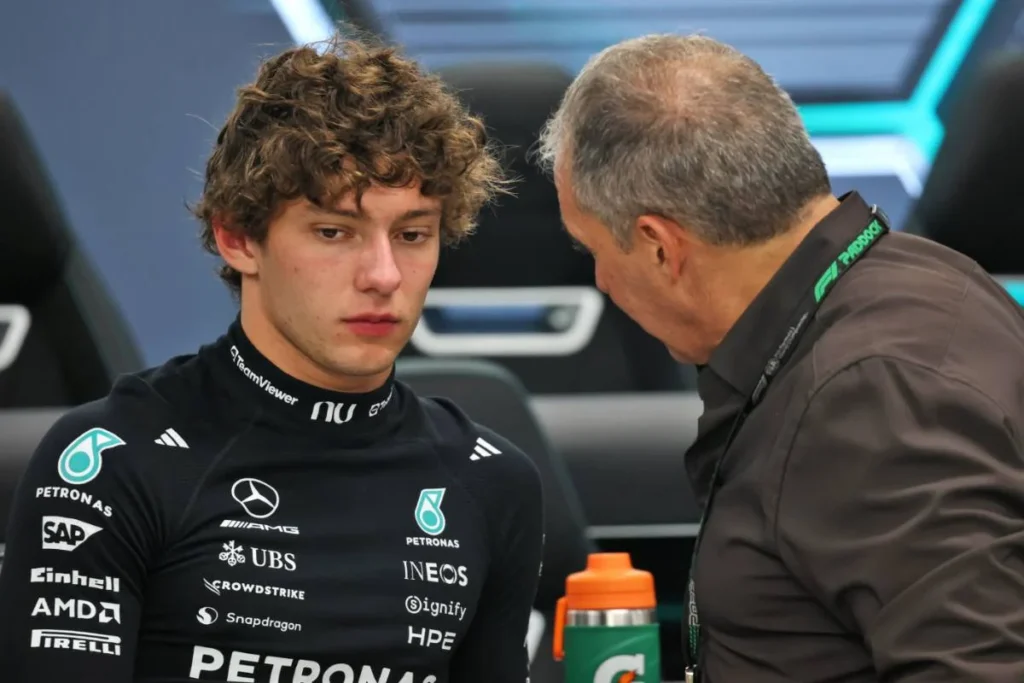
The Formula 1 paddock is rarely a place of total consensus, but the situation currently unfolding within the Mercedes-AMG Petronas garage in Singapore is creating a unique, high-stakes technical drama. As the sport descends upon the Marina Bay Street Circuit, the Brackley-based team finds itself locked in an internal investigation that could dictate the trajectory of their championship challenge.
Mercedes has entered the Singapore weekend with a split-development strategy, pitting their veteran hand, George Russell, against their championship-leading rookie, Kimi Antonelli. The results of the Sprint Qualifying session have laid bare a startling disparity: Russell, utilizing a refined version of the previous aerodynamic specification, finds himself on the front row, while Antonelli, equipped with the latest upgrade package introduced in Malaysia, is grappling with a car that appears to be fundamentally flawed in its current configuration.
The Chronology of a Split Weekend
The divergence in performance was evident from the moment the cars hit the asphalt for the singular Free Practice session (FP1). George Russell immediately signaled his intent, topping the timesheets and demonstrating a confidence in the W17 that has been somewhat elusive in recent outings. His pace was not a flash in the pan; it carried through into the high-pressure environment of Sprint Qualifying.
Russell secured a formidable second-place start for the Sprint race, narrowly trailing the relentless Max Verstappen. The qualifying session was a tactical chess match, with Verstappen opting for a single-lap glory run, while Russell pushed to extract maximum consistency from his machinery.
Conversely, Kimi Antonelli’s day was a study in frustration. The young Italian, who has been the revelation of the season, struggled to find a balance that allowed him to attack the demanding Marina Bay corners. Stuck in seventh place throughout both the practice session and the subsequent qualifying, the contrast between the two teammates was stark. While Russell was dissecting the circuit with surgical precision, Antonelli was fighting an unpredictable, nervous car that seemed to resist his every input.
Technical Analysis: The Upgrade Paradox
At the heart of this narrative is the decision by Mercedes engineering to conduct a live, track-side A/B comparison between two distinct aerodynamic philosophies. This is a rare move for a top-tier team, usually reserved for off-season testing or private filming days. However, the urgency of the championship battle has necessitated this "all hands on deck" approach.
The Russell Factor: Embracing the "Old"
George Russell’s success with the previous-spec W17 raises profound questions about the direction of the team’s development. By reverting to the older aero package, Russell has found a stable platform that allows him to exploit the mechanical grip of the car without the erratic aerodynamic shifts that have plagued the team’s latest updates.
"What we can confirm is that the previous version is certainly not bad," Russell stated during the post-qualifying media briefing. His words, while diplomatic, carry the weight of an indictment against the newer components. "As a team, we have no data suggesting the new parts shouldn’t work. But the stopwatch is the ultimate judge, and so far, the times with the new updates have not been competitive."
The Antonelli Struggle: Unlocking the New
For Kimi Antonelli, the weekend has been a sobering experience. The transition to the new aero package was expected to provide a performance leap; instead, it has provided a technical headache. The rookie has described the car as "extremely difficult" and "unpredictable."
The inability of the new package to generate consistent downforce—or perhaps, its tendency to stall at certain ride heights—has left Antonelli struggling to find a rhythm. The seven-tenths of a second gap to his teammate is an eternity in modern F1, and it highlights the sensitivity of the current ground-effect regulations. For a driver who has relied on supreme confidence to lead the standings, this technical uncertainty is a new and unwelcome variable.
Supporting Data and Performance Metrics
The telemetry from the Singapore street circuit paints a concerning picture for the development team back in Brackley.
- Cornering Speeds: Russell’s car, in the older configuration, demonstrates significantly higher mid-corner stability, allowing him to get on the throttle earlier in the exit phase of the tight Marina Bay sectors.
- Predictability: Antonelli’s car shows increased "snappiness" in the rear end during turn-in, indicating that the new aero package may be suffering from a center-of-pressure shift that is difficult for the driver to catch.
- The Seven-Tenths Deficit: The consistent 0.7-second gap throughout the day suggests that this is not a setup issue but a fundamental aerodynamic disparity. If the team cannot find a mechanical solution before the Sprint race, they may be forced to abandon the upgrade package entirely for the remainder of the weekend.
Official Responses and Tactical Outlook
The pressure on the Mercedes technical leadership is immense. Team Principal and engineering staff are currently working around the clock to analyze the correlation between the simulator data and the reality of the Singapore track.
Russell, while pleased with his own performance, is acutely aware of the tactical disadvantages of his starting position. "The grip difference between the left and right side of the grid is massive here," he explained. "Last year, those starting on the pole side had a significant advantage. My goal is to hold on to second place and manage the race from there."
Antonelli, meanwhile, is maintaining a stoic, if concerned, outlook. "I don’t really see where we can find seven-tenths of a second overnight, but this is Formula 1, and you never know what the data might reveal," he remarked. His focus has shifted from winning the Sprint to damage limitation—a vital skill for any championship contender.
Strategic Implications for the Championship
This internal development race carries massive implications for the remainder of the season.
- The Validation Crisis: If the older package continues to outperform the new one, Mercedes will face a difficult PR and technical reality. It would suggest that their wind tunnel correlation or CFD (Computational Fluid Dynamics) models are failing to capture the complexities of the current aero-elastic environment.
- The Rookie’s Resilience: How Antonelli handles this adversity will be a litmus test for his maturity. Facing a car that doesn’t work while his teammate excels is the ultimate challenge for a young driver. His ability to provide constructive feedback rather than succumbing to frustration will be crucial for the team’s recovery.
- Development Freeze or Pivot: The team must decide quickly whether to continue "polishing" the new package or to fully commit to the older spec for the rest of the season. A mid-season return to an older concept is a bold move, but one that could save their championship bid if the new updates prove to be a "dead end."
Conclusion: A Weekend of Reckoning
As the lights prepare to go out for the Sprint in Singapore, the eyes of the F1 world will be on the two Mercedes garages. Will George Russell be able to fend off the charging bulls of Red Bull Racing, or will he be swamped by the pack behind? And can Kimi Antonelli find a breakthrough in the dark, or will he be forced to battle in the midfield, potentially relinquishing his grip on the championship lead?
Mercedes stands at a crossroads. The data collected this weekend will be the most valuable they have possessed all season, but it comes at the cost of potential points and the peace of mind of their drivers. In the unforgiving world of Formula 1, there is no room for sentimentality in engineering. The stopwatch has spoken, and for Mercedes, the path forward must be defined by the hard, cold reality of what works on the track, not what looks best on a CAD screen. The Singapore Sprint is no longer just a race; it is the laboratory where the fate of the 2024 Mercedes season will be decided.
