

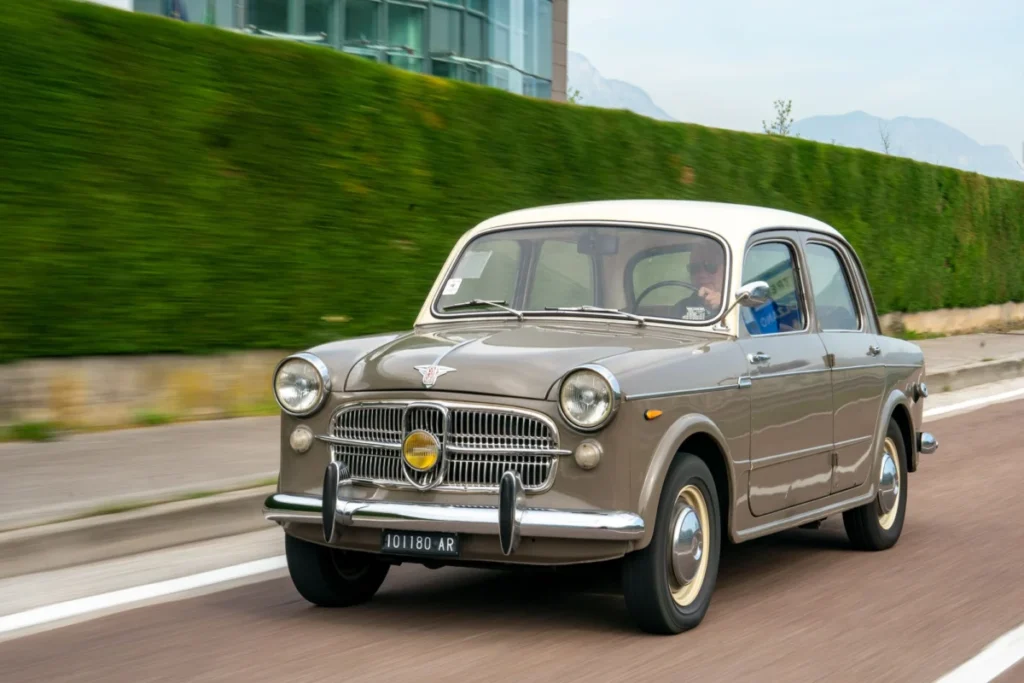
In the annals of automotive history, few collaborations are as intriguing yet overlooked as the partnership between the German manufacturer NSU and the Italian giant Fiat. While enthusiasts often focus on the iconic status of the Volkswagen Beetle or the elegance of Italian sports cars, the "Neckar" experiment represents a fascinating period of cross-border industrial synergy. Born out of financial necessity and geopolitical maneuvering, this cooperation saw the creation of vehicles that blurred the lines between German engineering heritage and Italian stylistic flair.
The Genesis of an Unlikely Partnership
The story begins in the picturesque town of Neckarsulm, situated at the confluence of the Neckar and Sulm rivers in Baden-Württemberg. Founded in 1873 in Riedlingen, the company originally produced knitting machines before relocating to Neckarsulm in 1880, rebranding as the Neckarsulmer Strickmaschinenfabrik Union—the origin of the acronym NSU.
By the late 19th century, the firm followed the trajectory of many industrial pioneers, pivoting toward the burgeoning mobility sector. Between 1885 and 1888, NSU expanded into bicycles and motorcycles. By the early 1900s, they had ventured into automotive manufacturing, initially producing chassis for luminaries like Daimler and Maybach, before launching their own branded vehicles in 1906.
However, the expansion of their manufacturing footprint—specifically the opening of a new plant in Heilbronn in 1926—coincided with a catastrophic economic downturn. By 1928, NSU faced a staggering loss of 14.8 million marks. The salvation of the company came from an unexpected quarter: Turin.

In 1929, Fiat, seeking to bypass German import tariffs and solidify its presence in the lucrative German market, acquired the rights to the NSU automotive brand and the Heilbronn facility. This marked the birth of NSU Automobil AG. While the motorcycle division remained at Neckarsulm, the automotive arm became a vital outpost for Fiat, effectively serving as an assembly hub for Italian-designed vehicles under a German identity.
A Chronology of Integration and Evolution
The integration of Italian design and German assembly was not immediate but methodical. Under the leadership of Italian executives like Guido Soria and Rambaldo Bruschi, who managed both the car and motorcycle wings of the company, the Heilbronn factory began producing vehicles that were essentially localized versions of Fiat’s lineup.
1929–1941: The Pre-War Era
The first "Germanized" Fiat was the 2.5-liter six-cylinder model, a near-perfect replica of the 1928 Italian Fiat 521. This was followed in 1931 by the NSU 10/52 PS, which eventually became the NSU-Fiat 2500, marking the first time the double-branded badge appeared on a production vehicle. This period established the blueprint for the company: a consistent output of Italian-designed models tailored to German tastes, which continued until 1941, when the onset of World War II forced the industry to pivot toward military production.
1953–1959: The Rise of the 1100/103
The post-war era saw the rebirth of the Heilbronn plant, which had been damaged by Allied bombing. The most pivotal vehicle of this reconstruction era was the 1100/103.

- 1953: The NSU-Fiat "Neue" 1100 enters production, synchronized with the Italian 1100/103 launch.
- 1955: The "Neckar" brand name is officially introduced, replacing the NSU-Fiat moniker to honor the local river and establish a distinct market identity.
- 1956: The lineup expands with the "Sport" coupe and cabriolet, designed by the Weinsberg coachbuilders.
- 1957: The launch of the "Neckar 58," a localized version of the Italian 1100/103 D.
- 1959: Introduction of the upgraded 1100 Lusso, leading to a confusing but fascinating rebranding where the base model simply became "Neckar."
Supporting Data: Engineering and Market Strategy
The "Neckar" vehicles were primarily built using the CKD (Completely Knock Down) method. Since the Heilbronn plant lacked heavy-duty machinery like deep-draw presses or rolling mills, the body components and mechanical assemblies were shipped directly from Turin. Workers in Heilbronn acted as master assemblers, ensuring that the final product met the rigorous standards expected by the German consumer.
The 1100/103 was a strategic masterpiece. It offered a 1.1-liter displacement that allowed it to compete directly with the Volkswagen Beetle, yet it boasted a modern, familial design that felt more sophisticated. Furthermore, the engine-gearbox unit, inherited from the pre-war NSU-Fiat 1100, was reliable and exceptionally easy to maintain, providing the "Neckar" with a significant competitive edge in terms of total cost of ownership.
Design Divergence
One of the most interesting aspects of the Neckar 58 was its aesthetic departure from the Italian original. While the Italian 1100/103 D featured a clean, minimalist grille, the German version retained a central fog lamp integrated into the grille, framed by a distinctive escutcheon. This design choice gave the vehicle a pseudo-aggressive, "Alfa Romeo-esque" front end, which resonated well with the German public’s preference for more expressive, robust styling.
Official Corporate Strategy and Responses
Throughout the 1950s, the relationship between Turin and Heilbronn was characterized by a push-and-pull of autonomy versus standardization. Fiat’s corporate communications often promoted these vehicles as "the 1100 of the 1958 model year," emphasizing the annual refinement cycles that were becoming standard in the automotive industry.

By contrast, the German entity—operating under the Neckar name—frequently made decisions that were not reflected in the Italian market. When the Italian 1100/103 H (the "Lusso") was launched with a more powerful engine and higher specifications, the Neckar version adopted the higher-end bodywork but opted to retain the older, lower-powered engine configuration. This decision was largely driven by a need to keep the entry price competitive in the German market, proving that the Neckar brand was not merely a passive assembly plant, but a marketing entity that understood its local demographic.
Implications: The Legacy of a Transnational Brand
The Neckar experiment offers profound implications for our understanding of the post-war European automotive landscape. It highlights three critical factors:
- Industrial Resilience: The partnership was born of a desperate need for financial stability and survived through two distinct eras—the pre-war push for industrial expansion and the post-war economic miracle.
- Cultural Localization: The "germanization" of the Fiat 1100 demonstrates that even in an era of globalization, successful product placement requires deep local knowledge. By rebranding as "Neckar," the company successfully detached itself from the "foreign" label of Fiat, allowing it to compete as a local German manufacturer.
- The Fading of the "Badge" Model: The history of Neckar reminds us that the automotive landscape was not always dominated by the massive, monolithic corporations we see today. It was a fluid landscape where brands were bought, sold, and repurposed across borders to facilitate market entry.
As the industry moves toward an era defined by electric vehicle platforms that are increasingly shared across global conglomerates, the story of the Neckar 58 serves as a poignant reminder of the early, analog days of platform sharing. It was a time when a car could be designed in Italy, built in Germany, and named after a river, creating a unique hybrid that captured the spirit of a recovering Europe.
Today, the Neckar models—whether the early NSU-Fiat variants or the later, more independent Neckar designs—are highly sought after by collectors. They represent a bridge between two automotive cultures, a testament to the ingenuity of engineers and businessmen who saw past borders to build machines that defined the middle-class mobility of a generation. The "forgotten" cooperation of Neckarsulm remains a cornerstone of automotive history, a lesson in how necessity can drive innovation and how identity can be successfully crafted through design and nomenclature.
