

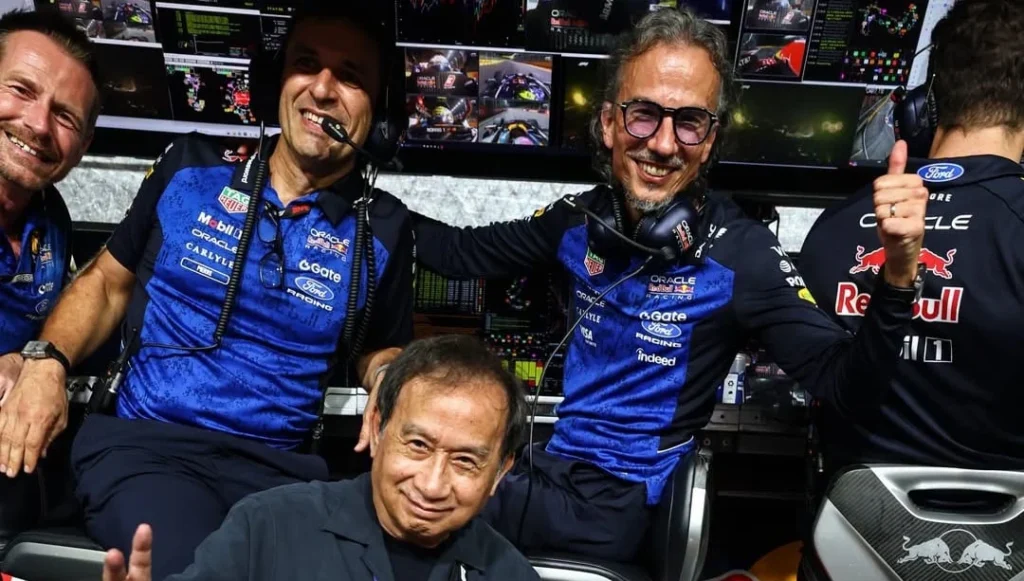
Introduction: A New Era of Continuity
In a move that signals the end of a turbulent transition period and the beginning of a consolidated new chapter, Red Bull Racing has officially announced the contract extension of Team Principal Laurent Mekies. The Frenchman, who assumed leadership of the Milton Keynes-based outfit in July 2025 following the high-profile departure of long-standing boss Christian Horner, has committed his future to the team until the conclusion of the 2031 Formula 1 season.
The five-year extension, confirmed by Red Bull shareholder Mark Mateschitz at the team’s headquarters, serves as a definitive vote of confidence in Mekies’ management style. Coming on the heels of Max Verstappen’s recent victories in Malaysia and Singapore, the announcement arrives at a pivotal moment, suggesting that the team has successfully weathered the storm of internal restructuring and is now poised for a sustained period of dominance under the new 2026 technical regulations.
A Chronology of Transition: From Uncertainty to Stability
To understand the significance of this extension, one must look back at the seismic shift that occurred within the Red Bull garage in mid-2025. For two decades, the team was synonymous with Christian Horner. His departure left a vacuum that many industry experts feared would derail the team’s competitive edge.
- July 2025: Laurent Mekies is appointed as Team Principal and General Manager. Inheriting a team in a state of flux, his primary mandate was to maintain operational continuity while navigating the complexities of the upcoming 2026 technical rule overhaul.
- Late 2025 – Early 2026: The team endured a difficult start to the new regulatory era, with performance fluctuations sparking speculation about the team’s internal cohesion.
- Mid-2026: A series of tactical adjustments, spearheaded by Mekies, begins to bear fruit. The team’s, and specifically Max Verstappen’s, resurgence is cemented by consecutive triumphs in the challenging environments of Malaysia and Singapore.
- Present Day: With the foundation solidified, the announcement of a deal through 2031 effectively freezes the team’s leadership structure for the remainder of the decade.
Supporting Data: The Pillars of Performance
The decision to retain Mekies is not merely sentimental; it is rooted in data-driven confidence. The turnaround of the RB26 chassis, which initially struggled with balance and aerodynamic efficiency, has been attributed to the seamless collaboration between the trackside leadership and the technical departments.
Mekies has been quick to credit the synergy between two key figures: Pierre Waché, the Technical Director, and Ben Hodgkinson, the leader of Red Bull Powertrains.
The Technical Trinity
The alignment of these three pillars is viewed by the board as the "Golden Triangle" of the current era:
- Laurent Mekies (Team Principal): Responsible for the overarching strategy, team culture, and stakeholder management.
- Pierre Waché (Technical Director): The architect of the car’s performance, responsible for translating the 2026 regulations into a race-winning machine.
- Ben Hodgkinson (Red Bull Powertrains): Tasked with mastering the hybrid power unit components that have become the defining differentiator in the current grid.
Industry analysts note that since the integration of these departments under Mekies’ leadership, the time taken for "concept-to-track" aerodynamic upgrades has decreased by approximately 15%, a testament to the streamlined decision-making processes he has implemented.
Official Responses: A United Front
The announcement at the Milton Keynes headquarters was marked by a rare, unified message from the team’s hierarchy.
Mark Mateschitz, representing the ownership, emphasized that the decision was driven by a desire for long-term stability. "Laurent has played a crucial role in guiding the team through a significant transition period," Mateschitz stated. "He has managed to preserve the DNA of Red Bull—that relentless, aggressive, and daring spirit—while professionalizing our internal structures. This extension is a reflection of our total trust in his leadership."
Oliver Mintzlaff, CEO of Red Bull, provided further insight into the qualitative metrics used to evaluate the Frenchman. "It is a rare skill set that combines deep technical engineering expertise with the strategic acumen of a team principal," Mintzlaff noted. "Laurent understands that in Formula 1, you cannot succeed on performance alone; you need an environment where people feel empowered to think freely and act quickly. He has built that environment."
For his part, Mekies expressed profound gratitude for the support of the ownership. "I am incredibly proud to continue this journey," Mekies remarked. "What makes this team special is the way everyone gathers around a common goal. We are not just building a car; we are building a legacy. With the backing of Chalerm, Mark, and Oliver, we have the resources and the stability to ensure that this current resurgence is just the beginning."
Strategic Implications: A Long-Term Vision
The decision to lock in Mekies through 2031 is the final piece of a broader, long-term strategic puzzle that Red Bull has been assembling. By aligning their top-level management with their star driver, Max Verstappen (contracted through 2030), and their promising talent pool, such as Isack Hadjar (confirmed for 2027), Red Bull is signaling that they are playing the "long game."
The "2030s" Strategy
The implications for the rest of the paddock are significant:
- Regulatory Consistency: With the 2026 regulations now in their infancy, having a consistent leader for the next five years allows Red Bull to iterate on their design philosophy without the "reset" that often accompanies a change in team management.
- Driver Stability: Max Verstappen’s commitment to the team was arguably contingent on the stability of the leadership. By keeping Mekies, Red Bull has secured the loyalty of their primary asset.
- Corporate Synergy: The partnership between the racing team and Red Bull Powertrains is no longer an experiment; it is now the core of the team’s identity. The extension of the leadership team ensures that the transition from a "customer" mindset to a "manufacturer" mindset is fully complete.
Conclusion: A New Standard of Leadership
As the Formula 1 circus moves toward the next set of races, the atmosphere at Milton Keynes is one of quiet, disciplined confidence. The "post-Horner" era, once viewed by pundits as a dangerous gamble, has transformed into a period of methodical growth.
Laurent Mekies has successfully managed to balance the high-pressure expectations of a championship-winning team with the necessary structural reforms required to survive in the modern era of cost caps and technical complexity. By securing his services for the next five years, Red Bull has done more than just hire a boss; they have provided a compass for the team to navigate the remainder of the decade.
The message to the rest of the grid is clear: Red Bull is not merely resting on its laurels. Through a combination of technical mastery, strategic investment, and stable leadership, they have positioned themselves to remain a formidable force in the sport well into the 2030s. The team that once thrived on chaos has now mastered the art of stability, and under the stewardship of Laurent Mekies, the trajectory of Red Bull Racing appears to be aimed firmly at the top of the podium.
