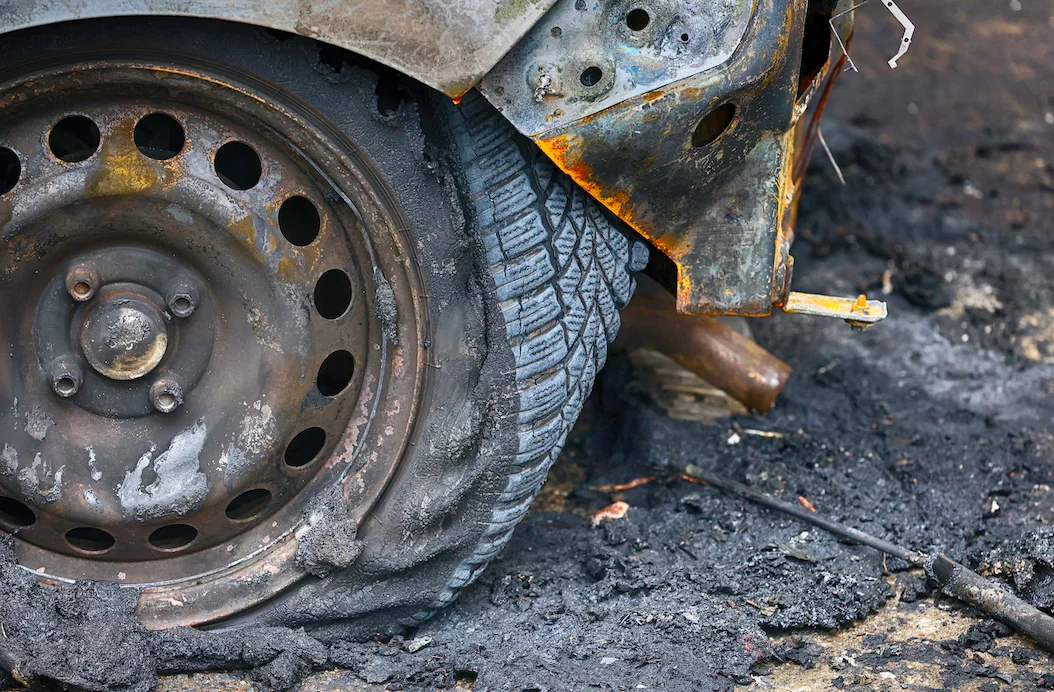
NANTES — For 18-year-old Romane, a student in osteopathy, May was a month of quiet triumph. Through a combination of her own hard-earned savings from odd jobs and the generous backing of her parents, she had finally purchased her very first car: a modest, reliable gray Ford Focus. For a young woman living away from home, studying in Nantes while hailing originally from the Somme department in northern France, that vehicle was far more than a mere mode of transportation. It was a lifeline, a symbol of newfound independence, and the vital bridge connecting her demanding academic life to the comforting embrace of her family.
Yet, in a matter of terrifying minutes on a Thursday afternoon, that hard-won independence was reduced to a heap of twisted, soot-stained metal. Caught in the volatile crosshairs of urban unrest during a high school blockade near the Lycée Carcouët, Romane’s car became collateral damage.
What could have been a devastating, isolating financial and emotional blow, however, evolved into a profound testament to community empathy. Within days of the incident, an organic web of solidarity swept across the region and the internet, turning a story of senseless destruction into an inspiring narrative of human kindness.
1. Main Facts: The Anatomy of a Senseless Loss
The incident unfolded on Thursday, October 1, against the backdrop of a student blockade at the Lycée Carcouët, located in the residential and sometimes turbulent Le Breil district of Nantes. High school blockades—frequently organized to protest educational reforms, economic pressures, or political grievances—occasionally attract fringe elements intent on escalating tensions. On this particular afternoon, those tensions boiled over onto the asphalt.
According to local reports compiled by France Bleu Loire Océan and regional media outlet Ici, a group of individuals shifted Romane’s parked Ford Focus, dragging it toward an already blazing barricade set up by demonstrators. Whether the car was targeted at random or specifically manipulated to fuel the flames remains a point of investigation, but the outcome was absolute. The vehicle was entirely engulfed by the fire, leaving behind nothing more than a charred, unrecognizable skeleton.
For Romane, the psychological impact was immediate and jarring. Initially believing her car had simply been towed due to a parking infraction—a stressful enough event for a cash-strapped student—she tracked the vehicle down, only to discover its true fate at the impound lot.
"That was when I truly realized I would never drive it again, that it was completely over. I was in total shock," Romane recounted to local journalists.
Inside the gutted cabin, there were no valuables to tempt a thief, but there were items of immense sentimental weight. Among the ashes were several compact discs—nostalgic mixtapes she used to listen to on repeat with her younger sister during childhood road trips. More than the physical objects, however, it was the erasure of her mobility that stung the most.
Remarkably, rather than harboring an overwhelming sense of blind rage toward the perpetrators, Romane expressed a deeper sense of disillusionment. "They didn’t stop to think that this might belong to a student who simply didn’t have the financial means to buy another one, and that really turned my stomach," she confided.
2. Chronology of Events: From Despair to Deliverance
To understand the magnitude of Romane’s turnaround, one must trace the timeline of her ordeal—a rapid descent into vulnerability followed by a breathtaking recovery through collective action.
Phase 1: The Destruction (Thursday, October 1)
- Morning: Romane parks her Ford Focus near the Lycée Carcouët to attend her classes or manage her daily routine, unaware that a student blockade is rapidly organizing in the immediate vicinity.
- Early Afternoon: Tensions flare at the blockade site. Protesters or opportunists move Romane’s vehicle, integrating it into or placing it directly adjacent to a burning barricade.
- Late Afternoon: Emergency services and police manage the unrest, but the car is beyond saving. It is towed away to a local impound lot as an unidentifiable burnt wreck.
Phase 2: The Shock and Realization (Friday, October 2 – Saturday, October 3)
- Romane discovers her car is missing. Assuming a standard municipal towing, she attempts to retrieve it.
- Upon arriving at the impound lot, she confronts the charred remains of the Ford Focus. The reality of the total loss sets in.
- Realizing she is insured only under a basic third-party policy (assurance au tiers), she learns that her insurance provider will offer zero financial compensation for the destruction of her vehicle. The financial gap to replace it appears insurmountable on an osteopathy student’s budget.
Phase 3: The Mobilization (Sunday, October 4 – Monday, October 5)
- Faced with the prospect of being stranded in Nantes, unable to visit her family in the Somme and struggling to commute to her university, Romane’s relatives intervene.
- Encouraged by her inner circle, she decides to launch an online crowdfunding campaign (cagnotte en ligne) using the popular French platform Leetchi.
- The financial target is set at €3,700—a calculated estimate required to purchase a reliable, roadworthy secondhand vehicle comparable to the one she lost.
Phase 4: The Wave of Solidarity (Tuesday, October 6 onward)
- The campaign goes live and immediately gains traction through social media shares and local word-of-mouth.
- Within days, dozens of contributors—ranging from family friends to complete strangers touched by news reports—pour funds into the digital kitty.
- By the end of the first week, the campaign not only meets its goal but surpasses it, breaking the €4,000 threshold with contributions from roughly 69 distinct donors.
3. Supporting Data and Financial Realities
The economic dimensions of Romane’s case highlight broader financial vulnerabilities faced by young adults and university students across France. Analyzing the numbers reveals why the loss of a sub-€4,000 vehicle can completely derail a young person’s education and independence.
- Vehicle Valuation: Romane’s Ford Focus, purchased in May, represented the upper limit of what an 18-year-old working part-time and relying on parental support could afford. In the French secondhand market, reliable first cars generally cluster around the €2,000 to €4,000 bracket—a segment heavily populated by older models requiring careful mechanical maintenance.
- Insurance Limitations: Opting for third-party liability insurance (responsabilité civile or assurance au tiers) is a common financial compromise for students. While it satisfies legal driving requirements and covers damages inflicted on others, it leaves the policyholder entirely unprotected against theft, vandalism, natural disasters, or arson. Upgrading to comprehensive coverage (tous risques) often doubles or triples annual premiums—an impossible luxury for many students.
- Crowdfunding Metrics:
- Target Amount: €3,700
- Final Amount Raised: Over €4,000
- Total Contributors: ~69 individuals
- Demographics of Donors: Roughly one-third of the contributors were completely anonymous individuals—local residents and internet users who read her story in regional press outlets like France Bleu and Ici.
- Attached Goodwill: Alongside financial contributions, dozens of messages of encouragement flooded the Leetchi page, offering emotional backing alongside monetary aid.
4. Official Responses and Institutional Context
The incident at the Lycée Carcouët ignited wider conversations among local authorities, educational administrators, and law enforcement regarding the methods and drift sometimes observed during high school demonstrations in urban centers.
Municipal and Law Enforcement Reactions
Local police prefectures and municipal authorities in Nantes have long grappled with the recurring phenomenon of transport blockades and peripheral delinquency. While peaceful demonstrations are a protected constitutional right in France, the escalation into property destruction—specifically targeting private citizens’ vehicles—draws sharp condemnation from civic leaders.
Law enforcement opened inquiries into the destruction of private property following the October 1 demonstrations. Investigators routinely review urban surveillance footage and social media uploads from protesters to identify individuals responsible for vandalism during blockades. However, identifying specific perpetrators in fast-moving, masked crowds remains a notoriously difficult challenge for prosecutors.
Educational Institution Standpoint
Administrators at the Lycée Carcouët, alongside regional education authorities (académie), routinely issue reminders concerning safety protocols around school perimeters during social movements. While recognizing the legitimate expression of student civic engagement, school boards have repeatedly stressed that collateral damage inflicted on working-class commuters, local residents, and fellow students undermines the core message of youth movements.
Social workers and student support services at Nantes universities also stepped up to offer guidance, highlighting the psychological toll that sudden property loss can inflict on out-of-town students already navigating the pressures of higher education.
5. Broader Implications: A Microcosm of Modern Urban Resilience
Romane’s ordeal and its heartwarming resolution serve as a powerful case study examining several overlapping themes in contemporary French society: the fragility of youth economic security, the double-edged sword of urban social protest, and the restorative power of digital-age solidarity.
The Vulnerability of the Working Student
For millions of young Europeans, the transition to university life coincides with a precarious financial balancing act. Rent, textbooks, utility bills, and transportation consume tightly budgeted resources. When an unexpected catastrophe strikes—be it a major health issue, a laptop theft, or the incineration of a first car—the safety net is often threadbare. Romane’s story underscores how deeply modern life relies on personal mobility, and how the destruction of a basic asset can instantly threaten a young person’s educational trajectory.
The Cost of Civil Unrest
France has a rich, storied tradition of public demonstration and civil disobedience. Blockades are frequently viewed by participating youth as a legitimate tactic to force institutional attention. However, incidents like the one at Lycée Carcouët provoke fierce debate over civic responsibility. When protests drift into gratuitous destruction affecting innocent bystanders—such as an 18-year-old osteopathy student from the Somme—they risk alienating public sympathy and turning community sentiment sharply against the demonstrators’ broader causes.
The Redemption of Digital Communities
Conversely, the rapid success of Romane’s Leetchi campaign highlights the positive potential of modern hyper-connectivity. In an era dominated by news cycles filled with division, cynicism, and conflict, peer-to-peer crowdfunding platforms act as digital conduits for instantaneous empathy.
When asked about the outpouring of support from people she had never met, Romane reflected a renewed sense of faith in her fellow citizens:
"When I saw how the fundraising campaign was growing, and that there were still good people out there—people who genuinely wanted to help and sent me messages wishing me courage—it made me feel so much better."
With the financial hurdle cleared and the crowdfunding campaign successfully wrapped up, Romane turned her attention back to the classified ads and second-hand dealerships of Nantes. Armed with her newly purchased replacement vehicle, she is once again ready to navigate the open road, bridging the distance between her academic ambitions in the Loire-Atlantique and her roots back home in the Somme—proving that even the ashes of a senseless fire cannot extinguish the resilience of a determined student backed by a compassionate community.