

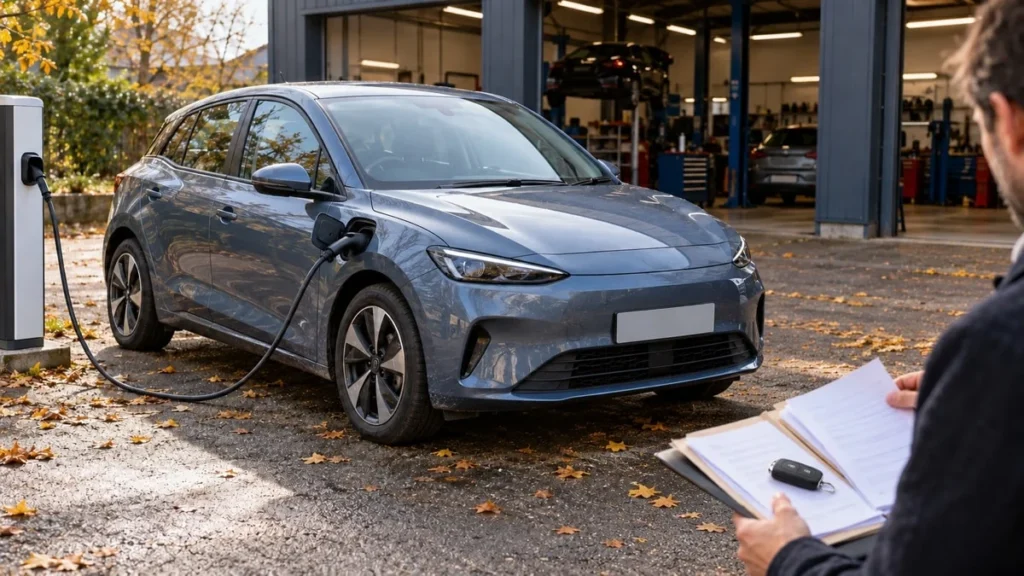
As the market for second-hand electric vehicles (EVs) continues to expand, buyers are increasingly looking for financial incentives to ease the transition away from internal combustion engines. In France, a specialized aid scheme operational since September 1, 2026, aims to bridge the affordability gap for used EVs. However, navigating the fine print is critical. A vehicle bearing a French license plate today does not automatically qualify for the grant; its administrative history, specifically its country of first registration, plays a decisive role.
Main Facts: Decoding the September 2026 Used EV Scheme
The financial incentive framework, formally established by the official decree of August 10, 2026, is designed to stimulate the circular economy of sustainable mobility. Yet, strict boundary conditions govern which automobiles can benefit from the financial support.
At the core of the eligibility criteria is the vehicle’s provenance. To qualify for the subsidy, an electric car must have been registered for the first time in France between January 1, 2023, and December 31, 2026 (note: while initial regulatory drafts pointed to older brackets, the operational parameters target specific generational windows). Consequently, any vehicle that was initially registered abroad—such as in Germany, Belgium, or Spain—and subsequently imported into France is strictly excluded from the scheme.
This exclusion applies regardless of the vehicle’s current administrative status or the nationality of the automotive brand. Two identical models of the exact same year, sitting side-by-side on a Parisian dealership lot with French registration plates, may face entirely different financial realities: one could be subsidized, while the other is completely ineligible due to its foreign genesis.
Furthermore, the mechanism relies on the Certificats d’Économies d’Énergie (CEE)—Energy Savings Certificates. Because the scheme is backed by energy operators rather than a universal direct government payout, the exact monetary value of the aid fluctuates depending on the chosen operator. Pleasingly for consumers, there are no stringent income-testing thresholds (means-testing) required to access the general variant of the dispositif.
Chronology: The Regulatory Timeline of the Incentive
Understanding how this policy came to be requires looking at the step-by-step evolution of French and European sustainable transport incentives:
- January 2017 – December 2023: The foundational manufacturing and initial registration window. Vehicles born during this period form the backbone of the eligible second-hand pool, ensuring that buyers target relatively modern battery technologies without destabilizing the brand-new car market.
- August 10, 2026: The official publication of the landmark decree establishing the CEE-based financial framework for pre-owned electric cars.
- September 1, 2026: The official rollout date. From this point forward, buyers navigating the second-hand market can formally apply for the deduction through accredited professionals.
- January 1, 2027 & July 1, 2027: Critical terminal dates for the enhanced social mobility variants (detailed below). Operations for the home-care worker majoration must be engaged prior to January 1, 2027, and fully finalized by July 1, 2027.
Supporting Data: Eligibility Matrix and Technical Requirements
To make an informed purchase, buyers must cross-reference their target vehicle against a strict matrix of technical and administrative conditions.
The Administrative Filter: Three Scenarios
| Vehicle History | Eligible for the Subsidy? |
|---|---|
| First registration in France within the legal date parameters. | Yes, subject to fulfilling all other technical and procedural requirements. |
| First registration abroad (e.g., Germany), followed by a later importation into France. | No. The location of the initial registration disqualifies the vehicle, despite current French plates. |
| First registration in France, but outside the eligible date window (e.g., too early or too late). | No. The vehicle falls outside the chronological boundaries set by the decree. |
Technical and Transactional Guardrails
Beyond the paperwork, the vehicle and the buying process must clear several technical hurdles:
- Powertrain Restrictions: The vehicle must be 100% electric. Hybrid, plug-in hybrid (PHEV), and internal combustion engine (ICE) vehicles are entirely excluded.
- Professional Intermediary: The purchase or long-term rental must be processed through an authorized automotive professional. Peer-to-peer (C2C) transactions between private individuals do not qualify for the CEE-backed premium.
- Battery Health Integrity: The battery pack must meet strict performance thresholds. It must retain a State of Health (SoH) of at least 80%, or demonstrate a residual real-world autonomy of at least 200 kilometers, or maintain at least 80% of its original homologated range. Buyers are strongly advised to demand diagnostic certification from the seller.
- Commitment Period: The buyer must retain ownership of the vehicle for a minimum of three years. For leasing arrangements (such as Location avec Option d’Achat or Location Longue Durée), the contract must stipulate a non-tacit minimum duration of three years.
Official Responses and Targeted Support: The Home-Care Worker Majoration
While the general scheme is open to all buyers regardless of income, the French government has integrated targeted measures to support essential workers.
In collaboration with social solidarity ministries, the government has reinforced support for mobility within the home-care and personal-service sectors (aide à domicile). According to official portals such as Service-Public.fr, eligible professionals can access a significantly boosted variant of the aid, valued at approximately €2,000 per vehicle.
However, this majoration introduces its own set of constraints:
- The target vehicle must carry a total sticker price (including VAT and battery) of no more than €25,000.
- The vehicle’s mass in running order (masse en ordre de marche) must remain under 1,800 kg.
- Strict scheduling applies: transactions must be initiated before January 1, 2027, and concluded prior to July 1, 2027.
Public authorities stress that these specific caps apply only to the enhanced professional tier and should not be conflated with the general market rules, which do not impose a strict universal vehicle price ceiling of €25,000 for regular buyers.
Implications: What Buyers and Sellers Must Do Next
The introduction of this scheme shifts the dynamics of the French used car market. For dealerships, transparency regarding vehicle imports is no longer optional; it is a core selling point. For consumers, the primary takeaway is simple: never assume a car is subsidized just because it is electric and registered in France.
Essential Questions to Ask Before Signing
Before putting pen to paper or transferring deposits, buyers should secure written confirmation from the vendor addressing the following points:
- What is the exact country of first registration recorded on the vehicle’s original historical papers (the carte grise history)?
- Does the vehicle possess a certified battery health diagnostic proving an 80% State of Health or equivalent range retention?
- Is the selling entity an authorized professional capable of processing CEE-linked deductions?
- What is the finalized price after the specific CEE operator has validated the subsidy for this exact dossier?
The golden rule of the 2026 used EV market is clear: the price to compare is the final sum you will actually pay out of pocket, backed by written guarantees. A vehicle that appears to be a bargain at first glance may quickly lose its financial appeal once its international administrative history is fully brought to light.
