

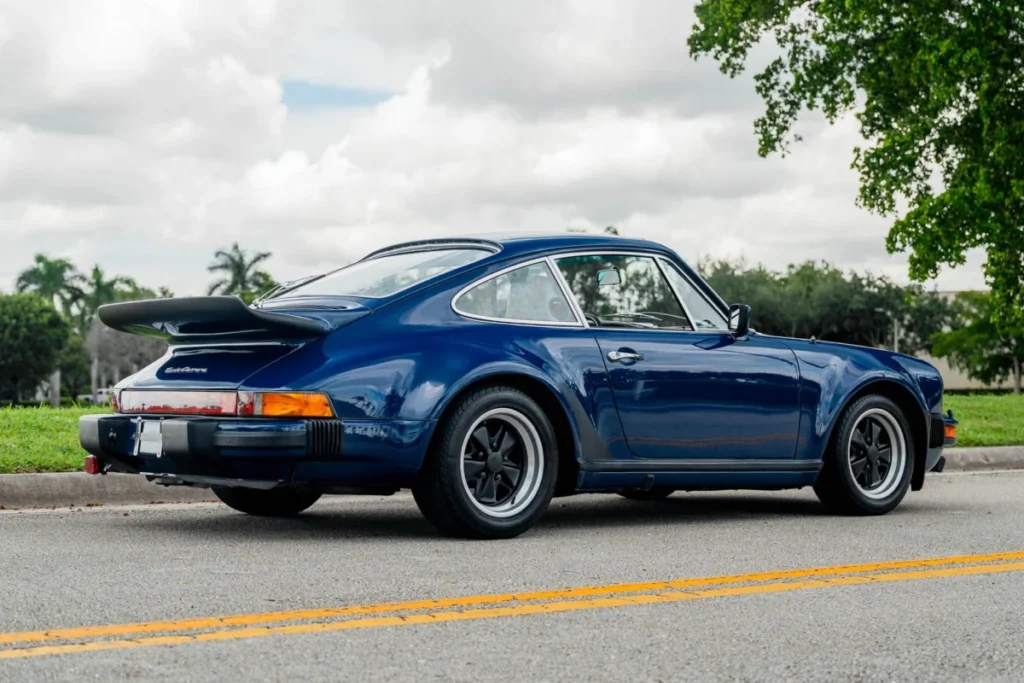
In the pantheon of air-cooled sports cars, few names command the immediate reverence—and healthy trepidation—of the original Porsche 911 Turbo, internally designated as the Type 930. Introduced to the world at the 1974 Paris Motor Show and arriving in North America for the 1976 model year, the 930 forever changed the landscape of high-performance road cars.
Now, a remarkably preserved and uniquely configured 1976 Porsche 930 Turbo Carrera has emerged on the collector market. Originally delivered new in Massachusetts, repatriated from Germany in 2026, and presently residing in Florida with a clean Arkansas title, this classic supercar showcases an extraordinary "Paint-to-Sample" specification. Showing 59,000 miles on the odometer and boasting a documented history including a 2013 engine top-end rebuild, this iconic early-production Turbo offers a fascinating blend of vintage analog terror and bespoke collector appeal.
Main Facts
At the heart of this classic machine is a turbocharged 3.0-liter air-cooled flat-six engine. In 1976 spec, this powerhouse was factory-rated at a formidable 245 horsepower and 253 lb-ft of torque. Power is managed by a robust four-speed manual transaxle, routing force exclusively to the rear wheels. To help harness this output, the original buyer wisely ticked the option box for a limited-slip differential.

Visually, the car sets itself apart immediately through its factory-ordered Paint-to-Sample Albert Blue exterior finish. This striking hue is complemented by a matching leather-to-sample gray interior, marking it as a distinctly bespoke build from an era when custom ordering was far less common than it is today.
Key equipment and specifications include:
- Chassis & Exterior: Iconic "whale tail" rear spoiler, front spoiler, power sunroof, H4 headlights with washers, fog lights, and a rear window wiper.
- Wheels & Brakes: Staggered 15-inch Fuchs alloy wheels wrapped in classic-profile Pirelli Cinturato P7 tires, paired with four-wheel ventilated disc brakes.
- Interior & Electronics: Reupholstered leather-to-sample gray cabin, a three-spoke steering wheel framing VDO instrumentation (including a 180-mph speedometer and a 6,700-rpm redline tachometer), and a modern Porsche Classic Communication Management (PCCM) head unit that blends vintage aesthetics with modern connectivity.
- Documentation: Accompanied by a Porsche Certificate of Authenticity confirming its rare factory colors, equipment, and production lineage.
Chronology of the 930 Turbo Carrera
To understand the significance of this specific 1976 model, one must examine the timeline of how Porsche brought turbocharging from the race track to the public highway.

1972–1974: From Can-Am Dominance to Paris Debut
Porsche’s domination of sports car racing in the early 1970s—specifically through turbocharged 917s in the North American Can-Am series and the 911-derived Carrera RSR Turbo—proved that forced induction was the future. In 1974, Porsche applied these lessons to a production road car, previewing the 911 Turbo at the Paris Motor Show. By 1975, series production was underway in Stuttgart.
1976: North American Introduction and "Turbo Carrera" Badging
For its inaugural model year in the United States (1976), the car was officially marketed as the Porsche Turbo Carrera. Because federal regulations and distribution timelines dictated early nomenclature, these initial cars hold a special place among purists. Massachusetts welcomed this specific Albert Blue example new off the showroom floor, where it began its multi-decade journey across the American landscape.
2013: Mechanical Rejuvenation
With decades of road use behind it, the car underwent a significant mechanical milestone in 2013 when its turbocharged 3.0-liter flat-six received a comprehensive top-end engine rebuild, ensuring the longevity and health of its matching-numbers powerplant.

2026: Transatlantic Repatriation and Current Offering
In a fascinating twist of modern car collecting, the vehicle crossed the Atlantic Ocean, being acquired out of Germany by a specialized dealer acting as a Bring a Trailer (BaT) Local Partner. Now located in Florida and offered with a clean Arkansas title, the 59,000-mile supercar stands ready for its next custodian.
Supporting Data & Market Analysis
The market for early 930 Turbos—particularly those produced between 1976 and 1977—has experienced a dramatic maturation over the last two decades. Once viewed simply as expensive, intimidating used sports cars, they are now recognized as foundational pillars of collector car portfolios.
| Feature / Metric | Specification |
|---|---|
| Model Year | 1976 |
| Engine Type | Turbocharged 3.0-Liter Air-Cooled Flat-Six |
| Horsepower | 245 hp @ 5,500 rpm |
| Torque | 253 lb-ft @ 4,000 rpm |
| Transmission | 4-Speed Manual Transaxle |
| Exterior Paint | Paint-to-Sample Albert Blue |
| Interior Trim | Leather-to-Sample Gray |
| Odometer Reading | 59,000 Miles |
| Key Upgrades | Porsche Classic Communication Management (PCCM) |
The inclusion of the Porsche Classic Communication Management unit reflects a growing trend among elite collectors: the desire to enjoy modern conveniences—such as Bluetooth connectivity and satellite navigation—without disrupting the authentic aesthetic of a classic dash. Furthermore, the presence of the original Porsche Certificate of Authenticity provides verifiable proof of its rare color combination, safeguarding its future valuation.

Official Responses and Expert Perspectives
Automotive historians and classic Porsche specialists have long regarded the early 3.0-liter 930s with a mix of awe and caution. Unlike the later 3.3-liter intercooled models introduced in 1978, the 1976 Turbo Carrera possesses a notoriously abrupt power delivery curve.
"The early non-intercooled 3.0-liter cars are raw, unfiltered driving experiences," notes one marque expert. "When the turbo spooled up, boost hit like a sledgehammer. Combined with the short wheelbase and rear-engine layout, it earned the moniker ‘The Widowmaker’ for a reason. But in terms of historical significance and pure aesthetic drama, nothing else from the 1970s comes close."
Regarding the car’s rare finish, restoration experts emphasize that Paint-to-Sample (PTS) options on 1970s Porsches exponentially elevate a vehicle’s desirability. Albert Blue, a deep and moody shade that shifts character depending on ambient light, transforms an already aggressive shape into an understated, sophisticated cruiser until the throttle is pinned.

Implications for Collectors and the Classic Market
The appearance of this 1976 Porsche 930 Turbo Carrera on the market highlights several broader trends within the high-end automotive hobby:
- The Premium on Bespoke History: Standard-production guards red or silver 930s will always have a following, but factory Paint-to-Sample cars command significant premiums. Collectors increasingly prioritize uniqueness and original factory documentation.
- Global Arbitrage and Repatriation: The fact that this car spent time in Germany before returning to the United States underscores the borderless nature of top-tier car collecting. Enthusiasts and dealers frequently scour international markets to source rare, historically significant specifications.
- Usability Meets Preservation: With 59,000 miles on the clock, a documented top-end rebuild, and modern interior amenities like the PCCM unit, this car strikes an ideal balance. It is not an ultra-low-mileage museum prisoner trapped in delivery plastic, nor is it a neglected project; it is a sorted, driver-quality classic meant to be experienced on the open road—provided its next pilot treats the throttle with proper respect.
As the hammer prepares to fall on this Albert Blue icon, it serves as a rolling reminder of an era when turbocharging was an untamed art form, and Porsche was busy writing the rulebook for modern supercars.
