

Introduction
In the intricate tapestry of industrial history, few corporate odysseys are as poetic, unexpected, and profoundly successful as that of Yamaha. Founded in 1887 by a visionary watchmaker and medical equipment repairman named Torakusu Yamaha, the company began its life not surrounded by the smell of gasoline and burning rubber, but by the quiet focus of acoustic tuning, crafting reed organs and pianos. That foundational musical DNA—rooted in precision, resonance, and an acute sensitivity to the harmony between creator and instrument—remains deeply embedded in the identity of the group, persisting long after its dramatic diversification into industrial machinery, electronics, and, most famously, motorcycles.
When Yamaha Motor Co. was officially spun off in 1955, it entered the transportation sector not as a tentative newcomer, but with the confidence of an established artisan. Its very first machine, the YA-1—a sleek, maroon-painted 125cc two-stroke often affectionately nicknamed the "Red Dragonfly"—did not merely limp onto the market. In a display of engineering foreshadowing, it swept its maiden competition at the Mount Fuji Ascent Race. This victory instantly established the tripartite corporate philosophy that would define Yamaha for the next seven decades: relentless performance, unyielding reliability, and an innate, rhythmic connection to the rider.
Today, Yamaha stands as a towering monolith of Japanese engineering. It is a brand that seeks to seduce the widest possible audience—from daily urban commuters to white-knuckled Grand Prix racers—without ever succumbing to technical or emotional blandness. This comprehensive retrospective explores how an enterprise born from the breath of music became a titan of mechanical power.
1. Main Facts: The Pillars of Yamaha’s Industrial Empire
To understand Yamaha is to comprehend a rare corporate duality: the coexistence of high-art acoustics and hardcore motorsport engineering. The company’s global footprint is vast, spanning marine propulsion, robotics, power equipment, and personal mobility. Yet, it is within the realm of two-wheelers that Yamaha’s soul truly resides.
The Musical Heritage Meets Mechanical Might
Yamaha’s logo—a geometric arrangement of three intersecting tuning forks—is a constant reminder of its origins. The expertise required to shape a soundboard for a grand piano or to wind strings to exact tension demands an obsession with materials science, vibration, and harmonics. When Yamaha engineers transitioned to internal combustion engines, they brought this acoustic sensitivity with them. To this day, Yamaha remains one of the few manufacturers that treats exhaust notes and engine pulsations not as a byproduct of combustion, but as an intentional acoustic composition.
Engineering Philosophy: Emotion Through Precision
Japanese engineering is frequently stereotyped as clinical, hyper-rational, and devoid of soul. Yamaha actively defies this trope. While machines like the YZF-R1 or the Ténéré 700 are triumphs of computer-aided design, metallurgy, and wind-tunnel testing, they are calibrated for the human nervous system. Yamaha designs its motorcycles to act as extensions of the rider’s body. The throttle response, chassis feedback, and weight distribution are tuned to evoke an emotional response, bridging the gap between cold calculation and visceral passion.
2. Chronology: From the Reed Organ to the Electric Horizon
The timeline of Yamaha is marked by bold pivots, technological breakthroughs, and an unquenchable thirst for competition.
1887–1954: The Acoustic Genesis
- 1887: Torakusu Yamaha successfully repairs a broken reed organ in Hamamatsu, Japan, inspiring him to build the first Japanese reed organ.
- 1897: Nippon Gakki Co., Ltd. (later renamed Yamaha Corporation) is established, expanding piano and organ production.
- 1900: Yamaha produces its first upright pianos, followed by grand pianos in 1902, establishing a reputation for uncompromising craftsmanship.
1955–1979: The Birth of the Motorcycle and Racing Dominance
- 1955: Yamaha Motor Co., Ltd. is separated from the musical instrument division. The 125cc two-stroke YA-1 is launched.
- 1956: The YA-1 triumphs again, sweeping its classes in both the Mount Fuji and Asama Highland races, proving the brand’s competitive viability immediately.
- 1960s: Yamaha enters international Grand Prix motorcycle racing. The brand quickly becomes a force to be reckoned with, securing its first world championships and cementing its legendary status at grueling events like the Isle of Man TT.
- 1970: Introduction of the legendary Yamaha XS-1, the company’s first four-stroke motorcycle, featuring a 650cc parallel-twin engine that wins the hearts of purists worldwide.
1980–2009: Technological Revolutions and Iconic Lineups
- 1985: The debut of the Yamaha V-Max, a muscle cruiser powered by a revolutionary liquid-cooled V4 engine featuring "V-Boost," forever changing the landscape of high-performance straight-line motorcycles.
- 1998: The unveiling of the YZF-R1. This liter-class supersport completely redefines open-class motorcycle design by stacking the gearbox vertically and horizontally, drastically shortening the wheelbase and offering razor-sharp handling that shocks competitors.
- 2004: Launch of the YZF-R1 with under-seat exhaust and breakthrough fuel injection, dominating superbike racing globally.
2010–Present: Diversification, Crossplane Engines, and Electrification
- 2015: Introduction of the MT-09 and MT-10 featuring revolutionary Crossplane Crankshaft (CP3 and CP4) technology, bringing MotoGP-derived engine architecture to the naked street bike market.
- 2020s: Yamaha shifts toward sustainable mobility, introducing advanced electric scooters like the E01 while investing heavily in autonomous systems, drone propulsion, and marine innovation.
3. Supporting Data: The Anatomy of Yamaha’s Diversity
Yamaha’s market strength lies not in a single product, but in an extraordinarily diverse portfolio that balances utility, recreation, and luxury.
A Snapshot of Product Diversification
- Supersport & Track: Led by the track-bred YZF series (R1, R7, R3), which translates championship-winning MotoGP technology directly to dealership floors.
- Hyper Naked: The MT ("Master of Torque") series—ranging from the nimble MT-03 to the torque-monster MT-10—has consistently topped European and Asian sales charts by offering aggressive styling and unmatched real-world usability.
- Adventure & Off-Road: The Ténéré 700 has redefined the middleweight adventure segment, proving that rugged durability and mechanical simplicity often outperform bloated, over-electronified competitors.
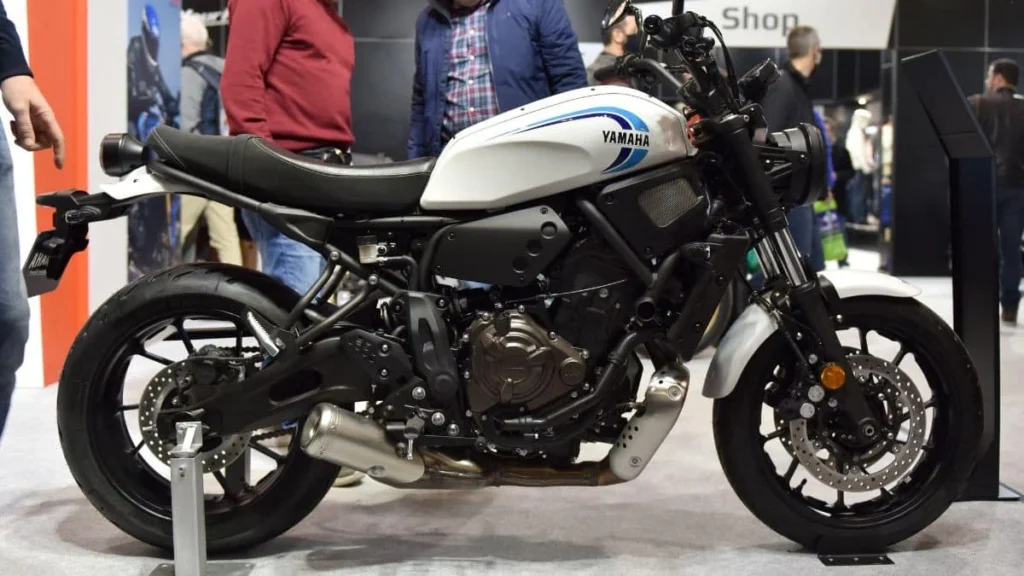
- Cruisers & Sport Heritage: The XSR range merges retro styling with modern performance, appealing to riders nostalgic for the classic aesthetics of the 1970s and 80s.
- Scooters & Urban Mobility: From the ubiquitous NMAX to the three-wheeled Tricity (utilizing Leaning Multi-Wheel technology), Yamaha dominates urban commuting spaces.
R&D and Innovation Metrics
Yamaha consistently reinvests a substantial percentage of its annual revenue into Research and Development. This capital is not restricted to internal combustion engines; it fuels advanced robotics, marine outboard motors (where Yamaha is a global market leader), industrial drones used in precision agriculture, and clean-energy research.
4. Official Perspectives: Inside the Yamaha Mindset
To gain insight into the corporate philosophy driving Yamaha, one must look to statements from its executive leadership and chief engineers down through the decades.
The Philosophy of Kando
Central to Yamaha’s corporate vocabulary is the Japanese concept of Kando—a word that defies direct translation but roughly means "simultaneous feelings of deep satisfaction and intense excitement we experience when we encounter something of exceptional value."
In official corporate releases, Yamaha executives frequently emphasize that their vehicles are not merely tools for conveyance.
"Our mission is not simply to build machines that move people from point A to point B," explains a senior Yamaha mobility strategist. "We build machines that stimulate the senses. When a rider throws a leg over a Yamaha, they should feel an immediate alignment between their own heartbeat and the rhythm of the motor. If a machine does not evoke Kando, we have not completed our work."
Racing as an Open-Air Laboratory
Unlike manufacturers that view motorsport purely as an advertising expense, Yamaha’s engineering division treats the racetrack as an unforgiving, accelerated laboratory.
"Racing is where we test the absolute limits of human endurance and material science," notes a veteran Yamaha MotoGP development engineer. "The lessons learned on the asphalt of Sepang or the gravel traps of Phillip Island find their way into the commuter scooter you ride to work or the adventure bike you take across the desert. Competition strips away ego; it forces you to find the purest, most efficient path to performance."
5. Implications: The Electric Future and the Preservation of Soul
As the global automotive and motorcycle industries face an existential crossroads characterized by tightening emissions regulations and the relentless march toward electrification, Yamaha finds itself at a fascinating juncture.
Navigating the Electric Transition
The challenge for traditional motorcycle manufacturers is profound: internal combustion engines possess a visceral character—vibration, acoustic crescendo, mechanical complexity—that is notoriously difficult to replicate in an electric powertrain. Yet, Yamaha is tackling this challenge head-on.
With projects like the E01 electric scooter and ongoing research into compact, high-output electric motors, Yamaha is proving that electric mobility does not have to be sterile. By leveraging its deep expertise in torque delivery and chassis dynamics, Yamaha aims to infuse its electric offerings with the same agile, playful character that defines its petrol-powered fleet. Furthermore, the company is exploring hydrogen combustion engines in partnership with other Japanese manufacturers, signaling that the soul of the internal combustion engine may find a clean-burning lifeline in the decades to come.
Beyond the Road: Autonomous Systems and Robotics
Yamaha’s diversification strategy ensures that its future is not tied solely to the whims of the personal vehicle market. The company’s autonomous unmanned helicopters (such as the RMAX series) have revolutionized agricultural spraying across Asia and the Americas. Its golf cars, industrial robots, and electric wheelchair propulsion units demonstrate a holistic commitment to mobility in all its forms.
The Eternal Orchestration
Despite these futuristic horizons, the core identity of Yamaha remains unchanged. Whether designing a titanium exhaust valve for a liter-class superbike, tuning the suspension of an adventure tourer, or crafting the action of a concert grand piano, the underlying principle is identical.
Each Yamaha possesses its own distinct voice, functioning like a specialized instrument within a vast mechanical orchestra. The brand successfully embodies an engineering of controlled pleasure—concocting motorcycles that serve as instruments of freedom, rhythmically nuanced and perfectly attuned to every tempo of modern pilotage. As the world accelerates into an unpredictable tomorrow, Yamaha remains firmly anchored in its rhythm, proving that true mechanical power is most potent when it is born from the breath of art.
