

Main Facts
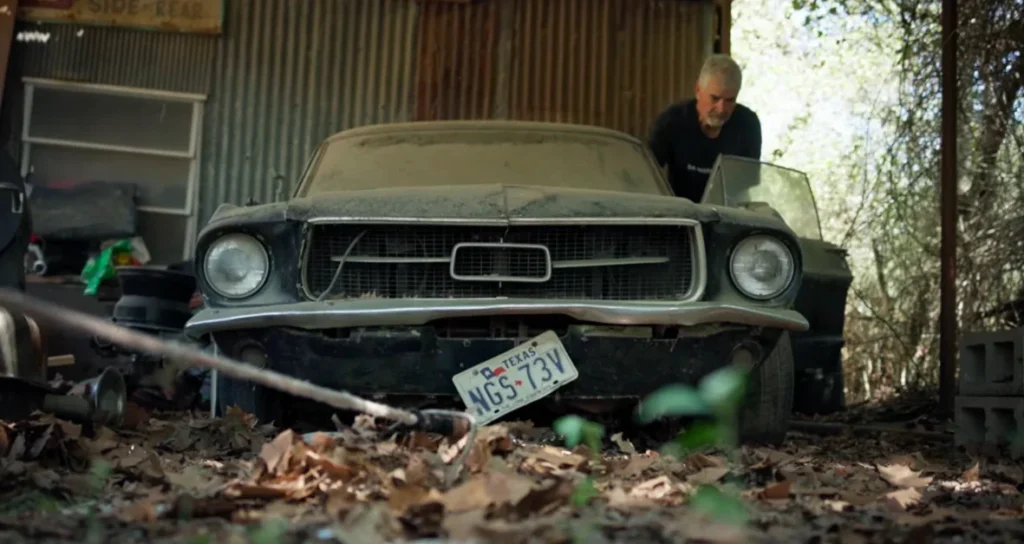
In the quiet corners of automotive lore, few discoveries capture the imagination quite like the "barn find." However, the latest project brought to light by Lance and Wyatt Bush of the popular YouTube channel RESTORED transcends the traditional definition of a dusty classic. For more than four decades, a classic 1967 Ford Mustang coupe languished in the dark, debris-strewn confines of an aging hotel’s garage. It was not merely parked; it was entirely colonized by a thriving population of rodents that transformed the iconic pony car into a multi-room residential complex and an industrial-scale pantry.
When the YouTube mechanics finally secured the green light to extract the vehicle, they found an astonishing 14 kilograms (nearly 30 pounds) of chickpeas meticulously stashed throughout the cabin, trunk, and even beneath the rear seat bench. Yet, beneath the layers of accumulated filth, rodent nesting materials, and decades of environmental decay lay a legendary machine: a 1967 Ford Mustang, a coveted model year that saw 472,121 units roll off the production lines, boasting an authentic Mexican-block small-block V8 engine.
What makes this specific resurrection remarkable is not just the condition of the car, but the visceral, step-by-step documentation of its revival. Captured in the satisfying, methodical style of mechanical ASMR, the process challenged conventional automotive wisdom: Can a vintage V8 engine that has sat dormant for forty years truly be brought back to life without a complete, ground-up teardown? The Bush brothers set out to answer that exact question, turning a rusted relic into a breathing, rolling piece of American automotive history.
Chronology of a Rescue
The journey of the 1967 Mustang from a forgotten roadside fixture to a functioning classic reads like a cinematic redemption arc. For Lance Bush, the car was practically a phantom limb of his childhood; he had passed the exact same rusting coupe from his school bus window more than thirty years prior, watching it slowly sink into the mud with its tires flattened into unnatural geometric shapes and its windows rendered entirely opaque by accumulated grime.
Phase One: Extraction and Initial Assessment
Upon arrival, the scene was the quintessential picture of automotive abandonment, surrounded by high weeds and detritus. Surprisingly, the extraction proved "suspiciously fluid." Despite decades of immobility, the wheels still rotated, and the brakes miraculously remained unseized—a rare stroke of luck for a vehicle left to the elements for over forty years. Loaded onto a trailer, the Mustang was hauled directly to the workshop to face the harsh light of professional mechanical inspection.
Phase Two: Breathing Life into the V8 Small Block
Under the hood, the Mexican-spec small-block V8 presented a daunting challenge. With open spark plug wells that had invited moisture for decades, the interior of the cylinders was far from pristine. Inserting an endoscope camera revealed heavy surface rust in the primary cylinder, alongside the skeletal remains of a long-dead spider.
Opting to avoid an immediate, full engine teardown, the mechanics flooded the combustion chambers with Evapo-Rust. After allowing the chemical agent to work its magic, they gently applied leverage to the crankshaft until free rotation was achieved. A subsequent compression test revealed wildly erratic readings—ranging from a healthy 140 psi down to a dismal 65 psi—due to severely stuck valves.
The team engineered a clever solution: introducing compressed air into the cylinders while simultaneously tapping the valve springs with a mallet. This successfully unseated the valves, clearing the path for a tentative first ignition attempt. Complete with spectacular backfires and a seized distributor that required localized heating to adjust ignition timing, the vintage V8 finally sputtered to life, engulfing the workshop in a thick, triumphant cloud of smoke.
Phase Three: Fuel, Fluids, and Fire
With the engine running, the next hurdle was keeping it alive. The cooling system leaked from virtually every orifice, with the water pump pouring water as though designed to do so. The team replaced the worn-out pump and installed a brand-new radiator to ensure stable temperatures during testing.
The fuel system presented an even greater biological and chemical challenge. The original gas tank was filled with a solidified, tar-like substance, while the fuel lines were completely choked with rust and debris. A brand-new fuel tank, thoroughly cleaned fuel lines, and a temporary auxiliary carburetor allowed the V8 to idle smoothly for over fifteen minutes, ensuring proper oil circulation throughout the block. Meanwhile, the completely dry automatic transmission initially refused to engage any gear. A simple application of ATF (Automatic Transmission Fluid) poured directly into the transmission filler neck coaxed the dormant gearbox back to life, successfully transferring power to the rear wheels.
Phase Four: Braking, Exhaust, and Aesthetics
The final mechanical frontier was the braking system—the aspect every classic car restorer dreads most on a long-immobilized vehicle. Predictably, pressing the brake pedal resulted in it sinking straight to the floorboard. The team replaced all four wheel cylinders and the master cylinder, followed by a rigorous hydraulic bleed to restore stopping power.
The rotting, corrosion-eaten exhaust system was excised with a reciprocating saw and replaced with long-tube headers and a modern Flowmaster exhaust system, instantly restoring the unmistakable, deep rumble of a classic pony car. Under the rear bench seat, the massive rodent nest packed with remaining chickpeas was entirely eradicated to clear space for the new exhaust hangers.
Finally came the visual metamorphosis. The layer of grime on the windshield and rear glass was so thick it required manual scraping before the vehicle could even endure a high-pressure wash. Mounted on a set of gleaming Magnum 500 wheels, the rehabilitated 1967 Mustang finally emerged from its decades-long hibernation, its classic lines restored and ready to write a brand-new chapter on the open road.
Supporting Data & Technical Specifications
To fully appreciate the scope of the RESTORED channel’s project, it is essential to examine the technical foundation of the vehicle and the constraints of the restoration process:
- Vehicle Model: 1967 Ford Mustang Coupe.
- Production Context: The 1967 model year was a watershed moment for the Mustang, representing the first major redesign of the first-generation pony car, with a total production volume reaching 472,121 units.
- Engine Architecture: Equipped with an authentic Mexican-block small-block V8, renowned among classic Ford enthusiasts for its higher nickel content in the casting, making the block significantly stronger than its standard American counterparts.
- Biological Debris Volume: Approximately 14 kilograms (30 pounds) of stored chickpeas and organic rodent nesting material removed from the cabin, trunk, and structural cavities.
- Restoration Metrics:
- Initial cylinder compression variance: 65 psi to 140 psi (normalized post-valve liberation).
- Sustained idle time achieved during initial fluid circulation: 15+ minutes.
- Key component replacements: Water pump, radiator, fuel tank, fuel lines, master cylinder, all four wheel cylinders, and the complete exhaust system.
Official Responses & Community Reactions
The resurrection of the "Rat Hotel Mustang" has sparked widespread discussions across automotive forums, enthusiast platforms, and digital media channels like AutoEvolution.
Industry commentators have praised the restraint shown by Lance and Wyatt Bush. Rather than stripping the car down to a bare metal chassis—a path that often results in stalled projects sitting in workshops for years—the creators opted for an operational revival. By prioritizing mechanical functionality first, they demonstrated that internal combustion engines possess a remarkable resilience, often capable of overcoming decades of neglect with targeted chemical intervention and old-fashioned mechanical ingenuity.
Viewers of the RESTORED channel have particularly lauded the ASMR-style presentation. In an era dominated by hyper-edited, fast-paced automotive content, the slow, deliberate pace of rust removal, fluid flushing, and the eventual raw audio of the V8 engine firing up provided a deeply satisfying viewing experience. Classic car purists have also expressed relief that another piece of 1960s American automotive heritage was saved from the crusher, proving that even a vehicle used as a rodent pantry can find its way back to the asphalt.
Implications for the Classic Car Community
The successful revival of this 1967 Ford Mustang carries several significant implications for the broader classic car and "barn find" culture:
- Shift Toward Operational Preservation: This project highlights a growing preference within the hobby for preserving patina and mechanical authenticity over pristine, over-restored "trailer queens." Bringing a car back to life while retaining its historical battle scars is becoming an increasingly celebrated art form.
- Advanced Chemical Solvents in Revival: The use of modern rust-dissolving agents (such as Evapo-Rust) and endendoscopic inspection tools proves that backyard mechanics can now diagnose and solve internal engine seizures without immediately resorting to expensive machine shop overhauls.
- The Economic Reality of Forgotten Classics: As prime barn finds become scarcer, vehicles previously written off as total losses—due to heavy biological contamination or severe environmental exposure—are being re-evaluated. Projects like this demonstrate that sheet metal and cast iron are remarkably durable, and with patience, persistence, and the right fluids, almost any automotive icon can be coaxed back from the brink of extinction.
