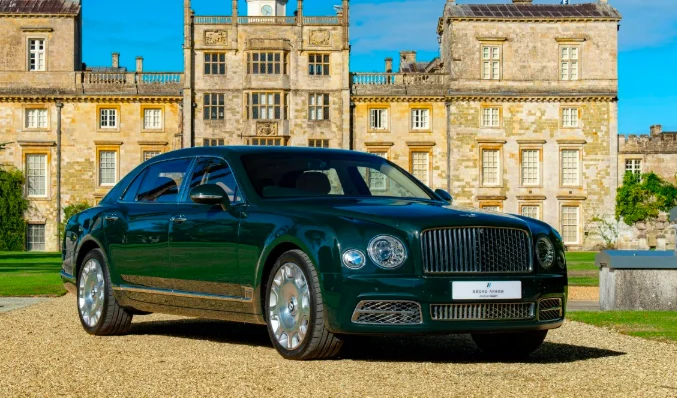
In the rarefied world of high-end automotive auctions, the provenance of a vehicle is often the primary driver of its value. While a standard 2016 Bentley Mulsanne Extended Wheelbase (EWB) might struggle to fetch more than €70,000 on the secondary market—a victim of the brutal depreciation curves typical of ultra-luxury limousines—a specific, dark-green example recently took center stage at Broad Arrow Auctions. This was no ordinary vehicle; it was the personal transport of the late Queen Elizabeth II.
Despite an aggressive pre-auction estimate of between €400,000 and €450,000, the vehicle remained unsold during the Global Icons: Zoute Online auction in October 2026. This unexpected outcome has ignited a debate among collectors and market analysts alike: what is the true price of history when it is stripped of its most intimate royal signatures?
The Anatomy of a Sovereign’s Carriage
The vehicle in question, bearing the registration plate DG66 OKM, is a masterclass in bespoke British engineering. Manufactured at the historic Crewe factory, this Mulsanne EWB was one of only two long-wheelbase limousines commissioned specifically for the Queen by the Bentley Press and Special Vehicles Department.
Under the hood lies a formidable 6.75-liter twin-turbocharged V8 engine, capable of producing 530 horsepower. Yet, during its tenure in the Royal Mews, this powertrain was rarely pushed to its limits. In the context of royal duties, the vehicle was primarily used for slow-speed processions, often moving at a stately pace of no more than 9 mph (15 km/h).
The interior was a sanctuary of discretion and comfort. Outfitted with Twine and Cumbrian Green leather, Burr Walnut woodwork, and lambswool rugs, the cabin was designed to shield the monarch from the public gaze with rear privacy curtains. Perhaps the most poignant feature was a bespoke modification to the front center armrest: it had been removed to accommodate a custom-built tray, designed specifically to hold the Queen’s signature Launer London handbag.
A Chronology of Royal Service
The life of this Bentley is inextricably linked to the final years of Queen Elizabeth II’s reign. Delivered in October 2016, the car entered the service of the Royal Mews, serving as a silent witness to some of the most significant moments of the late monarch’s twilight years.
- 2016–2019: The Active Years. The Bentley became a fixture at high-profile engagements. It was present at the British Champions Day at Ascot, the centenary celebrations of the GCHQ, the funeral of the Countess Mountbatten, and the 2018 London Fashion Week. It even carried the Queen to the birthday celebrations of motor racing legend Jackie Stewart.
- 2019–2022: The Return to Crewe. Following its three-year service period, the vehicle was returned to Bentley Motors. It was retained by the manufacturer as part of their corporate heritage collection, remaining in their care until after the Queen’s passing in September 2022.
- 2024: Transition to Private Ownership. In March 2024, the vehicle was sold to a private collector through Bentley’s Certified Pre-Owned program. Since then, it has appeared at prestigious events, including the Hampton Court Concours d’Elegance, where it earned accolades from the Bentley Drivers Club.
- October 2026: The Auction Block. Entered as Lot 121 in the Global Icons: Zoute Online sale, the car failed to meet its reserve price, leaving the automotive world to wonder if the market for royal provenance has reached a saturation point.
The Paradox of "Royal Provenance"
To understand why this Bentley failed to sell, one must look at the tension between "royal utility" and "royal intimacy." Before the auction, the vehicle underwent a significant transformation. At the request of the Royal Household, the most personal elements of the car were removed. The royal crests, which had been elegantly inlaid into the woodwork, were stripped away. The bespoke Launer handbag tray was replaced with a standard, factory-issue armrest.
For a collector, the value of such a vehicle lies in its status as a time capsule. By removing the physical markers of the Queen’s presence, the car was effectively "de-royalized." While it remains a unique specimen—as the only other Mulsanne EWB built for the Queen is held permanently in the Bentley heritage collection and will never come to market—the modification process may have diminished the emotional connection potential bidders felt toward the machine.
Market Data and Comparative Analysis
The auction results for royal vehicles are notoriously inconsistent, reflecting a niche market driven as much by sentiment as by asset valuation.
| Vehicle | Owner/Connection | Sale Price (Approx.) |
|---|---|---|
| 1985 Ford Escort RS Turbo | Princess Diana | €800,000 |
| 2006 Range Rover L322 | Queen Elizabeth II | €220,000 |
| 2016 Bentley Mulsanne EWB | Queen Elizabeth II | Unsold (Est. €450k) |
The comparison to Princess Diana’s Ford Escort is particularly revealing. While the Bentley is a far more sophisticated and expensive piece of engineering, the Escort achieved nearly double the expected value of the Mulsanne. Analysts suggest that the "Diana factor"—the intense public fascination with the life and tragic death of the Princess of Wales—often generates a fervor that the more stoic, institutional image of Queen Elizabeth II does not always command in the auction room. The Queen’s vehicles are viewed as symbols of duty and tradition, whereas vehicles associated with Diana are seen as intimate artifacts of a modern icon.
Implications for the Future of Royal Collectibles
The failure to sell the Mulsanne does not necessarily indicate a decline in the value of royal memorabilia, but rather a maturation of the market. Buyers are becoming increasingly discerning. They are no longer willing to pay a massive premium simply for a vehicle that was "used" by a royal; they are looking for the soul of the vehicle.
Furthermore, the "depreciation cliff" of the Bentley Mulsanne segment is a formidable force. Even with royal provenance, the technical complexity and high maintenance costs of a 10-year-old V8 limousine act as a deterrent to investors who do not view the car as a long-term keeper.
Broad Arrow Auctions and the consignor now face a difficult decision: keep the car in hopes that its scarcity will drive interest in a private sale, or re-list it with a more modest estimate that reflects the current reality of the collector car market.
The Sovereign’s Passion for Driving
It is worth noting that this Bentley was more than just a carriage for the monarch; it was a testament to her lifelong love affair with the automobile. Despite her royal status, Queen Elizabeth II was famously hands-on, frequently driving herself across her estates. She only stopped driving on public roads at the age of 92, and only then upon the firm advice of her medical team.
This car represents the final chapter of that passion—a transition from a car she would have driven herself to one that was strictly a chauffeured environment. The fact that the vehicle exists at the intersection of British industrial excellence and royal tradition ensures that it remains an important piece of history. Whether it finds a new home for €400,000 or substantially less, it will remain a silent, elegant witness to the end of a second Elizabethan age.
As the dust settles on the Global Icons auction, the Mulsanne remains parked, waiting for the right buyer—someone who values not just the leather and the engine, but the quiet, dignified history that once filled its cabin. The market may be hesitant today, but history, in the long run, rarely loses its luster.