

Date: October 5, 2026
Category: Industry Analysis / European Energy Strategy
Main Facts
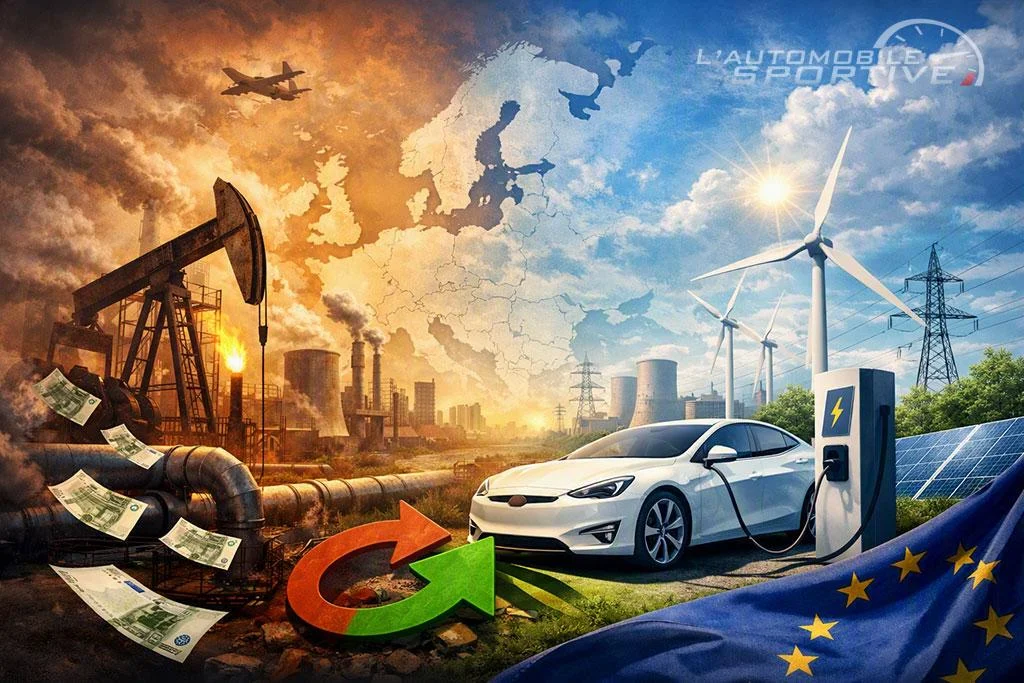
The transition toward electric vehicles (EVs) in Europe is routinely framed as an environmental imperative aimed at slashing transportation-related carbon emissions to meet strict climate targets. However, an analysis of the continent’s macroeconomic, energy, and industrial landscape reveals that climate policy is only part of the equation.
Behind the progressive phase-out of the internal combustion engine (ICE) lie critical energy security vulnerabilities, intense global trade competition with China and the United States, and high-stakes industrial maneuvering. While a greener future remains a central goal, the European Union’s aggressive push for electrification is fundamentally an exercise in continental sovereignty. By moving away from imported crude oil and toward locally produced electricity, Europe is attempting to restructure its entire energy framework—even as it confronts new dependencies on foreign critical minerals and battery supply chains.
Chronology of the European EV Transition
- Pre-2020: European automotive policy focuses primarily on incremental fleet-wide tailpipe emissions reductions, with traditional manufacturers relying heavily on diesel technology to meet targets.
- 2020–2022: The economic fallout of the COVID-19 pandemic and the outbreak of the war in Ukraine brutally expose Europe’s extreme vulnerability to international fossil fuel markets. Energy prices skyrocket, accelerating political momentum for domestic energy independence.
- Late 2022: Washington passes the Inflation Reduction Act (IRA), deploying massive subsidies to lure EV, battery, and clean-energy supply chains to the United States, intensifying global industrial competition.
- 2024: Data indicates that the European Union’s dependency on imported crude oil and petroleum products hovers at a staggering 96.6%, underlining the fragility of its transport infrastructure.
- 2025: Facing economic pressures and industrial strain, the European Commission launches the €1.8 billion "Battery Booster" program to fortify the local battery value chain. In December 2025, the Commission introduces regulatory flexibility regarding emissions standards, pivoting from a rigid ban to a target demanding a 90% reduction in tailpipe emissions by 2035, with the remaining 10% offset via mechanisms like low-carbon steel, e-fuels, and biofuels.
- October 2026: Debates intensify across the continent over whether European automakers can successfully close the technological and cost gap with surging Chinese competitors while managing high domestic energy costs.
Supporting Data and Energy Realities
To understand why Europe is transforming its automotive sector at breakneck speed, one must look closely at its energy balance sheet.
The Oil Import Trap
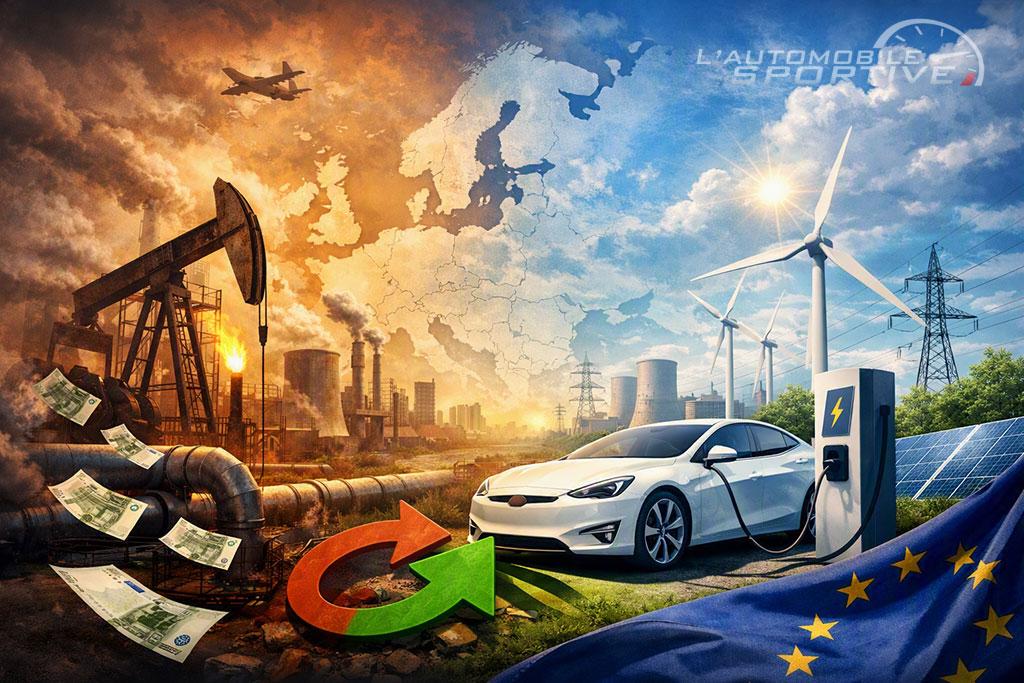
In 2024, the EU’s dependency rate on imported crude oil and refined petroleum products reached approximately 96.6%. Traditional gasoline and diesel vehicles lock the European economy into a permanent reliance on a global commodity market where Brussels has virtually no control over major producers, global output volumes, or primary shipping routes. Geopolitical instability in distant regions triggers immediate spikes at fuel pumps from Lisbon to Helsinki.
Efficiency Gains and Energy Demand
Electric motors are vastly superior to internal combustion engines in terms of thermodynamic efficiency, converting a far higher percentage of input energy into kinetic motion. Over an equivalent distance, an EV requires significantly less final energy than its ICE counterpart. The International Energy Agency (IEA) notes that the widespread adoption of EVs is already acting as a crucial drag on global oil demand within the road transport sector.
The Power Price Paradox
However, this transition introduces a new set of economic hurdles. According to International Monetary Fund (IMF) data, energy prices in Europe remain notably higher than those in the United States. This structural disadvantage penalizes energy-intensive industries—including automotive assembly lines, steel mills, and battery gigafactories. For electrification to succeed, Europe must rapidly expand its generation capacity, modernize its electrical grids, and keep power prices globally competitive.
Official Responses and Policy Shifts
The regulatory landscape governing European transport has undergone significant recalibration to balance ecological ambition with industrial survival.
For years, mainstream media and political rhetoric distilled the policy down to a simple slogan: "Europe is banning internal combustion engines in 2035." However, regulatory realities have necessitated a pragmatic shift.
Recognizing the mounting pressure on traditional European manufacturers—who are struggling against low-cost Chinese imports and massive American green subsidies—the European Commission adjusted its approach in late 2025. The revised 2035 framework targets a 90% reduction in tailpipe emissions rather than an absolute zero-emission mandate for every single new vehicle. The remaining 10% can be offset through certified mechanisms utilizing e-fuels, advanced biofuels, and low-carbon steel.
This policy evolution proves that Brussels is attempting a difficult tightrope walk: maintaining aggressive decarbonization timelines while safeguarding a beleaguered domestic industrial base from premature collapse.
Implications: A Shift in Dependencies
The most profound implication of Europe’s automotive transformation is that electrification does not erase dependency; it merely relocates it.

From Hydrocarbons to Critical Minerals
By shrinking its appetite for crude oil, Europe simultaneously expands its demand for raw materials essential to EV production. Lithium, graphite, nickel, cobalt, and copper are non-negotiable inputs for modern traction batteries. Because the mining and refining of these critical minerals are heavily concentrated outside of Europe—frequently dominated by China—the continent risks trading a dependency on petro-states for a new vulnerability centered on mineral suppliers and advanced electronic components.
The Geopolitical Battleground
The global auto industry has transformed into a high-stakes industrial battleground. China commands a dominant position across virtually every tier of the EV value chain, from raw material processing to cell manufacturing. Backed by a vast domestic market, Chinese automakers have scaled rapidly and driven down costs.
Meanwhile, American protectionism and state-aid packages under the IRA have forced Europe to frantically subsidize its own ecosystem. The European Commission’s €1.8 billion "Battery Booster" initiative represents an acknowledgment that if Europe loses the battery sector, it loses control over the core value driver of future mobility.
Divergent National Realities
It is inaccurate to speak of a single, homogenous European transition. Member states possess vastly different energy mixes. France, benefiting from a robust, largely decarbonized nuclear energy fleet, enjoys structurally favorable conditions for mass electrification. Other nations relying on fossil-heavy power generation face a much steeper carbon hill to climb, proving that the localized environmental impact of an EV depends heavily on where and how its battery is charged—and manufactured.
Conclusion
Framing the European electric vehicle transition strictly as an environmental crusade is dangerously reductionist; dismissing ecology as a mere political pretext is equally short-sighted.
The reality is a complex convergence of climate action, energy security, and industrial strategy. For a century, European mobility was powered by a resource the continent largely lacks: petroleum. The ongoing revolution offers a pathway toward an energy system fueled by locally generated electricity—whether from nuclear, hydro, wind, or solar sources.
Yet, the ultimate success of this gamble depends on whether Europe can secure its critical mineral supply chains, lower domestic industrial energy costs, and out-innovate fierce global competitors. Behind the quiet hum of the electric motor lies nothing less than a battle for Europe’s economic and industrial sovereignty.
Related News & Updates
-
[Read More] The End of Costly Batteries? GM Prepares an Alternative to LFP
Battery costs remain a primary barrier to EV mass adoption. To slash expenses, major automotive players are racing to develop novel chemistry alternatives… Read full article -
[Analysis] Electric Vehicles: Is It Already Too Late to Catch Up with China?
Has Europe missed the EV boat? As China firmly cements its dominance across the entire battery value chain, European policymakers grapple with an unprecedented industrial deficit… Read full article -
Passion vs. Reason: What is the Real Cost Difference?
In enthusiast circles, fuel consumption is the eternal debate when considering a high-performance sports car versus an efficient daily driver. We break down the real-world financial impact… Read full article
