

In the late 1990s, the European automotive landscape was undergoing a seismic shift. The traditional sedan and hatchback were being systematically dismantled by the rise of the compact MPV (Multi-Purpose Vehicle), a segment ignited by the runaway success of the Renault Mégane Scénic. As the French manufacturer redefined family mobility, the executives at Fiat in Turin found themselves at a crossroads: should they chase the leader with a derivative clone, or should they bet the company’s reputation on an radical, industry-defying vision?
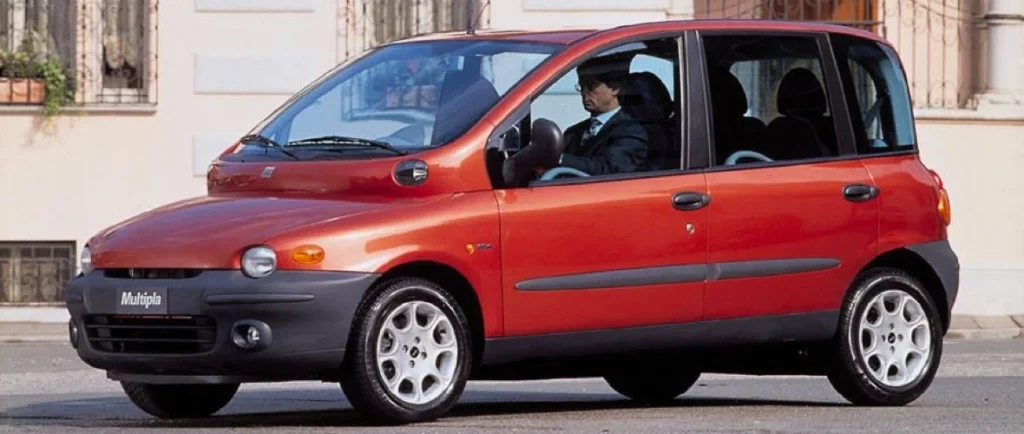
Fiat chose the latter. Entrusting the project to the Centro Stile and the visionary designer Roberto Giolito, the company embarked on a "vertiginous" mission: to reinvent family habitability within a footprint of less than four meters. The result was the 1998 Fiat Multipla—a masterpiece of interior engineering trapped within one of the most polarizing and ridiculed body shells in automotive history.
The Architectural Genesis: A 3×3 Revolution
To understand the Multipla, one must abandon the conventional automotive design process. Under Roberto Giolito’s guidance, the engineering team worked from the "inside out," prioritizing the human experience over aerodynamic styling.
The Logic of Width
The primary constraint was length; at only 3.99 meters, a standard four-seat layout would have compromised cargo space. Fiat’s solution was a masterclass in lateral thinking: they increased the vehicle’s width to a staggering 1.87 meters. This width, unprecedented for a compact city car, allowed for the installation of two rows of three identical, individual seats.
The interior was a marvel of ergonomic cleverness. By elevating the gear lever onto the dashboard and eliminating the traditional transmission tunnel, Fiat created a perfectly flat floor. The central front seat was shifted slightly backward, ensuring the driver had full range of motion while maintaining the intimacy of a six-passenger cabin.
The Bubble Effect
The Multipla’s interior felt less like a car and more like a futuristic glass conservatory. With an exceptionally low beltline and near-vertical side windows, the cabin was flooded with natural light, providing a panoramic visibility that remains unmatched even by today’s standards. The seats were not merely chairs; they were modular, foldable, and removable components that could turn the cabin into a mobile lounge or a light commercial vehicle in seconds.
This functional excellence was so profound that in 1999, the Museum of Modern Art (MoMA) in New York included the Multipla in its "Different Roads: Automobiles for the Next Century" exhibition. It was a formal acknowledgment that, despite its exterior, the Multipla had solved the riddle of urban space optimization.
Chronology: From Concept to Cult Status
- 1996: Fiat unveils the "Multipla" concept car, signaling a radical departure from traditional aesthetics.
- 1998: The production model is launched at the Frankfurt Motor Show. Critics are immediately baffled by the "bead" design.
- 1999: The Multipla is displayed at the MoMA, cementing its status as an engineering icon in design circles.
- 2004: Following sustained low sales outside of Italy, Fiat performs a drastic restyling, removing the controversial front end.
- 2010: After twelve years, the Multipla is officially retired, replaced by the more conventional Fiat 500L.
- 2020–Present: The vehicle experiences a massive resurgence in popularity as a "cult classic," with prices for pristine Phase 1 models steadily climbing.
Supporting Data: The Cost of Courage
The Multipla’s commercial performance provides a case study in the dangers of prioritizing function over form. While it was a resounding success in its home market of Italy—where families and taxi drivers embraced its practicality—the global market was less forgiving.
| Metric | Phase 1 (1998–2004) | Phase 2 (2004–2010) |
|---|---|---|
| Sales Strategy | Bold, avant-garde design | Conventional, "safe" design |
| Global Reception | High ridicule, niche loyalty | Indifference, sales stagnation |
| Key Advantage | Unbeatable packaging | Better brand alignment |
| Market Outcome | Commercial failure | Continued decline |
The data reveals a stark truth: the "Phase 2" model, which stripped away the car’s unique character, performed even worse than the original. By making the car "normal," Fiat inadvertently removed the only reason a buyer might choose a Multipla over a more reliable or stylish competitor.
Official Responses and Public Backlash
Fiat’s marketing department was acutely aware of the "Multipla problem." Rather than shy away from the criticism, they leaned into it with a series of daring, self-deprecating advertisements. One famous campaign featured the slogan: "You don’t have to be beautiful to be brilliant."
Despite these efforts, the court of public opinion was merciless. The front fascia, which featured a distinct "bead" (a horizontal crease) just below the windshield that housed the high-beam headlights, was mocked relentlessly. It was compared to everything from a mutant duck to a bewildered dolphin. British automotive media, in particular, made a sport of ranking the Multipla as the "ugliest car in the world."
The psychological impact of the design was such that many potential customers could not get past the first five seconds of observation. The car became a social litmus test: to drive a Multipla was to signal that one cared more about the welfare of their passengers and the efficiency of their commute than the vanity of their image.
Implications: The Legacy of the "Ugly" Genius
The story of the Fiat Multipla is more than a footnote in automotive history; it is a profound lesson on the limitations of market-driven design. It stands as a testament to the fact that, in the automotive industry, the "eye" often dictates the wallet.
The Triumph of Substance
Decades after its launch, the Multipla has been vindicated. As urban centers become more crowded and the need for space-efficient transport grows, the Multipla’s "3×3" layout is increasingly seen as a missed opportunity rather than a design folly. Modern micro-mobility solutions often mimic the very principles that Giolito pioneered in the late 90s.
The Cultural Shift
Today, the Multipla occupies a unique space in pop culture. It is no longer viewed as a "failed" car, but as an object of affection. It represents a time when a major manufacturer was brave enough to risk its reputation on an idea that was genuinely innovative.
In an era where many modern cars are criticized for being homogenous, indistinguishable blobs of aerodynamic efficiency, the Multipla stands out as a beacon of personality. It is the ultimate paradox of modern engineering: a vehicle that was technically perfect, yet socially unacceptable. Its legacy serves as a poignant reminder that while design must be functional, it must also resonate with the human desire for beauty—or, at the very least, a design that does not invite ridicule.
The Multipla was, in every sense, ahead of its time. It dared to prioritize the human condition inside the cabin, only to be rejected by the cold, judgmental gaze of the world outside. Ultimately, history has moved on, and the Multipla has moved from the pages of "worst cars" lists to the pantheon of design legends, where it sits—as it always did—in a class of its own.
