By Hugues Chaussin
Originally featured in Gazoline (Issue No. 351)
Main Facts: The Short, Sweet Life of a French Sun-Seeker
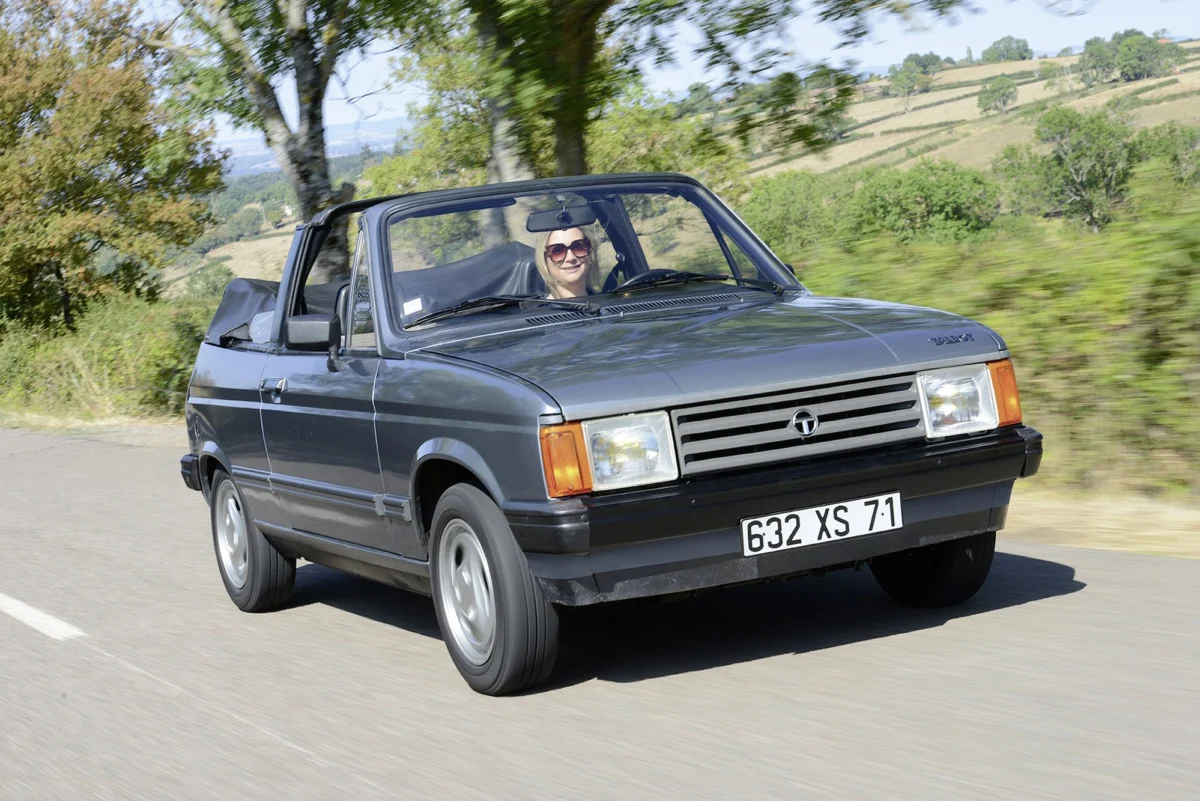
When the jovial Talbot Samba dropped its top to greet the first warm rays of spring in 1982, it instantly multiplied its allure. Conceived as a youthful car for a youthful demographic, the latest offspring bearing the DNA of the storied Simca brand appeared utterly uninhibited, carefree, and primed for coastal cruising and sun-drenched boulevardier driving.
Yet, beneath its cheerful veneer and wind-in-the-hair appeal lies a bittersweet automotive legacy. The Samba Cabriolet was not merely a breath of fresh air for a brand struggling to find its footing; it also inadvertently closed the book on the Talbot nameplate in France.
Today, preserved examples like the 1985 model showcased by enthusiast Pauline offer a fascinating window into a turbulent era of European automotive history. Finished in metallic "burnt bread" (pain brûlé) paint and rolling on distinctive three-oval-slot 14-inch alloy wheels wrapped in Pirelli rubber, Pauline’s fully-optioned drop-top encapsulates the ultimate evolution of the breed. It is a rolling time capsule from an era when French manufacturers were desperately fighting to stay relevant against an advancing tide of sophisticated continental rivals.

Chronology: The Evolution of the Samba Cabriolet (1982–1986)
To understand the Talbot Samba Cabriolet is to understand a product shaped by rapid corporate restructuring, shifting market demands, and a constant quest for refinement under financial duress. During its relatively brief production run, the model underwent several notable iterations:
- Spring 1982: The Samba Cabriolet makes its official debut, capturing the imagination of young motorists looking for an affordable open-top vehicle. It launches with lively performance and an infectious personality.
- July 1983: Talbot introduces a mechanical update running parallel to the original 72-horsepower engine. A new 80-horsepower variant joins the lineup, utilizing the same core engine block but breathing through twin single-barrel carburetors instead of the standard 72-hp model’s single dual-barrel setup.
- Late 1983: Practicality upgrades arrive. Tinted windows become standard factory equipment, improving both occupant comfort and the car’s external aesthetic.
- June 1984: The confusing mechanical overlap ends. The original 72-hp engine is retired, leaving the 80-hp dual-carburetor variant as the sole powerplant for the remainder of production.
- Autumn 1984 (The 1985 Model Year): A flurry of changes hits the assembly line. The boot carpet is downgraded to a simple felt mat, while an analog clock makes way for a modern digital timepiece. Externally, the decorative body side stripes and door-sill embellishments are quietly deleted to streamline production costs.
- The 1985 Dashboard Overhaul: The most significant interior revision occurs for the 1985 model year. The cabin receives a heavily revised dashboard heavily inspired by the benchmark Volkswagen Golf Mk1, lending a more austere yet structured look to the cockpit. Simultaneously, the fabric soft-top—available in parchment or mink depending on the exterior paint—receives an internal thermal/acoustic lining for the first time.
- Late 1985 / 1986: Sales slow to a trickle. Cars sit on dealer lots for weeks or months, signaling the twilight of the Talbot brand in passenger cars.
Supporting Data: Specifications, Packaging, and Practicality
To step inside a Talbot Samba Cabriolet is to appreciate the art of packaging small-car architecture. Based heavily on the mechanical foundations of the Peugeot 104 and Citroën LN, the Samba made remarkable use of its diminutive footprint, even if compromises were inevitable.
Dimensions and Accommodations
While front-seat occupants enjoy adequate shoulder and legroom to stretch out comfortably on a long drive, the rear quarters tell a different story. With very limited elbow room and tight headroom, the back seat is firmly relegated to children—such as Pauline’s young daughters, Elena and Mia—or short emergency journeys.
The Clever Cargo Conundrum
Luggage capacity presents a unique design quirk. Accessing the boot requires opening a tiny, glovebox-style trunk lid. Once opened, the aperture is awkward and restrictive, making bulky suitcases a logistical nightmare. Soft travel bags are strongly recommended by seasoned owners.

However, clever engineering saves the day. Borrowing a page from the Citroën LN—one of the world’s pioneers in flexible interior configurations—the Samba features a split-folding rear seat system. Owners can fold down just the seatbacks or tumble the entire lower cushions forward. Talbot officially advertised a maximum cargo volume of up to 610 cubic decimeters (roughly 610 liters) with the rear seats stowed, bridging the gap between a weekend toy and a practical runabout.
Mechanical and Trim Summary (1985 Model)
- Engine: Transverse 4-cylinder, fed by twin single-barrel carburetors.
- Power Output: 80 horsepower.
- Transmission: 5-speed manual.
- Wheels & Tires: 14-inch alloy wheels with three oval apertures, shod in Pirelli tires.
- Soft-Top: Multi-layer fabric (mink or parchment) with internal lining.
- Notable Options: Metallic pain brûlé paint, full alloy wheel package, tinted glass.
Official Responses and Industrial Context: The Decline of Simca-Talbot
The story of the Samba Cabriolet cannot be told without addressing the corporate turbulence at PSA Peugeot Citroën during the early 1980s. Following Peugeot’s acquisition of Chrysler Europe—which birthed the short-lived Talbot marque in 1979—management faced the monumental task of rationalizing overlapping factories, badge-engineered models, and a tarnished brand image.
The Corporate Strategy
Privately, company executives positioned Talbot as the volume-oriented, dynamic alternative to Peugeot and Citroën. The Samba, launched in late 1981 as a three-door hatchback before spawning the Pininfarina-inspired or in-house-adapted cabriolet variants, was intended to prove that the Poissy factory could build modern, desirable city cars efficiently.
Official press releases from the era emphasized youth appeal, fuel efficiency, and French ingenuity. "A car designed for the generation of tomorrow," boasted promotional brochures in 1982.

The Reality on the Ground
Despite marketing enthusiasm, public perception was shifting. By 1984 and 1985, as Pauline’s car—improving on showroom floors in Nice on October 16, 1985—sat unsold in inventory, the writing was on the wall. Consumers gravitated toward fresher alternatives like the Volkswagen Golf Cabriolet or domestic rivals like the Renault 5.
Factory insiders and retrospective manufacturing reviews acknowledged that build quality had begun to fray. As drivers behind the wheel of a late-model Samba quickly notice, interior plastics began to warp, and trim alignment grew increasingly haphazard—silent testaments to the financial strain and low morale hanging over the legacy Simca workforce as PSA steadily wound down operations.
Implications: The Samba’s Legacy in Collector Circles
What does the Talbot Samba Cabriolet mean to the automotive landscape today?
Time has a way of softening corporate missteps. What was once viewed in the mid-1980s as a desperate, cost-cut dying gasp of a fading brand is now celebrated as a rare, endearing, and increasingly collectible piece of French motoring history.

A Rare Breed on Modern Roads
Because many Sambas suffered from aggressive corrosion, heavy teenage usage, or simple neglect during the 1990s and 2000s, surviving cabriolets—especially high-spec, late-production 80-horsepower models like Pauline’s—have become genuine rarities. Spotting one cruising down a sun-dappled country lane in Burgundy evokes a distinct wave of nostalgia.
Driving Dynamics Reconsidered
Out on the open road, the Samba Cabriolet reveals its true character. Settlement over minor road imperfections highlights a chassis that behaves best when not pushed to its absolute limits. The steering wheel sits noticeably low for taller drivers—a quirk one quickly adapts to—and the cabin exudes that specific, charmingly imperfect aroma of 1980s French plastics and velour. Yet, with the roof folded down, the engine humming eagerly through its dual carburetors, and the wind rushing through the cabin, minor ergonomic complaints melt away.
Ultimately, the Talbot Samba Cabriolet stands as a monument to missed potential and bold creativity. It proved that even under the dark cloud of corporate liquidation, French designers and engineers could inject pure joy into steel and fabric. For enthusiasts willing to look past the warped dash trim and the quirky trunk lid, it remains one of the most delightful, sun-worshipping classic hatchbacks of its generation.