

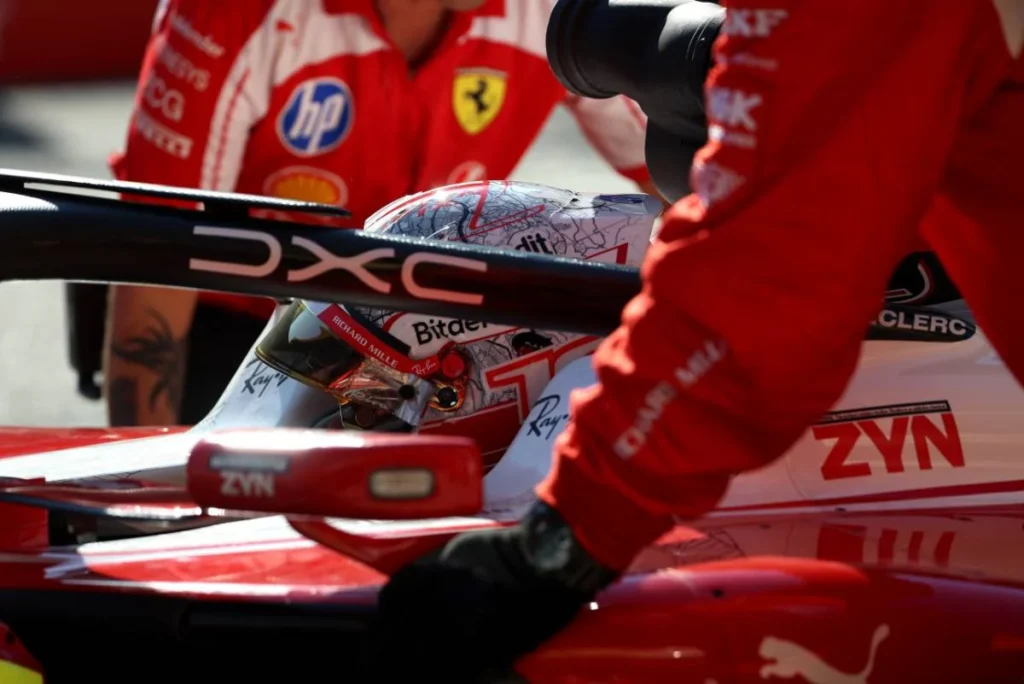
The Circuit of the Americas (COTA) in Austin, Texas, played host to a riveting opening day of track action, with Charles Leclerc cementing his status as the man to beat. In a masterclass of precision and pace, the Monegasque driver swept both practice sessions, signaling that Ferrari’s aggressive upgrade package is not merely a theoretical improvement but a potent reality. As the sun set over the Texas plains, the paddock was left to grapple with a new, emboldened reality: the Scuderia is no longer just a challenger—they are the current benchmark.
Main Facts: A Statement of Intent from Maranello
Friday at the United States Grand Prix served as a litmus test for the latest iteration of the Ferrari SF-26. Bringing a comprehensive suite of aerodynamic refinements—including a revised floor geometry and a re-profiled diffuser—the Italian team arrived in Austin with the clear intention of salvaging their championship momentum.
Charles Leclerc’s dominance was total. By securing the fastest time in both Free Practice 1 (FP1) and Free Practice 2 (FP2), he demonstrated an ability to extract performance across varying track temperatures and fuel loads. His best lap of 1:35.291 in the afternoon session stands as the time to beat, yet the margin of victory—a razor-thin 42 milliseconds over Mercedes’ rising star Kimi Antonelli—highlights just how volatile the pecking order remains. This performance represents a significant psychological victory for Ferrari, as they successfully integrated complex updates that have often proved finicky for their rivals during this high-stakes 2026 season.
Chronology: The Evolution of a Perfect Friday
The day began under clear Texan skies, with the teams eager to collect data on the challenging 5.513-kilometer circuit.
The Morning Session (FP1)
In the opening hour, the narrative was established immediately. Leclerc set a commanding pace of 1:36.052. While Max Verstappen pushed hard in his Red Bull, finishing just 84 milliseconds adrift, the stability of the Ferrari was apparent. Early on, the session was marked by close-quarters tension, most notably a near-miss in the pit lane exit between Verstappen and Williams’ Liam Lawson. The two went wheel-to-wheel toward Turn 1, a preview of the aggressive driving standards expected throughout the weekend.
The Afternoon Session (FP2)
As temperatures rose, so did the intensity. The early reference was set by George Russell, who utilized the medium C3 compound to clock a 1:36.035. Max Verstappen, seemingly finding more grip on the soft C4 tires, moved the goalposts to 1:35.480. However, Leclerc’s late-session qualifying simulation was the decisive moment. Clipping the apexes with surgical precision, he dropped the benchmark to 1:35.291. Kimi Antonelli, driving with the poise of a seasoned veteran, pushed the Mercedes to its absolute limit to clock 1:35.333, narrowly missing out on the top spot.
The session was not without its moments of chaos. Lewis Hamilton found the limits of the track at Turn 19, while Lando Norris had a significant excursion at the final corner. Perhaps the most contentious moment involved Leclerc and Russell at Turn 18, where a miscommunication during differing run programs forced the Ferrari driver off-track to avoid a collision.
Supporting Data: Technical Insights and Performance Gaps
The data gathered on Friday confirms that the 2026 grid is converging at an unprecedented rate. While Leclerc holds the advantage, the spread between the top three teams—Ferrari, Mercedes, and Red Bull—is remarkably small.

- Ferrari’s Technical Edge: The new floor and diffuser package has significantly reduced the sensitivity of the SF-26 to ride-height changes, a critical factor on the bumpy surface of COTA. Leclerc’s sector times consistently showed him gaining time in the technical "S" section of the first sector, where downforce stability is paramount.
- The Mercedes Threat: Kimi Antonelli’s performance is the story of the day. Finishing within 0.042 seconds of the lead suggests that the Mercedes W17 chassis is well-balanced. However, the team struggled with rear-end stability for George Russell, who reported significant grip losses in Turn 5, suggesting the car remains sensitive to setup changes.
- The Midfield Struggles: The day was less kind to others. Williams experienced a difficult outing, with Alex Albon battling severe wheel-locking issues. Carlos Sainz’s vocal frustration—“The car is a disaster… I have no confidence in the rear”—underscores the challenge teams face in dialing in their cars on a track that evolves rapidly.
Official Responses and Driver Feedback
The post-session debriefs provided a window into the frustration and elation inherent in the sport.
Ferrari’s garage was a picture of cautious optimism. Leclerc, speaking to reporters, remained grounded: "The car feels better than it has in months, but we know the track will change significantly tomorrow. We cannot rest on our laurels."
Conversely, the radio chatter from other drivers painted a picture of a difficult day at the office. Carlos Sainz’s blunt assessment of his car’s handling as a "disaster" will likely trigger an all-night investigation by the Ferrari engineering team to determine if his setup diverged too far from his teammate’s.
The incident between Leclerc and Russell was reviewed by the stewards, who ultimately chose not to intervene. This decision was met with mixed reactions, though it likely sets a precedent for "letting them race" as the season enters its final, most intense phase. Isack Hadjar, representing the Red Bull junior contingent, was perhaps the most vocal in his dissatisfaction, describing the handling of his RB22 in slow-speed corners as "disgusting." His engineer’s acknowledgement of these flaws suggests that Red Bull is currently chasing a balance window that is proving difficult to capture.
Implications: A Three-Way Fight for the Crown
What does this Friday tell us about the remainder of the Austin weekend? Firstly, the "upgrade cycle" is alive and well. Ferrari’s ability to find gains in the final quarter of the season forces Red Bull and Mercedes to push their own development cycles to the breaking point.
The proximity of the lap times—less than a tenth of a second covering the top two—suggests that Qualifying will be decided by the smallest of margins. The pole position will likely go to the driver who can best manage the trade-off between the high-speed aero sections and the low-speed, traction-dependent corners.
Furthermore, the incidents involving Russell, Verstappen, and Lawson highlight a growing tension in the paddock. With the championship standings tightening, the "elbows-out" approach seen in Friday’s practice is a precursor to a volatile race day.
For Ferrari, the goal is now to maintain this upward trajectory. If they can replicate Friday’s balance during Saturday’s qualifying, they have a genuine chance to disrupt the current power structure. For the fans in the grandstands, the narrative is perfect: a competitive, unpredictable, and high-speed battle that promises to be one of the highlights of the 2026 Formula 1 season. As we look toward the qualifying session, one thing is certain: Charles Leclerc has laid down the gauntlet, and the rest of the field is scrambling to pick it up.
