

By: Editorial Staff, MotorsInside
Date: June 30, 2026
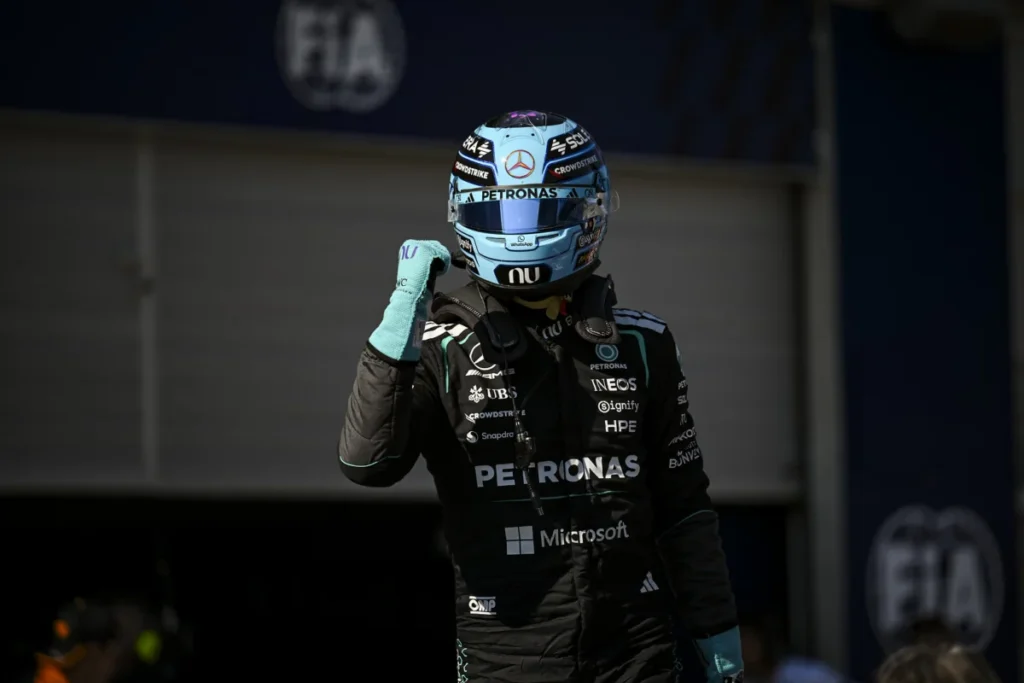
The Red Bull Ring, a circuit defined by its brevity and its brutality, lived up to its reputation during the 2026 Austrian Grand Prix qualifying session. In a spectacle that oscillated between technical precision and pure, unadulterated chaos, George Russell emerged as the master of the mountains. The Mercedes driver secured a spectacular pole position with a lap time of 1:06.113, snatching the top spot in the final, tension-filled moments of Q3.
The session was a rollercoaster of shifting fortunes, punctuated by a dramatic accident involving championship leader Max Verstappen and a controversial officiating call that left the paddock buzzing. As the dust settles on the Styrian hills, the grid is set for a Sunday race that promises to be as volatile as the qualifying hour that preceded it.
The Battle for the Top: A Statistical Margin
On a track where the lap time is barely over a minute, the difference between glory and mediocrity is measured in mere thousandths of a second. The competitiveness of the 2026 field was on full display as the top five drivers were separated by less than four-tenths of a second for the majority of the session.
Russell’s pole lap was a testament to his composure under extreme pressure. While Ferrari’s duo of Charles Leclerc and Lewis Hamilton had looked poised to lock out the front row in the dying embers of the session, Russell found the necessary pace to eclipse Leclerc by 0.236 seconds and Hamilton by 0.295 seconds. It was a tactical masterpiece for the Briton, who had struggled to find his rhythm in the early stages of the afternoon.
Chronology of a High-Stakes Afternoon
The Early Jitters (Q1)
The weekend began with a clear narrative: Kimi Antonelli was the man to beat. The young Mercedes prodigy, leading the championship standings, had dominated Friday’s practice sessions and confirmed his form by topping Q1 with a blistering 1:07.083.
In contrast, George Russell appeared to be grappling with a lack of grip, famously complaining over the team radio that his car was "sliding on all four wheels." The intensity of the field was such that the gap between the leaders and the back of the pack remained razor-thin. For the legacy teams, the session was a harsh reality check. Williams endured a catastrophic afternoon, with Carlos Sainz and Alex Albon both eliminated in Q1. Cadillac, despite bringing a substantial package of aerodynamic upgrades, saw their weekend stall early, with Sergio Perez and Valtteri Bottas finishing well off the pace. The bottom of the order was rounded out by a struggling Aston Martin pair, Fernando Alonso and Lance Stroll, who appeared to have no answer to the circuit’s unique demands.
The Mid-Session Squeeze (Q2)
As the track temperature fluctuated, the intensity in Q2 rose. Antonelli continued his fine form, clocking a 1:06.763 to once again set the benchmark. However, it was here that the cracks began to show for some of the sport’s biggest names.
Russell nearly saw his session end prematurely after an excursion at Turn 3, forcing his team principal, Toto Wolff, to intervene over the radio with a stern, "George, just drive." The directive worked, as Russell composed himself to post a 1:06.979, safely progressing into the final shootout.
Max Verstappen, the local hero and quadruple world champion, narrowly skirted disaster. The Red Bull driver struggled to find the balance of his car, scraping into Q3 by the skin of his teeth. Pierre Gasly, representing Alpine, was the heart-wrenching exclusion of the session, missing out on the top ten shootout by a mere 0.04 seconds.
The Q3 Climax: Glory and Gravel
The final phase of qualifying transformed the session from a test of skill into a test of survival. Initially, Antonelli took provisional pole with a 1:06.414, with Russell and Verstappen hot on his heels. Lewis Hamilton, pushing the limits of his Ferrari, had his first attempt ruined by a lock-up at Turn 3.

Then came the turning point. As the drivers entered their final flying laps, Ferrari appeared to have secured a 1-2 finish. But as Verstappen pushed to reclaim his position, disaster struck. The Red Bull lost its rear end at the entry of Turn 9, sliding across the gravel trap and impacting the tire barriers at high speed. While the driver emerged unscathed, the yellow flags were deployed immediately, throwing the final sector into disarray.
The Controversy of the Yellow Flags
The immediate aftermath of the crash ignited a firestorm of debate. Kimi Antonelli, seeing the incident, immediately lifted off the throttle, believing the double-yellow flags were being displayed. George Russell, however, continued his push, eventually securing pole.
The stewards launched an investigation into whether Russell had respected the yellow flag zone. After a lengthy review of telemetry and footage, the FIA ruled that no infringement had occurred. The governing body clarified that the sector timing and flag signaling did not warrant a penalty for the Mercedes driver. However, the optics of the situation—Russell improving while a fellow competitor was in the barriers—left many in the paddock, including Antonelli himself, questioning the consistency of the officiating.
Official Responses and Team Perspectives
Following the conclusion of the session, the mood in the paddock was subdued. Max Verstappen, speaking to the media, expressed confusion regarding his accident: "I don’t have a clear explanation for the rear-end snap. It just went, and there was nothing I could do to catch it."
Red Bull’s management expressed relief that their lead driver was unharmed, though the frustration of losing a home-race pole was evident. For Mercedes, the focus shifted to the race. Toto Wolff defended his driver, noting that the team had analyzed the data alongside the stewards and were confident that Russell had acted within the letter of the law. Antonelli, ever the professional, admitted he was disappointed by the result but acknowledged the complexity of the final seconds of the session.
Implications for Sunday’s Grand Prix
As the grid prepares for the race, the implications of Saturday’s qualifying are profound. George Russell sits in the prime position, but he will have to contend with a Ferrari duo that has demonstrated exceptional race pace throughout the weekend.
Lewis Hamilton and Charles Leclerc, starting second and third respectively, will undoubtedly look to challenge the Mercedes from the start. Kimi Antonelli, starting fourth, is in a precarious position; he is fast enough to win but must navigate the politics of team orders and his own championship aspirations.
Perhaps the biggest wild card is Max Verstappen. Starting fifth, he is far from out of the fight. The Red Bull RB22 has shown remarkable straight-line speed, and the partisan Austrian crowd will be expecting a charge through the field. Furthermore, the midfield—led by the impressive Lando Norris and Oscar Piastri in their McLarens—is perfectly poised to capitalize on any mistakes made at the front.
Ultimately, the Austrian Grand Prix is set to be a tactical battle of tire degradation, track position, and the ability to handle the relentless pressure of the Red Bull Ring. Saturday proved that in 2026, the margins for error are non-existent, and Sunday’s 71 laps will likely be just as unforgiving.
Starting Grid: Austrian Grand Prix 2026
| Pos | Driver | Team | Q3 Time |
|---|---|---|---|
| 1 | George Russell | Mercedes | 1:06.113 |
| 2 | Charles Leclerc | Ferrari | 1:06.349 |
| 3 | Lewis Hamilton | Ferrari | 1:06.408 |
| 4 | Kimi Antonelli | Mercedes | 1:06.414 |
| 5 | Max Verstappen | Red Bull Racing | 1:06.475 |
| 6 | Lando Norris | McLaren | 1:06.502 |
| 7 | Oscar Piastri | McLaren | 1:06.511 |
| 8 | Isack Hadjar | Red Bull Racing | 1:06.632 |
| 9 | Liam Lawson | Racing Bulls | 1:06.955 |
| 10 | Arvid Lindblad | Racing Bulls | 1:07.007 |
(Full classification continues down to 22nd position)
