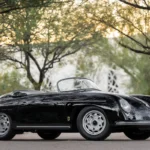
SEVILLE, SPAIN — In the heart of Andalusia, where centuries of history echo through narrow, sun-drenched alleys, a modern mechanical masterpiece recently met its match. In mid-October 2026, the historic Casco Antiguo of Seville played host to an unexpected and viral spectacle: a pristine, Portuguese-registered Ferrari Roma Spider—a supercar valued at well over €300,000—navigating a medieval maze never designed to accommodate anything wider than a horse-drawn cart.
Captured on video by bewildered onlookers and subsequently blasted across social media platforms like Instagram, the incident quickly transcended a simple tourist mishap. It evolved into a viral micro-drama that highlights the jarring incompatibility between modern ultra-luxury supercars and the heavily restricted, tightly preserved urban cores of historic European cities.
Main Facts: Anatomy of a Misadventure
The scene unfolded in Seville’s labyrinthine old town, specifically at the intersection of Calle Bamberg and Calle Argote de Molina. Here, the urban architecture dates back centuries, defined by closely packed whitewashed buildings, sharp 90-degree turns, and streets barely wider than a standard compact hatchback.
Into this historical bottleneck drove an unsuspecting motorist at the wheel of a blazing red Ferrari Roma Spider. With its sleek Italian lines, retractable fabric soft top, and a roaring front-mounted V8 engine idling under the scorching Andalusian sun, the vehicle commanded attention long before it got stuck.
However, the laws of physics and urban planning quickly intervened. Measuring 4.66 meters in length and a sprawling 1.97 meters in width (excluding side mirrors), the Roma Spider possesses a formidable footprint. As the driver attempted a left-hand turn, the car’s flanks came dangerously close to scraping ancient masonry.
Trapped between century-old stone walls, the driver was forced to engage in an agonizing sequence of micro-maneuvers: inching forward by mere centimeters, checking mirrors, and reversing with agonizing precision. Local pedestrians quickly stopped in their tracks, pulled out their smartphones, and transformed from casual bystanders into an impromptu pit crew. One helpful local even positioned himself directly in front of the multi-million-dollar Italian machine to act as a human guide, directing the driver’s millimeter-by-millimeter escape.
While the video drew millions of views and triggered widespread amusement online, it also underscored a serious municipal issue: the strict traffic regulations governing Seville’s historic center.
Chronology: From Open-Road Dream to Urban Nightmare
To understand how a driver of a high-performance grand tourer ended up in such a predicament, it helps to trace the timeline of events that mid-October afternoon.
-
Phase 1: The Open Road Fantasy
The journey likely began on the sweeping, sunlit highways outside Seville. The Ferrari Roma Spider is engineered for precisely this environment—grand touring across open landscapes, utilizing its 620-horsepower engine to chew up miles with the roof down. -
Phase 2: The Erroneous Entry
At some point, the driver crossed into Seville’s Casco Antiguo, a protected zone operating under strict municipal rules. Whether misled by an overly optimistic GPS navigation system or simply unfamiliar with local geography, the motorist bypassed the architectural reality check awaiting them in the ancient quarter. -
Phase 3: The Bottleneck
Turning onto Calle Bamberg, the driver encountered a tight urban canyon. Attempting to negotiate the corner onto Calle Argote de Molina, forward progress ground to a complete halt. The front bumper pointed perilously close to historic brickwork, while the rear flanks risked scraping against jutting window frames. -
Phase 4: The Viral Gridlock
Realizing the gravity of the situation—both literally and financially—the driver froze. Pedestrians flooded the sidewalks, capturing the surreal contrast of a bleeding-edge Maranello machine trapped among medieval facades. Social media user Aymeric Grassart captured the definitive footage, uploading it to Instagram and sparking an instant digital firestorm. -
Phase 5: The Extraction
Through painstaking reverse maneuvers, frantic hand signals from local volunteers, and a heavy dose of driver humility, the Ferrari eventually backed its way out of the bottleneck, escaping without apparent permanent structural damage—though dignity was undoubtedly left behind on the cobblestones.
Supporting Data: The Machine vs. The Monument
The absurdity of the Seville incident becomes even clearer when examining the technical specifications of the Ferrari Roma Spider alongside the realities of Seville’s urban design.
The Vehicle: Ferrari Roma Spider
- Price Tag: Estimated upwards of €300,000 (before options, taxes, and customization).
- Powertrain: 3.9-liter twin-turbocharged V8 engine.
- Output: 620 horsepower and 760 Nm of torque, sent to the rear wheels via an 8-speed dual-clutch automatic transmission.
- Performance: 0 to 100 km/h in 3.4 seconds; top speed exceeding 320 km/h.
- Dimensions: 4.66 meters long, 1.97 meters wide.
- Design Heritage: Notable for reintroducing a fabric soft top to a front-engine Ferrari for the first time since the 1969 365 GTS4. The five-layer acoustic fabric opens or closes in 13.5 seconds at speeds up to 60 km/h.
The Environment: Seville’s Casco Antiguo
- Historical Context: Urban layout established primarily during medieval Moorish and post-reconquest eras, designed exclusively for pedestrian and animal traffic.
- Street Widths: Many alleyways measure less than 2.5 meters across, leaving virtually zero margin for error with modern vehicles nearing two meters in width.
- Regulatory Status: Designated as a Low-Emission Zone (Zona de Bajas Emissions or ZBE) and restricted traffic zone (Áreas de Restricción Acústica y de Tráfico).
Official Responses and Regulatory Context
While the viral video focused primarily on the comedic and financial irony of a scratched supercar, the incident shines a spotlight on municipal enforcement within Spain’s historic urban centers.
Seville’s Casco Antiguo is heavily regulated to protect both pedestrian safety and the architectural integrity of the UNESCO-recognized surroundings. Access is strictly limited to:
- Local residents with registered parking spaces.
- Authorized public utility and emergency vehicles.
- Special delivery transport under strict time constraints.
- Vehicles transporting individuals with reduced mobility.
City officials have been progressively rolling out Low-Emission Zones (ZBE) to curb pollution, reduce noise, and reclaim public spaces from vehicular congestion. Unauthorized entry into these zones typically triggers automated camera fines.
As of press time, local traffic authorities have not officially confirmed whether the Portuguese-registered Ferrari was slapped with municipal citations for unauthorized entry into the restricted zone, or if the driver managed to slip out of the district before enforcement cameras logged the infraction. However, transport advocates and municipal planners point out that physical infrastructure—specifically stone walls and narrow turns—delivered a far more immediate punishment than any traffic ticket could.
Implications: Supercars in the Modern City
The Seville Ferrari incident is far more than a one-off viral joke; it serves as a symptom of a broader, growing tension across major European tourist destinations.
1. The Supercar-Infrastructure Mismatch
Modern supercars and luxury grand tourers have grown wider, longer, and more complex to accommodate safety regulations, hybrid batteries, aerodynamic downforce, and wider tires. Conversely, historic city centers across Italy, Spain, France, and Portugal are shrinking their vehicular footprint through pedestrianization projects, bollards, and strict zoning laws. Driving a nearly two-meter-wide exotic car through medieval cities is increasingly becoming an exercise in automotive self-torture.
2. The Rise of Luxury Tourism and Overtourism
The presence of a Portuguese-registered €300,000 supercar in Seville points to the booming market of cross-border luxury tourism and exotic car rentals. Wealthy travelers frequently tour Southern Europe’s scenic coastal and interior highways. Yet, the blurred lines between highway driving and urban navigation often lead tourists straight into historic neighborhoods where vehicles simply do not belong.
3. Public Sentiment and Urban Fatigue
Commentary surrounding the viral video revealed a palpable wave of fatigue among local residents. Many social media users and Seville locals voiced frustration over outsiders treating historic neighborhoods as personal playgrounds or exotic backdrops for social media content. For residents dealing with noise pollution, traffic congestion, and the commercialization of their neighborhoods, watching a multi-euro supercar sweat through a narrow alley offered a bittersweet moment of poetic justice.
Ultimately, the image of a bright red Ferrari Roma Spider sweating through Calle Bamberg will endure as a modern cautionary tale. It proves that no matter how many horsepower you command, or how much your car costs, you cannot negotiate with centuries of history carved in stone.