The latest edition of Gazoline (Issue 351, October 2026) arrives with a nostalgic roar, offering a curated blend of deep-dive mechanical analysis, historical retrospectives, and the enduring romance of the open road. As autumn settles in, the editorial team has pivoted toward the spirit of recovery and innovation, focusing on the vehicles that defined the post-war era while celebrating the quirky, accessible charm of the 1980s.
Main Facts: The Stars of the Show
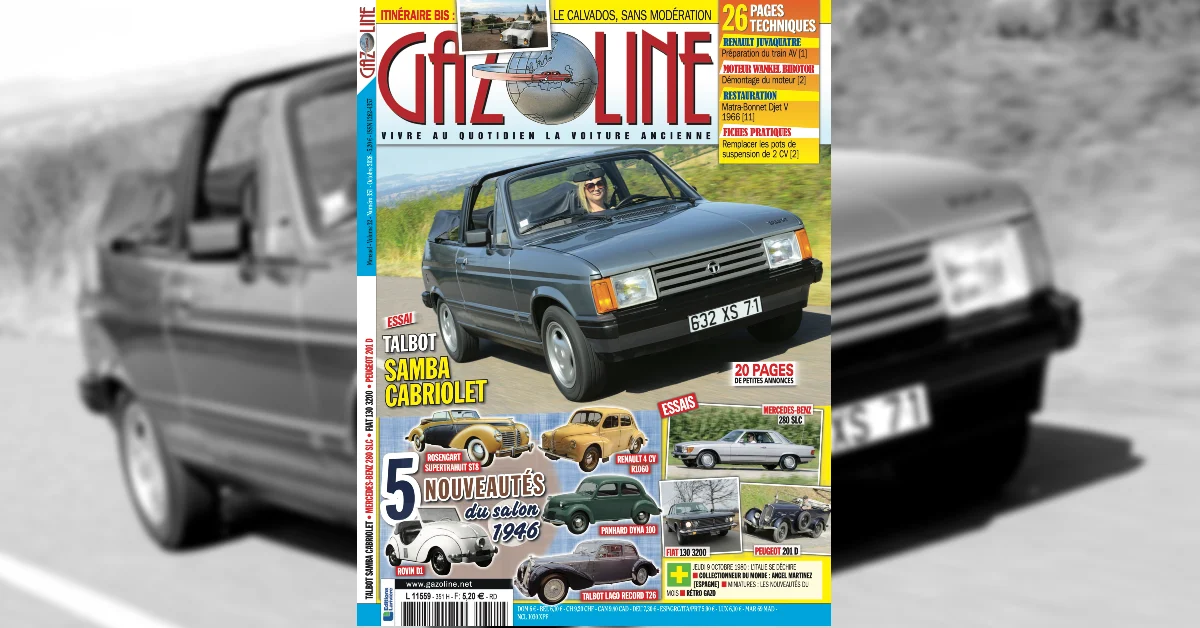
The cover feature for October 2026 is the Talbot Samba Cabriolet, a vehicle that holds a unique place in the hearts of French automotive enthusiasts. Drawing significant inspiration from the benchmark-setting Volkswagen Golf Cabriolet, the Samba brought the dream of an affordable, stylish open-top car back to the French market. Gazoline provides a meticulous evaluation of a late-production model, showcasing a survivor in pristine, original condition that perfectly captures the optimism of its era.
Beyond the Samba, this issue offers a diverse "garage" for the discerning collector:
- Mercedes-Benz 280 SLC: An exploration of the "stretching" philosophy that birthed this elegant coupe, powered by the legendary, velvet-smooth inline-six engine.
- Fiat 130 3200: A rare deep dive into the Italian manufacturer’s ambitious attempt to challenge the luxury establishment—a high-end sedan carrying the weight of a prestigious, albeit complex, heritage.
- Peugeot 201 D Torpédo: A near-unique piece of pre-war history, this commercial variant highlights the utility and ingenuity that characterized the early days of the French automobile industry.
Chronology: The 1946 Post-War Salon
The core of this month’s "Coups de Cœur" (Favorites) section is dedicated to the 1946 Paris Motor Show, the first to be held after the devastation of World War II. It was a time of immense uncertainty, where manufacturers were not just displaying cars, but fighting for survival.
- The Context: Europe was in ruins, fuel was rationed, and raw materials were scarce. Despite this, the 1946 Salon served as a beacon of national reconstruction.
- The Vehicles: The issue highlights five distinct fates from that momentous exhibition:
- Panhard Dyna 100: Exploring how the innovative use of aluminum helped ignite a design revolution.
- Renault 4 CV R1060: A symbol of mass-market recovery that was "swept away by the crowd."
- Rosengart SuperTrahuit ST8: Often referred to as "the other 22," this vehicle represents the ambitious, experimental spirit of the time.
- Rovin D1: A micro-car that brought a sense of whimsy ("Go, Oui-Oui!") to a recovering nation.
- Talbot-Lago Record T26: A display of pure mechanical passion, representing the "fever in the blood" of French luxury engineering.
Supporting Data: Technical Restorations and Global Collections
Gazoline 351 continues its tradition of providing technical support to the restoration community. This month’s technical dossier includes:
- Renault Juvaquatre AHG 2 (1951): The restoration series enters its 27th installment, focusing this month on the intricate preparation of the front axle.
- Moteur Wankel Birotor: The third part of this series dives into the technical complexities of the rotary engine, with a focus on the disassembly phase.
- Matra-Bonnet Djet V (1966): The 11th part of this project culminates in a triumphant moment—successfully passing the Contrôle Technique (MOT equivalent) with relative ease.
Furthermore, the "Collectionneur du Monde" (Collector of the World) feature profiles Angel Martinez from Spain, an enthusiast whose life is deeply influenced by the "Losange" (the Renault diamond emblem), showcasing how French automotive heritage transcends borders.
Implications: The Itinéraire Bis – The Calvados Coast
To mark the final "Itinéraire Bis" (Alternative Route) of the season, the editorial team travels to the Calvados region. This journey serves as a poignant intersection of history and tourism. By exploring the beaches of the D-Day landings, the magazine reminds readers that these classic cars are not merely objects of desire, but vessels that allow us to physically trace the history of the 20th century. Driving these machines through the coastal landscape offers a sensory connection to the past that modern vehicles simply cannot replicate.

Official Content Summary (Issue 351)
For those looking for the full scope of the October 2026 issue, here is the official breakdown of the magazine’s contents:
- Editorial/News: October 9, 1980: Italy is torn apart. A look back at the socio-political climate that shaped the decade.
- Redécouverte (Rediscovery): Detailed features on the Talbot Samba Cabriolet, Mercedes-Benz 280 SLC, and Fiat 130 3200.
- Avant-guerre (Pre-war): The Peugeot 201 D Torpédo commercial.
- Coups de Cœur: A deep dive into the five iconic cars of the 1946 Salon.
- Itinéraire bis: Traveling the Calvados route in the footsteps of the conquerors.
- Collectionneur du Monde: Angel Martinez and his love for Renault.
- Restoration Workshops: Step-by-step guides for the Renault Juvaquatre, Wankel Birotor, and Matra-Bonnet Djet V.
- Market Trends: A look at the latest scale model miniatures and the "RétroGazo" retrospective.
Professional Journalistic Perspective
The inclusion of the 1946 Salon retrospective in the October 2026 issue is particularly timely. As the automotive industry currently navigates its own "post-war" style transition toward electrification and shifting mobility paradigms, looking back at the 1946 Salon provides a masterclass in adaptation. The vehicles of 1946 were born out of necessity, yet they defined the aesthetic and mechanical language of the next two decades.
Similarly, the focus on the Talbot Samba Cabriolet highlights a shift in current collector trends. As the "youngtimer" market continues to mature, vehicles that were once considered everyday runabouts—like the Samba—are now being elevated to the status of design icons. This indicates a generational shift in the collector base, where the cars of the late 20th century are now receiving the same level of scholarly and mechanical rigor previously reserved for pre-war legends.
The restoration articles, particularly the work on the Wankel Birotor, emphasize Gazoline’s commitment to preserving niche engineering. The Wankel engine remains one of the most polarizing and fascinating chapters in automotive history; documenting its internal complexities ensures that the knowledge required to keep these unique powerplants running does not vanish with time.
Conclusion
Gazoline Issue 351 is more than a magazine; it is a comprehensive resource for the preservation of automotive culture. By balancing the "big picture" history of the 1946 Salon with the "hands-on" technical reality of restoring a 1951 Juvaquatre, the publication maintains its status as the definitive voice for French and European classic car enthusiasts.
Whether you are a seasoned collector looking for your next project, an armchair historian interested in the reconstruction of post-war France, or a driving enthusiast looking for the perfect coastal route, this issue offers a deep, satisfying dive into the world of heritage motoring.
For those interested in securing a copy of this issue, the publication is currently available through the official Gazo online boutique.