

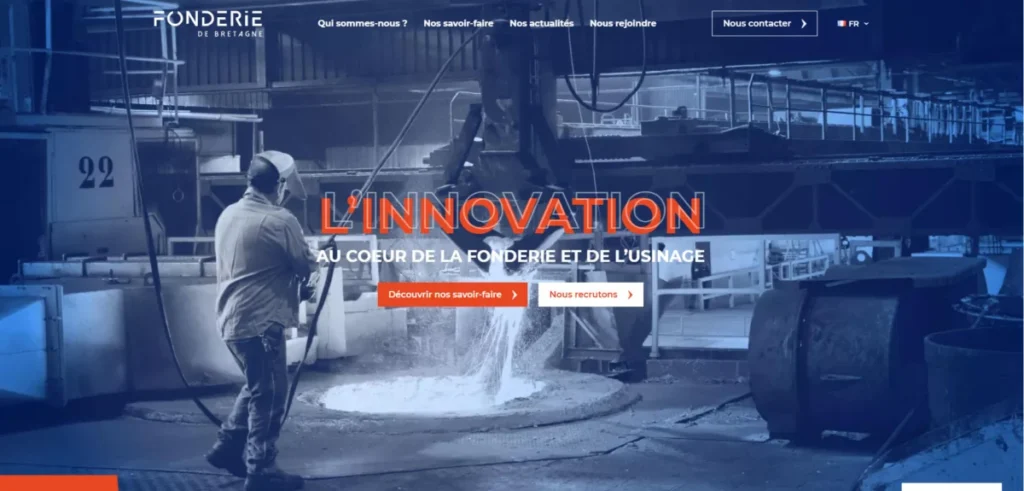
CAUDAN, Morbihan — The writing has long been on the wall for the industrial heartlands of regional France, but the final strokes are now being painted in grim, unyielding shades. Next Thursday, October 15, the Commercial Court of Lorient is set to deliver its final verdict on the fate of the Fonderie de Bretagne. Situated in the commune of Caudan in the Morbihan department, this historic foundry—founded by automotive giant Renault in 1966—faces imminent liquidation. Despite desperate eleventh-hour efforts to keep the molten fires burning, the absence of a sufficiently solid, credible takeover bid within the court-mandated deadlines has sealed the doom of a site that employs 244 workers.
For industry observers, union leaders, and the local population, this is not merely the closing of a factory; it is the Chronicle of a Foretold Industrial Waste (Chronique d’un gâchis industriel typique). It is a stark reminder of a deeper malaise eating away at the French industrial landscape: the slow, agonizing erosion of blue-collar employment, systemic lack of strategic anticipation, and the human cost of a nation’s painful transition through successive technological and economic revolutions.
Main Facts: The End of the Line in Morbihan
The immediate reality facing Caudan is brutally straightforward: 244 direct jobs are on the line, representing hundreds of indirect livelihoods tied to the ecosystem of the Morbihan foundry.
Earlier this week, Fabrice Vély, the mayor of Caudan, shared his profound bitterness with national media following a tense visit to the plant. He described a workforce suspended between raw anger and profound resignation, deeply disillusioned to see an essential industrial tool facing absolute extinction without a transition to new activities.
Yet, the situation appeared, at least theoretically, to have a lifeline as recently as late summer. In July, Renault—the historical parent company—unlocked a financial injection of €4.5 million intended to sustain the operations of its former subsidiary. According to local officials, a portion of these funds will likely be redirected to soften the blow for departing employees, cushioning the Social Plan (Plan de Sauvegarde de l’Emploi, or PSE) and financing professional retraining initiatives.
However, cash infusions for wind-down operations do not translate into sustainable employment. Mayor Vély noted that while the physical infrastructure—the modern offices and heavy production workshops—retains strong industrial potential for future ventures, the immediate outcome remains a disaster. The plant’s 250-odd positions are vanishing, continuing a decades-long trend of shrinking headcounts at the facility.
Chronology: A Century of Metalwork and Corporate Hot-Potato
To understand the tragedy of Fonderie de Bretagne, one must look deep into the annals of French industrial history, where the site stands as a direct descendant of centuries-old Breton metallurgical traditions.
From Hennebont to Caudan: A 20th-Century Legacy
The roots of the Fonderie de Bretagne trace back through the Société bretonne de fonderie et mécanique (SBFM) to the legendary Forges of Hennebont. That colossal complex sustained the local economy for 103 years before collapsing into liquidation in 1963, a victim of underinvestment and outmoded technology unable to compete with more modern facilities. Half of the surviving workforce from Hennebont was salvaged and transferred to a brand-new facility constructed in neighboring Caudan in 1966.
Renault’s Creation and Expansion
The architect of the Caudan plant was Renault. The French automotive pioneer desperately required a reliable domestic supply of cast-iron exhaust manifolds, engine blocks, and steering knuckles for its burgeoning vehicle lines. In its heyday, the plant was a titan of employment, boasting a workforce of up to 1,600 people.
The Carousel of Ownership
As the global automotive market fractured and consolidated, Renault began shedding non-core assets.
- 1998: Renault sold the facility to Teksid, the metallurgical arm of Italian automotive giant Fiat.
- 2006: Teksid offloaded the plant to another Italian industrial investor. Profits proved elusive, and the facility slid toward insolvency.
- 2009: Pressured intensely by the French State (a major Renault shareholder), local authorities, and militant labor unions, Renault reluctantly reacquired its former subsidiary for a nominal sum, establishing the official name Fonderie de Bretagne.
Massive Subsidies and False Hopes
Renault subsequently pumped more than €85 million into the plant over a seven-year span in an attempt to modernize its operations. Despite these massive investments, structural deficits persisted. Deeply financially strained by its own global restructuring, Renault ultimately transferred the facility for a symbolic €1 to a German investment fund, the Callista private equity group, in a controversial deal.
By last year, another lifeline was tossed when Europlasma stepped forward as an acquirer. The pitch seemed tailor-made for the geopolitical moment: repurposing the foundry to produce heavy mortar shells. With national defense, European rearmament, and sovereign ammunition manufacturing storming back to the top of political priorities, optimism briefly flickered. Yet, eighteen months later, not a single mortar shell had rolled off the production lines, the CEO was abruptly ousted, and the company plunged irrevocably into judicial liquidation.
Supporting Data: The Broader Deindustrialization of France
The plight of Fonderie de Bretagne is not an isolated local anomaly; it is part of a systemic, decades-long hemorrhage across France’s industrial heartlands.
+---------------------------------------------------------------------------------+
|               NOTABLE RECENT FRENCH FOUNDRY & AUTO-SUPPLIER FAILURES            |
+--------------------------+---------------------+--------------------------------+
| Company Name             | Location            | Fate / Year of Collapse        |
+--------------------------+---------------------+--------------------------------+
| Fonderie de Bretagne     | Caudan (Morbihan)   | Liquidation / October 2024     |
| Fonderies du Poitou      | Ingrandes (Vienne)  | Liquidation / 2022             |
| GM&S                     | La Souterraine      | Repeated bailouts / Closure    |
+--------------------------+---------------------+--------------------------------+
The systemic erosion mirrors structural shifts seen across other legendary suppliers, such as GM&S in La Souterraine. Founded in 1963 as Socomec by Bernard Godefroy, GM&S once employed up to 1,200 workers producing automotive components for French giants like PSA (Peugeot-Citroën). Like Caudan, GM&S bounced through a succession of private hands, each transition stripping away jobs, enduring bitter strikes, and highlighting the catastrophic vulnerability of single-industry towns in provincial France.
France is far from alone in this pain, though European neighbors have experienced different timelines. Germany, long viewed as a fortress of manufacturing resilience, is now absorbing a massive structural shock. Since 2019, German industry has shed between 245,500 and 250,000 jobs. Within the German automotive sector alone, analysts project a cumulative loss of roughly 225,000 jobs between 2019 and 2035 as the continent accelerates its painful pivot away from internal combustion engines.
Official Responses and Stakeholder Finger-Pointing
As the court date looms, recriminations fly freely among the various actors who shaped the foundry’s destiny.
- The Trade Unions: Labor representatives point accusing fingers in multiple directions: toward the state, the weather, and above all, Renault. Union leadership argues that because Renault is historically tied to the birth of the plant—and because the French State remains a powerful shareholder in the automaker—authorities should have used their leverage to force Renault to step in once more and guarantee production orders.
- The State and Renault: Opposing views argue that Renault already played the savior role once in 2009, pouring tens of millions of euros into a structural black hole with zero long-term economic return. Forcing a publicly traded, globally competitive car manufacturer to artificially prop up an uncompetitive foundry is viewed by economists as fiscal and industrial madness.
- Local Leadership: Municipal officials, caught in the crossfire, focus their remaining energy on extracting maximum support for the displaced workforce. Mayor Vély emphasizes that if the factory walls must go dark, the social safety net and retraining allowances funded by Renault’s final €4.5 million contribution must be optimized to their absolute limit.
Implications: The Electric Vehicle Dilemma and the Ghost of ’83
The death of Fonderie de Bretagne exposes a fundamental, inescapable paradox of the modern green transition: The electric vehicle (EV) is simultaneously a blessing and a curse for industrial employment.
The Technical Obsolescence of Cast Iron
On the negative side of the ledger, internal combustion engines require vast quantities of complex metal castings—such as heavy cast-iron exhaust manifolds, intricate cylinder blocks, and specialized engine housings. Electric vehicles require none of these. An electric motor is mechanically far simpler, contains vastly fewer moving parts, and requires a fraction of the heavy foundry labor force to manufacture.
The Ideological Roots of Deindustrialization
Historians of French policy trace these structural vulnerabilities back to watershed political moments, most notably the ideological pivot of 1983. Under President François Mitterrand, France decisively abandoned traditional industrial policies in favor of a service-oriented, high-tech, nuclear, and aerospace-driven economy—a French variant of Thatcherism. Prominent corporate leaders like Serge Tchuruk of Alcatel famously theorized a "factory-less France" dominated by white-collar knowledge workers rather than blue-collar technicians.
Decades later, telling a 54-year-old foundry worker in Morbihan that they are expected to effortlessly pivot into a career in IT or digital services offers little solace.
While higher vehicle price points in the EV era have recently allowed major French automakers to profitably bring certain assembly lines back to northern France, these high-tech hubs do not replace the localized industrial ecosystems destroyed in rural and regional departments like Morbihan or the Creuse. Caudan is light-years away from Douai or Sochaux.
Conclusion
Ultimately, the impending liquidation of Fonderie de Bretagne stands as a sobering monument to a lack of foresight. As global trade pressures, shifting energy paradigms, and corporate globalization continue to redraw the map of European manufacturing, the human cost is invariably borne by workers on the shop floor. Without aggressive, forward-looking industrial planning that anticipates technological shifts rather than merely reacting to their wreckage, Caudan will simply be one more name on an ever-growing list of industrial ghosts.
