

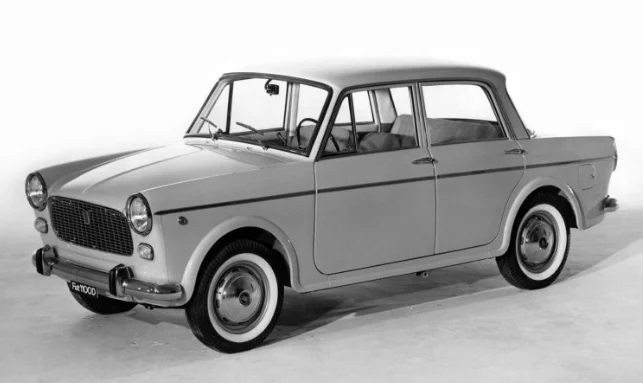
In the shadow of the majestic Piccolomini Castle in the Abruzzo region of Italy, a seemingly mundane Sunday morning was transformed into a cinematic masterpiece of emotion. What began as a local classic car rally—a gathering of enthusiasts dedicated to preserving the golden age of Italian motoring—became the stage for a deeply personal, life-altering surprise.
For one local man, the day was intended to be a simple excursion, marred slightly by the physical discomfort of a nagging foot injury. He arrived at the event with low expectations, yet he departed having reclaimed a piece of his own history. Thanks to a sophisticated, weeks-long conspiracy orchestrated by his children, Federico and Mariagabriella, he found himself face-to-face with the exact model of car that defined his childhood: a pristine black Fiat 1100 D.
The Chronology of a Secret Mission
The story of this extraordinary reunion did not begin at the castle gates, but in the digital corridors of the automotive classifieds. The father, a long-time admirer of classic Italian design, had recently stumbled upon an online advertisement for a 1964 Fiat 1100 D. The car was more than just a piece of machinery; it was a tangible link to his past, a vehicle that had served as the backdrop for his formative years and his first experiences behind the wheel.
The Seed of an Idea
Upon discovering the advertisement, the father shared his excitement with his family. He spoke fondly of the car’s history, the memories it evoked, and the unique allure of the 1960s aesthetic. However, when the time came to commit to the purchase, he hesitated. Despite his family’s encouragement, he ultimately decided to let the opportunity slip by, citing practical concerns and his own reluctance to undertake such a commitment.
The Silent Conspiracy
Unbeknownst to him, his children viewed his hesitation not as a final decision, but as a challenge. Shortly after he abandoned the search, Federico and Mariagabriella took matters into their own hands. They contacted the seller, negotiated the purchase, and secured the vehicle in total secrecy. For ten days, the siblings operated as clandestine agents, hiding the car and coordinating its transport to the upcoming raduno (rally) organized by the Marsi Motor Club in Celano.
When the father noticed the online listing had been removed, he felt a sting of regret, convinced he had missed his chance. He had no way of knowing that his "lost" dream was, at that very moment, being prepped for a grand reveal.
The Sunday Reveal
On the day of the rally, the father was initially reluctant to attend. The pain in his foot made walking difficult, and the prospect of navigating a crowded event seemed daunting. However, his family insisted, gently guiding him toward the castle grounds.
As they approached the rows of polished chrome and vintage lacquer, the atmosphere was one of nostalgic celebration. The Marsi Motor Club had assembled an impressive collection of automotive history, but for the father, the world seemed to narrow down to a single point: a black Fiat 1100 D with a striking red interior. It was a mirror image of his father’s car from 1964. As he approached the vehicle, the scent of vintage vinyl and the tactile memory of the steering wheel triggered a wave of nostalgia. It was only when his children produced a set of keys and explained that the car was now his that the full weight of the surprise hit him.
Supporting Data: The Fiat 1100 D Legacy
The Fiat 1100 D holds a hallowed place in the annals of Italian automotive history. Introduced in the post-war era, the 1100 series became the quintessential family vehicle for a burgeoning middle class.
- Engineering Specifications: The 1100 D, produced during the early-to-mid-1960s, was powered by a 1,221cc four-cylinder engine. It was lauded for its reliability and its ability to comfortably transport families, distinguishing it from the smaller, more cramped Fiat 500 or 600 models of the same era.
- Cultural Significance: During the 1960s, the Fiat 1100 was more than transportation; it was a symbol of mobility and progress. It represented the "Economic Miracle" of Italy, a time when families were finally able to explore their country, travel to the coast, and enjoy the fruits of a recovering economy.
- The "Madeleine de Proust" Effect: Psychologists often refer to sensory triggers—such as the smell of old upholstery or the sound of a specific engine note—as "Proustian moments." These involuntary memories, rooted in deep emotional associations, can transport an individual back to a specific moment in time with startling clarity. For the father, the Fiat 1100 D was precisely this: a mechanical time capsule.
Official Perspectives and Community Reception
The Marsi Motor Club, which hosted the event, is part of a broader network of classic car enthusiasts who view these vehicles as vital cultural artifacts.
"The preservation of these cars is not just about the mechanics; it is about preserving the soul of our history," noted a representative from the club. While the club organizes these events to showcase engineering prowess, they are often surprised by the emotional weight these cars carry for spectators. The incident in Celano has since gone viral, with automotive forums and social media outlets highlighting the story as a testament to the enduring power of family and memory.
Experts in the classic car market, such as those cited by El Pais, suggest that the value of such vehicles is increasingly defined by their "provenance of emotion." A car that is historically significant is valuable, but a car that holds a personal history for the owner is priceless.
The Implications of a Shared Memory
The act of gifting this car has broader implications beyond the immediate happiness of the family. It highlights the importance of intergenerational connection and the preservation of family narratives.
Strengthening Family Bonds
By actively participating in their father’s past, Federico and Mariagabriella did not just buy a car; they validated his life experiences. They showed that his memories were worthy of preservation. This creates a bridge between generations, allowing the children to understand the man behind the father figure.
The Role of Material Culture
This event serves as a poignant reminder that objects can act as anchors for our identity. In an increasingly digital and ephemeral world, the tactile nature of a classic car—the heavy steel, the manual gear shifts, the lack of electronic assistance—grounds individuals in a reality that feels more permanent and authentic.
A Lesson for Enthusiasts
For the wider community of classic car owners, this story provides a new perspective on why they do what they do. It isn’t just about restoring paint or tuning carburetors; it is about keeping the "memories of the road" alive. Every restored car is a potential vessel for someone’s return to their own past, a way to make history breathe once more.
Conclusion
The story of the Celano Fiat 1100 D is a rare, beautiful intersection of automotive history and human emotion. It is a reminder that while cars are, by definition, machines designed to move us from one place to another, the best ones are those that move us in ways we never expected.
As the father stood before his restored, black 1100 D under the gaze of the Piccolomini Castle, he was no longer just a man with a sore foot at a Sunday rally. He was a man reunited with his youth, gifted a second chance to drive the roads of his childhood. In the final analysis, the value of the car lies not in its engine displacement or its market price, but in the joy it brought to a family who realized that the most precious thing you can give someone is a way to remember who they were, and a reason to look forward to where they are going.
