

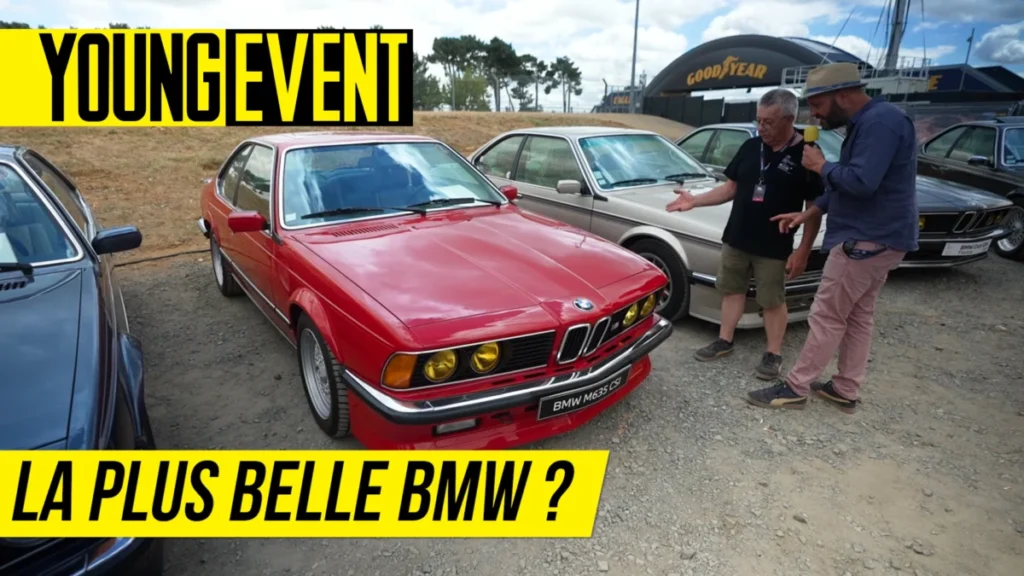
In the pantheon of automotive history, few silhouettes possess the enduring magnetism of the BMW E24 6 Series. Half a century after its inception, this "shark-nosed" grand tourer remains a benchmark for elegance, performance, and engineering ambition. As part of the prestigious Le Mans Classic Legends 2026, we took the opportunity to immerse ourselves in the world of the E24, meeting the dedicated enthusiasts and collectors who ensure this Bavarian icon continues to prowl the asphalt with the same grace it possessed in 1976.
Main Facts: A Masterpiece of Bavarian Design
The BMW E24 is not merely a car; it is a statement of intent. Launched in 1976, the E24 was tasked with a difficult mission: to replace the exquisite E9 coupes while ushering BMW into a new era of luxury and refinement. While the chassis and technical underpinnings were derived from the robust 5 Series (E12), the market positioning was entirely different. At the time of its release, the E24 commanded a price tag comparable to the 7 Series, establishing it as the flagship coupe of the BMW range.
The design, famously penned by the legendary French designer Paul Bracq, remains the car’s most defining feature. Bracq, who had previously shaped the identity of Mercedes-Benz with the iconic "Pagoda" SL, brought a distinct aesthetic to BMW. The shark-like nose, long hood, and thin pillars created an aura of predatory elegance. It was a vehicle designed for high-speed cruising across the autobahns of Europe, capable of carrying its occupants in unparalleled comfort while maintaining a menacing, athletic stance.
Chronology: The Evolution of an Icon
The lifespan of the E24 (1976–1989) is a masterclass in evolution. It remains one of the longest-running production series in BMW history, reflecting its inherent design excellence.
- 1976: The 630 CS and 633 CSi are introduced at the Geneva Motor Show, replacing the E9.
- 1978: The introduction of the 635 CSi. With its 3.5-liter engine, it became the performance benchmark of the lineup and the car that cemented the "shark" reputation.
- 1982: A major technical overhaul occurs. The E24 switches from the E12 5 Series platform to the more modern E28 5 Series platform, improving handling and electrical architecture.
- 1984: The arrival of the M635 CSi. Equipped with the M88/3 engine derived from the M1 supercar, it effectively turned the luxury cruiser into a high-performance sports car.
- 1987: The final aesthetic facelift (the "World" bumpers) is introduced to meet global safety regulations, though many purists still prefer the earlier, chrome-heavy aesthetic.
- 1989: Production concludes after 86,216 units, leaving a legacy that defined the grand tourer segment for a generation.
Supporting Data: The Market Reality of Ownership
For the modern collector, the E24 is no longer just a used car—it is a blue-chip classic. During our interviews at Le Mans, we gathered insights into the current state of the market.
Current Market Valuation
The "value" of an E24 is bifurcated. Entry-level 628 CSi models in decent condition can be acquired for approximately €20,000–€30,000. However, the market for the M635 CSi is a different beast entirely, with pristine, low-mileage examples regularly fetching between €70,000 and over €100,000. The appreciation curve has been steady, driven by a growing recognition of the car’s scarcity and its status as a "youngtimer" icon.
The Real Cost of Maintenance
Enthusiasts are quick to point out that the E24 is a demanding mistress. Maintenance costs can be broken down into three primary categories:
- Corrosion Management: The most significant threat to the E24 is rust. Owners must be diligent with structural checks.
- The "Big Six" Engine: The M30 engine is famously robust, but it requires frequent valve adjustments and cooling system refreshes to handle modern traffic.
- Specialized Components: Parts for the M-series variants are increasingly expensive, with some trim pieces and specific electrical components becoming difficult to source.
Official Perspectives: The Soul of the E24
We spoke with members of the BMW Classic Club, whose dedication to preserving the E24 is the reason many of these cars are still road-legal today. For these owners, the choice of a 6 Series over a contemporary Porsche or Mercedes is ideological.
"It’s about the driving experience," says one long-term owner. "You don’t just drive an E24; you arrive in it. It has a presence that modern cars, with their plastic interiors and digital noise, simply cannot replicate."
When asked why they choose the E24 over newer models, the consensus is clear: the balance. The car offers a tactile connection to the road that is becoming extinct. The steering, the visibility afforded by the thin A-pillars, and the mechanical feedback of the gearbox provide a sense of agency that makes every drive, whether to the grocery store or a cross-continental road trip, an event.
Implications: Why the E24 Still Matters
The 50th anniversary of the E24 serves as a poignant reminder of a time when grand tourers were built to be driven, not just admired in showrooms. As the automotive world pivots toward electrification and autonomous driving, the E24 stands as a monument to the internal combustion era’s peak.
Cultural Significance
The E24 represents the transition of BMW from a niche manufacturer of sporty sedans to a global powerhouse of luxury performance. It proved that BMW could compete with the best in the world in terms of design and prestige. Its influence can be seen in the design language of subsequent BMW coupes, but few have managed to capture the specific blend of aggressive styling and refined luxury that Paul Bracq achieved in 1976.
The Preservation Challenge
The challenge for the next decade is stewardship. As these cars move from "used vehicle" status to "heritage asset," the burden on owners to perform period-correct restorations increases. The community at Le Mans emphasized that "preserving" does not just mean keeping the engine running; it means maintaining the historical integrity of the interior, the original color palettes, and the specific mechanical quirks that make the E24 what it is.
Conclusion: A Legacy in Motion
As we watched the parade of E24s at Le Mans, it was impossible not to be struck by the sheer diversity of the crowd. From the 628 CSi, serving as a reliable entry point for younger collectors, to the high-strung M635 CSi, the E24 platform bridges the gap between generations.
Is it one of the most beautiful BMWs ever produced? The answer from the crowd was a resounding "Yes." Its silhouette—long, low, and perfectly proportioned—is a testament to the fact that great design transcends time.
For those looking to enter the world of classic BMWs, the E24 remains a compelling proposition. It offers the performance to keep up with modern traffic, the reliability of a well-engineered 80s machine, and the timeless style of a Paul Bracq masterpiece. As the sun set over the Le Mans circuit, the gleaming chrome of the shark-nosed coupes served as a reminder: legends never truly retire; they just become more valuable with every passing mile.
Are you a fan of the BMW E24? Whether you own a 635 CSi or are currently scouting the market, we want to hear from you. Tell us in the comments: which version of the "Shark" is your personal favorite, and what makes it the ultimate driving machine in your eyes? Don’t forget to subscribe to Youngtimers La Chaîne for more deep dives into the cars that defined an era.
