

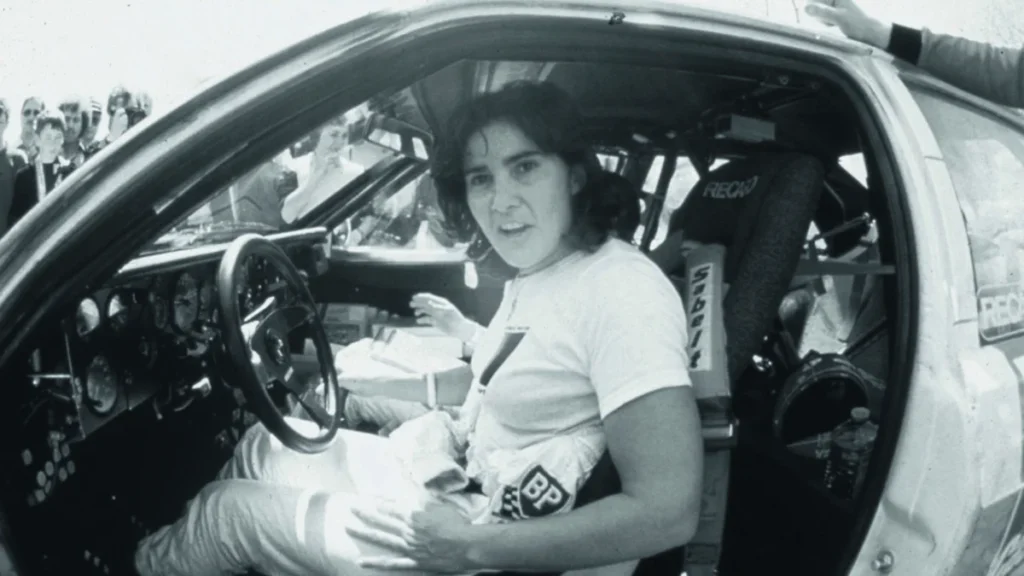
On October 10, 1981, the sun rose over the Italian Riviera to witness a transformation in the landscape of motorsport. As the white and red Audi quattro number 14 rolled onto the Sanremo waterfront, caked in the dust of Tuscany and scarred by the razor-sharp rocks of the Ligurian hills, history was made. Michèle Mouton, accompanied by her Italian co-driver Fabrizia Pons, did not merely win a rally; she shattered the glass ceiling of the World Rally Championship (WRC), becoming the first woman to claim an outright victory in a top-tier world rally event.
This was no fluke of attrition or a gift from failing rivals. Across five grueling days and 59 stages—totaling over 750 kilometers of intense, high-speed combat—Mouton commanded the field. She faced legends like Henri Toivonen and the cream of the factory teams, yet she dominated from the start. This is the chronicle of a watershed moment that forever changed the trajectory of rallying.
The Genesis: Taming the Beast from Ingolstadt
In the autumn of 1981, the Audi quattro Group 4 was an enigma, a mechanical UFO that few truly understood. Having been homologated earlier that year, the German machine had already showcased the undeniable potential of all-wheel drive on the snow-dusted tracks of Sweden under Hannu Mikkola. However, its reliability on gravel and its agility on dry tarmac remained subject to intense skepticism.
The car was a brute. With a 2.1-liter turbocharged engine mounted far forward, creating a significant front overhang, and a mass hovering around 1,200 kilograms, it was a physical challenge to drive. It possessed a stubborn, inherent understeer that required constant, heavy-handed correction.
Michèle Mouton, recruited by Audi to bolster their ranks alongside Mikkola, found herself in a unique predicament. She had to discard the delicate, millimeter-precise driving style she had honed in the Alpine A110 and Porsche Carrera RS. To survive the quattro, she had to learn to bully it. Alongside Fabrizia Pons, whose Italian pace notes were delivered with surgical precision, Mouton transformed from a promising driver into a force of nature. She was not there to collect manufacturer points; she was there to win.
The Chronology of a Conquest
The 1981 Rallye Sanremo was a test of endurance and versatility, switching between the dusty, loose surfaces of Tuscany and the narrow, winding asphalt of the Ligurian mountain passes.
Phase 1: The Tuscan Gravel
From the opening stages, Mouton signaled her intent. While Ari Vatanen, then locked in a fierce battle for the world title in his rear-wheel-drive Ford Escort RS1800, pushed the limit only to succumb to a race-ending accident, Mouton kept her cool. The quattro’s all-wheel-drive system excelled on the loose terrain, allowing her to put power down where her rivals struggled for traction. She secured a series of consecutive scratch times, building a buffer that would prove vital as the rally transitioned.
Phase 2: The Ligurian Asphalt
The traditional expectation was that once the rally hit the narrow tarmac, the lighter, rear-wheel-drive cars—the "purist" rally machines—would reel the heavy Audi in. It was a reasonable assumption, but it failed to account for Mouton’s growing mastery of the beast. Even as the rally moved to the grip-heavy asphalt, the pace did not slacken. The young Finnish prodigy Henri Toivonen, driving a Talbot Sunbeam Lotus, threw everything into the fight. He was relentless, searching for every tenth of a second, yet he could not close the gap.
The Conclusion
When the final stage concluded, the victory was emphatic. Mouton crossed the finish line with a lead of over three minutes over Toivonen. Tony Pond secured third in his Datsun Violet GT, while Hannu Mikkola brought the second Audi home in fourth. The podium was a testament to the fact that the era of two-wheel drive was drawing to a close, and a woman had been the one to write the final chapter of that transition.
Supporting Data: The Physics of the Quattro
The success of the Audi quattro was not merely a triumph of driver skill; it was a triumph of engineering, albeit an engineering style that demanded absolute commitment.
- The Engine: A 2.1-liter, 5-cylinder, turbocharged unit producing over 300 horsepower.
- The Drive: Permanent all-wheel drive (AWD), which at the time was considered a liability due to its weight and complexity.
- The Challenge: Massive understeer due to the longitudinal engine placement.
- The Solution: The "Left-Foot Braking" technique.
To make the car turn, Mouton had to master a complex dance. She would apply the brake with her left foot while keeping her right foot pinned on the throttle. This kept the turbocharger spinning at peak pressure (eliminating "turbo lag") while the rear wheels were locked just enough to initiate a slide. It was an exhausting, high-stakes balancing act that subjected the brakes and transmission to extreme thermal stress over 750 kilometers of racing.
Official Responses and Industry Impact
The aftermath of Sanremo sent shockwaves through the FIA and the automotive industry. Audi’s Motorsport director, Roland Gumpert, noted at the time that the victory proved that all-wheel drive was not just a gimmick for snow, but the future of all rallying.
"Michèle has shown the world what we already knew," the team statement read. "The quattro is the future, and she is its most capable pilot."
Rival teams were forced to scramble. The victory forced manufacturers like Lancia and Peugeot to accelerate their own AWD programs. The motorsport press, which had been skeptical of a "female driver" in such a heavy machine, was forced to undergo a paradigm shift. Reports from L’Équipe and Autosport at the time reflected a genuine sense of astonishment, with headlines shifting from "The Woman at the Wheel" to "The Master of the Road."
The Implications: A Legacy Sealed
The victory on October 10, 1981, was the catalyst for a meteoric rise. In the following year, 1982, Mouton proved that Sanremo was no anomaly. She secured three prestigious victories in Portugal, Greece, and Brazil. She pushed the legendary Walter Röhrl to his absolute limit, ultimately finishing as the runner-up for the World Championship title.
The implications of her career reach far beyond the record books. Michèle Mouton became a symbol of competence and grit, proving that in the cockpit of a rally car, the only thing that matters is the driver’s ability to extract the maximum from the machine.
By the time she retired, she had not only broken the gender barrier; she had redefined the technical requirements of the sport. The "left-foot braking" technique she perfected on the narrow roads of Liguria became standard practice for every rally driver who followed. She did not just drive the Audi quattro; she tamed it, and in doing so, she carved her name into the bedrock of motorsport history. The world of rallying would never be the same again.
