

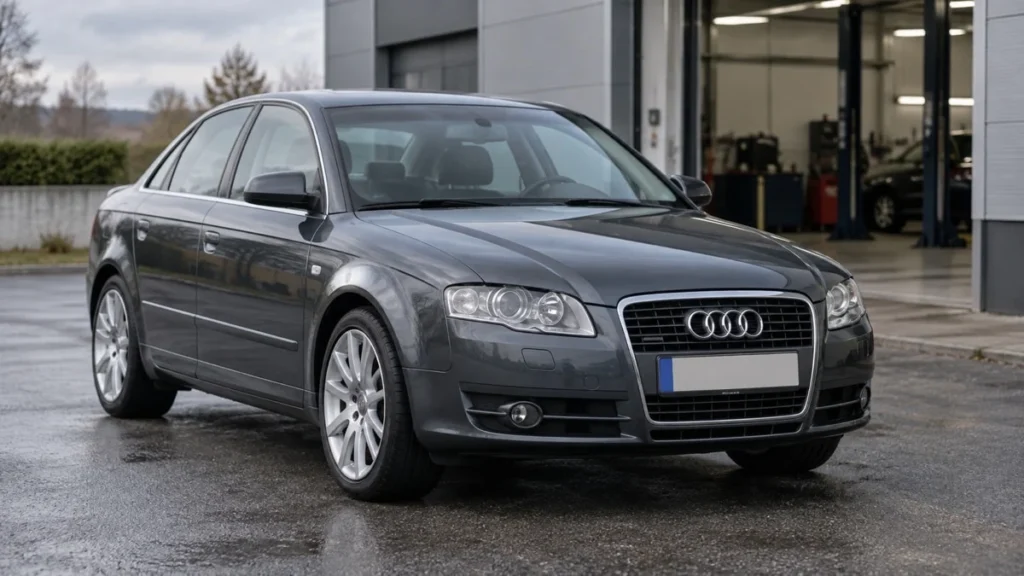
LONDON / PARIS — The automotive industry’s longest-running safety nightmare continues to cast a long shadow over millions of motorists worldwide. As of September 2026, German luxury carmaker Audi has revealed that tens of thousands of its vehicles across Europe remain trapped in a rolling safety crisis due to defective Takata airbag inflators. With strict "Stop Drive" orders still in effect for multiple core models, transport authorities and manufacturers are racing against time to prevent further tragedies.
For affected owners, the message is unequivocal: do not turn the ignition key until the faulty hardware has been replaced.
Main Facts: The Scope of the Audi Takata Crisis
The global Takata airbag scandal—triggered by millions of exploding inflators deploying with excessive force and expelling metal shrapnel into vehicle cabins—remains the largest safety recall in automotive history. In its latest updated monitoring report released in September 2026, Audi outlined the stark reality of its ongoing remediation campaign. Thousands of vehicles on European roads are still operating under absolute immobilization directives.
Audi’s official data highlights the heavy burden still resting on specific models:
| Audi Model | Vehicles Remaining to be Treated ("Stop Drive") |
|---|---|
| Audi A4 | 35,256 |
| Audi A6 | 24,666 |
| Audi TT | 5,563 |
| Audi Q5 | 4,823 |
| Audi A3 | 3,587 |
(Note: These figures represent a snapshot of active cases under strict "Stop Drive" categorization as of September 2026.)
Industry experts emphasize that simply owning an Audi A4 or A6 does not automatically mean a vehicle is dangerous; however, the statistical probability within certain production windows is alarmingly high. Because defects depend heavily on manufacturing plants, production dates, and environmental exposure—particularly high humidity and temperature fluctuations—individual verification via the Vehicle Identification Number (VIN) remains mandatory.
Chronology of a Disaster: How the Takata Scandal Unfolded
To understand the gravity of the September 2026 figures, one must look back at how a single component supplier brought down global automotive giants.
- The Early 2000s: Takata Corporation, a major Japanese automotive parts manufacturer, began utilizing phase-stabilized ammonium nitrate (PSAN) as a propellant in its airbag inflators. The chemical compound was chosen for its low cost, but it lacked a crucial drying agent.
- 2004–2008: The first major structural failures began to surface. Exploding inflators during minor collisions resulted in erratic deployments, spraying metal fragments into passenger compartments. Early incidents were treated as isolated anomalies by both manufacturers and safety regulators.
- 2013–2014: As reports of fatalities and severe injuries mounted globally, major automakers—led by Honda, Toyota, and Nissan—initiated the first widespread recalls. Investigations revealed that prolonged exposure to moisture caused the propellant to degrade violently over time.
- 2015–2017: The crisis exploded into public consciousness. Takata faced intense regulatory pressure, multi-billion-dollar lawsuits, and criminal investigations. In June 2017, Takata filed for bankruptcy protection with liabilities exceeding $10 billion, marking one of the largest manufacturing bankruptcies in history.
- 2018–2023: Audi, alongside Volkswagen Group and dozens of other international brands, systematically expanded its recall campaigns. Millions of vehicles were retrofitted. Yet, millions more remained unaccounted for as second- and third-hand owners proved difficult to track.
- 2024–2026: Regulators introduced aggressive measures, escalating standard safety recalls into mandatory "Stop Drive" directives. Governments across Europe empowered transport ministries to urge immediate immobilization, bypassing standard grace periods and warning that vehicles left un-repaired pose an unacceptable public hazard.
Supporting Data and The Danger of Ammonium Nitrate
The core issue behind the Takata inflators lies in the chemical physics of ammonium nitrate. Without a desiccant (a drying agent) to absorb moisture, the propellant degrades when subjected to cyclic temperature swings and high humidity.
When the airbag control unit triggers a deployment, the degraded propellant burns too quickly and violently. This generates internal pressures that rupture the metal inflator housing, turning the metal casing into shrapnel.
Why Time is the Enemy
Safety authorities note that the risk of a rupture increases exponentially with the age of the vehicle. An airbag manufactured in 2005 or 2010 is exponentially more hazardous in 2026 than it was a decade prior. This cumulative chemical degradation is precisely why transport ministries are demanding immediate immobilization for remaining models, rather than waiting for routine annual vehicle inspections (such as France’s contrôle technique or equivalent European roadworthiness tests).
Official Responses: Government Mandates and Consumer Rights
In response to lagging remediation numbers, European transport ministries—including the French Ministry for Ecological Transition and Transport—have stepped up pressure on both manufacturers and vehicle owners.
Zero Cost to the Consumer
Regulatory frameworks are unambiguous: the replacement of defective Takata airbags is entirely free of charge for the vehicle owner. Audi, as the manufacturer, bears 100% of the financial responsibility for parts, labor, and logistical accommodations.
Furthermore, for vehicles subject to a "Stop Drive" order, the manufacturer is legally and ethically bound to ensure the owner is not left stranded or forced to break the law by driving to a garage. Official guidelines stipulate:
- On-Site Repairs or Free Towing: If a vehicle cannot be driven, Audi must arrange for a mobile technician to perform the repair at the owner’s home, or provide free transportation (towing) of the vehicle to an authorized service center.
- Alternative Mobility Solutions: If an appointment for the repair cannot be secured within 15 days, the manufacturer must provide a complimentary temporary mobility solution. This can take the form of a courtesy car, a rental vehicle, or an equivalent transit allowance for the duration of the vehicle’s immobilization.
Implications for Audi Owners: Step-by-Step Verification
If you drive an Audi—particularly models from the A4, A6, TT, Q5, or A3 lines produced during the affected manufacturing windows—you must act immediately. Do not wait for a notification letter in the mail, as change of ownership records often delay official postal communications.
Step 1: Locate Your VIN
Locate the Vehicle Identification Number (VIN), a unique 17-character alphanumeric code. The easiest place to find this is in Section E of your vehicle registration document (carte grise in France), or stamped onto the lower corner of the front windshield on the driver’s side.
Step 2: Check the Official Audi Portal
Navigate to the official Audi recall portal (accessible via national Audi websites, such as audi.fr/fr/campagne-rappel-airbag-takata). Enter your VIN into the online lookup tool and complete any requested prompts.
Step 3: Contact an Authorized Audi Repairer Immediately
If the system indicates your vehicle is subject to a recall—specifically a "Stop Drive" notice—do not drive the car.
- Pick up the phone and call an authorized Audi service center.
- Explicitly state that your vehicle is under a "Stop Drive" Takata recall.
- Demand that the dealership coordinate the towing of the vehicle and arrange your temporary replacement transport free of charge.
By following these protocols, motorists can help close the final chapter on one of industrial history’s darkest safety failures, ensuring that a preventable tragedy does not strike another family on the road.
