

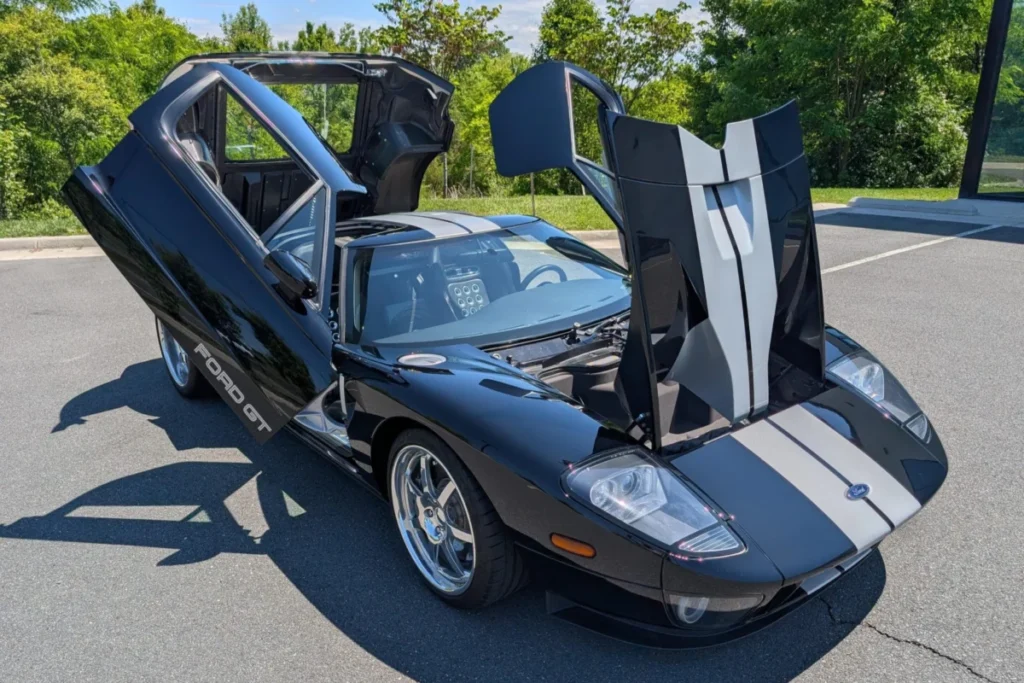
In the pantheon of modern American automotive icons, few vehicles command the same reverence as the 2006 Ford GT. Born as a celebration of the company’s centennial and a spiritual successor to the legendary GT40, the Ford GT was more than just a supercar; it was a masterclass in engineering that managed to blend 1960s Le Mans DNA with 21st-century manufacturing prowess. Currently listed for sale through dealer consignment is a pristine, heavily modified example that pushes the boundaries of this platform, turning a collector’s dream into a high-octane street machine.
Finished in striking Mark II Black with optional silver over-the-top racing stripes, this specific vehicle is one of only 292 finished in this particular color combination out of the 2,011 units produced for the 2006 model year. With 13,000 miles on the odometer—half of which were accrued during the current owner’s tenure since 2015—this Ford GT stands as a testament to both careful stewardship and a passion for performance.
The Engineering Pedigree: Honoring the GT40
The 2006 Ford GT was, and remains, an architectural marvel. It utilizes an extruded-aluminum space frame, roll-bonded floors, and aluminum body panels that pay homage to the structural innovations of the original GT40 racers. The chassis is a stiff, lightweight skeleton designed to handle the immense torque of its mid-mounted powertrain.

This specific example takes that foundation and elevates it with several bespoke touches. Most notably, the vehicle has been retrofitted with a Genaddi Design Group scissor-door kit, a modification that adds a dramatic, exotic flair to the already iconic silhouette. Further aesthetic and aerodynamic enhancements include a front splitter, a rear diffuser, a vented hood, and a rear bumper delete kit that exposes the raw, mechanical essence of the rear transaxle and exhaust assembly.
A Chronology of Modifications
While the Ford GT was a formidable performer straight off the assembly line, the current owner sought to sharpen its edges. The transformation process involved a comprehensive suite of mechanical upgrades, primarily handled by the experts at Discovery Automotive.
The Powerplant
At the heart of the machine lies the 5.4-liter DOHC V8, an engine already renowned for its robust power delivery. To move beyond the factory output, the engine was treated to a Whipple supercharger upgrade, significantly increasing the air intake volume. To support this boost, the system includes a larger-diameter throttle body and a DiabloSport MAFia signal tuner. The engine management system is controlled by an SCT Flash Pro-Race tuning system, ensuring that the air-fuel ratios remain optimal under heavy load.

The Exhaust and Drivetrain
The auditory experience of the V8 is heightened by a high-performance exhaust system. The car features Stainless Works headers mated to a Thermo-Tec-wrapped Accufab Racing exhaust, complete with an X-pipe and custom baffles. This setup creates a raw, visceral soundscape that mirrors the car’s aggressive demeanor. The power is funneled through a Ricardo six-speed manual transaxle, featuring a helical limited-slip differential to ensure that the rear wheels maintain traction. To keep the transmission temperatures in check during spirited driving, a Ford Racing transaxle cooler assembly has been integrated into the powertrain.
Chassis and Braking
Handling the added power required a serious upgrade to the rolling stock. The car sits on staggered-diameter HRE wheels—polished to a mirror finish—wrapped in sticky Michelin Super Sport tires. Bringing this beast to a halt are Brembo four-piston monoblock calipers, which clamp down on massive cross-drilled and ventilated rotors measuring 14 inches in the front and 13.2 inches at the rear.
Supporting Data: Interior and Ergonomics
The interior of this Ford GT is a study in purposeful design. The cockpit is swathed in Ebony leather, with the driver and passenger seated in Sparco-designed carbon-fiber shells. These seats aren’t just for aesthetics; they feature the iconic GT40-style ventilation grommets and harness slots that prioritize airflow and stability.

The driver’s environment is anchored by a leather-wrapped steering wheel mounted on a tilting and telescoping column. Behind it sits the legendary gauge cluster: a massive, centrally mounted tachometer with a 6,500-rpm redline, flanked by an offset 220-mph speedometer. Secondary gauges for boost, oil pressure, coolant temperature, voltage, and fuel level are positioned in the center stack, complete with the tactile, aircraft-inspired toggle switches that define the GT’s interior.
Modern amenities have been carefully integrated to enhance usability. These include a Ford Racing short-throw shifter for more precise gear changes, a retro-style dome light, push-button ignition, and a custom audio system equipped with a subwoofer. A Pioneer rearview camera has been added to assist with parking, a necessary upgrade given the low-slung, wide nature of the vehicle.
Official Responses and Documentation
For the discerning collector, documentation is paramount. This Ford GT comes with a clean Carfax report, verifying that the vehicle has remained accident-free throughout its life. The current owner has also taken meticulous care of the vehicle’s presentation, as evidenced by the recent dry-ice cleaning of the undercarriage—a process that removes road grime and oxidation to reveal the factory-fresh aluminum components underneath.

However, prospective buyers should take note of the disclosure provided by the selling dealer: due to the extensive nature of the aftermarket modifications, particularly those affecting the emissions and exhaust systems, the vehicle will not pass a Virginia state inspection. This car is intended for the enthusiast who values performance and character over factory-spec emissions compliance, and it is likely best suited for track use or as a premier piece for a private collection where such modifications are celebrated.
Implications for the Collector
The market for the 2006 Ford GT has remained exceptionally strong, with these cars increasingly viewed as the "final analog supercars" of the modern era. When a car is modified to this level, it often polarizes the collector community. Purists may gravitate toward stock examples, but those who understand the pedigree of components like Whipple superchargers and HRE wheels will recognize that this build was executed with an eye toward performance and long-term reliability.
The inclusion of an automatic fire suppression system is a subtle but significant detail that speaks to the owner’s intent for the vehicle. It is a car built to be driven, and driven hard. The 13,000 miles on the clock, while low, suggest a life lived in motion rather than one spent languishing under a dust cover.

In conclusion, this 2006 Ford GT is an intersection of heritage and innovation. It retains the spirit of the 1960s Le Mans racers while benefiting from the refined tuning and performance hardware of the modern aftermarket. It is a rare, well-documented, and mechanically enhanced iteration of one of the greatest automobiles ever produced by the Ford Motor Company. For the collector seeking a vehicle that is not just a museum piece, but a visceral driving experience, this Mark II Black GT presents an opportunity that is as rare as the car itself.
