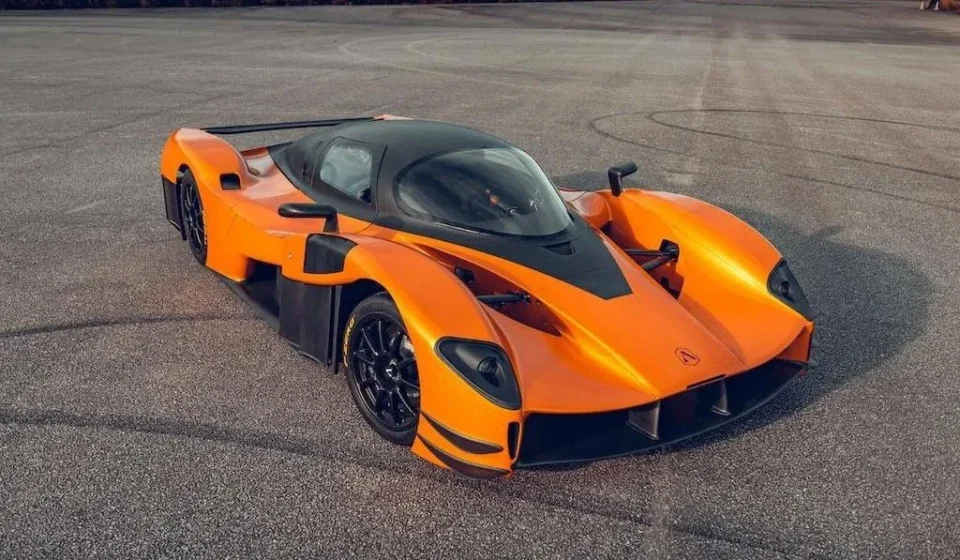

In the increasingly crowded and hyper-competitive segment of hypercars, where manufacturers compete for milliseconds and million-dollar price tags, a new, unexpected player has emerged from the Iberian Peninsula. Adamastor, a nascent start-up based in Portugal, has officially pulled the veil off its debut project: the Furia. With a design language that prioritizes aerodynamic efficiency above all else and a heart sourced from the industrial corridors of Detroit, the Furia is not merely a car—it is a bold statement of intent.
While Portugal is rarely the first nation cited when discussing the pantheon of extreme supercars, Adamastor aims to rewrite that narrative. The Furia is a track-focused machine that has been homologated for road use, possessing a silhouette that appears as if it were plucked directly from a Le Mans starting grid.
Main Facts: A Symphony of Carbon and Detroit Muscle
The Adamastor Furia is a masterclass in functional aesthetics. At its core, the vehicle operates under the philosophy of "form follows function," a mantra that has resulted in a radical, almost alien aesthetic.
Aerodynamics: The Pursuit of Downforce
The Furia’s exterior is dominated by a Formula 1-inspired nose, a narrow, canopy-like cockpit, and pronounced, floating wheel arches that give the impression of a vehicle sculpted by the wind rather than by a designer’s pen. The entire body is constructed from lightweight carbon fiber, ensuring the chassis remains as rigid as it is aerodynamically efficient.
The headline figure for the Furia is its downforce generation. In its track-optimized configuration, the vehicle generates a staggering 1,799 kg of downforce at 250 km/h. To put this in perspective, this figure exceeds the total weight of the car itself, suggesting that the Furia possesses the potential for lateral grip and cornering speeds that could challenge the most established names in the industry.
Powertrain: The Ford Connection
While competitors often opt for bespoke, high-strung naturally aspirated V12s, Adamastor has taken a pragmatic approach. The Furia is powered by a 3.5-liter twin-turbocharged V6—the very same "Made in USA" powerhouse that propelled the iconic Ford GT to global acclaim.
Retuned specifically for the Furia’s unique chassis, this power unit delivers 650 horsepower and 570 Nm of torque. While these figures may seem conservative compared to the 1,000+ horsepower monsters currently flooding the market, the Furia’s performance is dictated by its power-to-weight ratio. With a 0 to 100 km/h time of approximately 3.5 seconds and a top speed reaching 300 km/h in its road-legal iteration, the Furia relies on agility and balance rather than raw, unbridled brute force. Power is delivered to the rear wheels via a high-performance sequential transmission, with stopping power provided by a competition-grade braking system from AP Racing.
Chronology: From Concept to Reality
The journey of Adamastor began as a passion project, a multi-year development cycle aimed at bridging the gap between track-only prototypes and road-legal hypercars.
- Phase I: The Vision. Adamastor focused on rigorous wind-tunnel testing. The primary goal was to optimize the "ground effect" to ensure that the Furia could maintain stability at high speeds without requiring massive, drag-inducing wings.
- Phase II: The Engineering Prototype. The team selected the Ford V6 platform early on, recognizing the engine’s proven reliability and compact dimensions, which allowed for a lower center of gravity.
- Phase III: The Unveiling. After years of secrecy, Adamastor presented the Furia to the world. The debut was met with immediate comparisons to the Aston Martin Valkyrie, largely due to the similar cockpit bubble and aerodynamic channels.
- Phase IV: Production and Delivery. With the prototype validated, the company has announced a production run of just 60 units, marking the start of a new chapter for the Portuguese manufacturer.
Supporting Data: Technical Specifications at a Glance
To understand the Furia, one must look at the data that defines its personality. It is not designed to be the fastest car in a straight line, but the most precise car through a series of technical corners.
| Feature | Specification |
|---|---|
| Engine | 3.5L Twin-Turbo V6 (Ford sourced) |
| Output | 650 HP |
| Torque | 570 Nm |
| Downforce | 1,799 kg at 250 km/h |
| Transmission | Sequential |
| Production | 60 Units |
| Price | €1.6 Million (excl. taxes) |
The use of the AP Racing braking system highlights the car’s commitment to track performance. These components are specifically designed to handle the thermal stress of endurance racing, ensuring that the Furia remains consistent during long stints on the circuit.
Official Responses: What Adamastor Represents
While the hypercar market is often criticized for becoming a "spec-sheet war," the leadership at Adamastor has emphasized the experience of driving the Furia. In early statements, the company has described the Furia as an "analogue hypercar for the digital age."
By avoiding complex hybrid systems or oversized electric motors, Adamastor has kept the weight down, which they argue results in a more engaging, visceral, and "pure" driving experience. The decision to limit production to 60 units is not just a marketing ploy to increase value; it is a necessity for the boutique manufacturing processes employed at their facility. Each car is expected to be highly customizable, allowing clients to tailor the suspension and aerodynamic settings to their specific track requirements.
Implications: The Market Disruptor
The entry of the Adamastor Furia carries significant implications for the hypercar market, particularly for the "boutique" segment.
A Challenge to Established Icons
At a price point of €1.6 million (approx. $1.9 million), the Furia sits in a precarious position. It is priced to compete with giants like Pagani and Koenigsegg, and newcomers like the Czinger 21C. The primary challenge for Adamastor will be brand equity. In this segment, the badge is often as important as the performance. However, if the Furia can demonstrate its promised on-track performance, it could quickly become a "must-have" for collectors who prioritize engineering purity over brand history.
The Rise of Regional Hubs
The success of Adamastor signals a broader trend: the decentralization of high-performance automotive manufacturing. We are seeing a shift where small, highly specialized teams in non-traditional automotive hubs (such as Portugal, Croatia, and the Czech Republic) are leveraging global supply chains—like sourcing engines from Ford or components from AP Racing—to create world-class vehicles.
The Future of "Pure" Performance
Finally, the Furia represents a potential "last stand" for the combustion-powered track machine. As the automotive world tilts aggressively toward electrification, the Furia stands as a tribute to the internal combustion engine. By taking a proven, reliable V6 and housing it in an aerodynamic shell that defies physics, Adamastor is catering to a demographic that values mechanical feedback and engine noise over the instant torque of an electric motor.
In conclusion, while the Adamastor Furia faces an uphill battle to secure its place among the legends of the industry, its arrival is undeniably exciting. It combines the reliability of American engineering with the bold, avant-garde design sensibilities of a European boutique firm. Whether it succeeds in becoming a commercial juggernaut or remains a rare, cult-classic collector’s item, the Furia has effectively put Portugal on the map of high-performance automotive excellence. For the 60 lucky individuals who manage to secure an allocation, the Furia will not just be a car—it will be a testament to the fact that, even in a world of data and algorithms, there is still room for raw, wind-sculpted passion.