
While 2026 marks a monumental milestone for Volkswagen—the 50th anniversary of the legendary Golf GTI—the following year, 2027, is poised to be defined by a different letter: "R." As Volkswagen’s high-performance division celebrates its 25th anniversary, the German manufacturer has officially announced its return to the world of top-tier motorsport. The stage for this resurgence is the most demanding circuit on the planet: the Nürburgring Nordschleife. To signal this shift, Volkswagen R has unveiled a striking "24H show car," a prototype that serves as a precursor to a hardcore, all-wheel-drive racing machine designed specifically for the rigors of endurance racing.
The Evolution of the "R" Badge: From VR6 Roots to Racing Prowess
To understand the weight of this announcement, one must look back at the history of the "R" designation. When the Golf 4 R32 debuted in 2002, the "R" stood for "Reihe"—German for "in-line"—a direct reference to the iconic 3.2-liter VR6 engine that powered the hot hatch. It was a car that defined an era, blending luxury, daily usability, and a soundtrack that remains unmatched in the segment.
However, the "R" identity has undergone a profound metamorphosis. Over the last two decades, the focus shifted from simple displacement to the "Racing" ethos. The catalyst for this change was the Polo R WRC, a vehicle that shattered records and expectations, securing four consecutive World Rally Championship titles. This period cemented the idea that Volkswagen’s performance arm was no longer just about fast street cars; it was about engineering excellence under pressure. By 2027, as the division celebrates its silver anniversary, the brand is returning to its roots—the "Green Hell"—to prove that the DNA of the Golf R is forged in competition.
The Technical Challenge: Engineering for the Nordschleife
For this ambitious project, Volkswagen R is not going it alone. The manufacturer has entered a strategic partnership with Max Kruse Racing, an outfit with deep experience on the Nordschleife. The objective is to transform the current Golf 8 R production model into a high-downforce, endurance-focused racing prototype capable of surviving 24 hours of sustained abuse on the 25-kilometer circuit.
Keeping the Core DNA: The 4MOTION Legacy
While technical specifications remain largely under wraps, Volkswagen has confirmed that the vehicle will retain its signature 4MOTION all-wheel-drive system. This is a critical strategic decision. The 4MOTION architecture has been the backbone of the Golf R’s success in the consumer market, providing the grip and stability required to harness high horsepower. By keeping this system at the heart of the race car, Volkswagen is ensuring that the link between the track machine and the showroom floor remains intact.
Reinhold Ivenz, the director of Volkswagen R, has been vocal about the team’s high aspirations. "We are committed to delivering the most spectacular Golf R to date," Ivenz stated. The engineering team is focusing on weight reduction, chassis rigidity, and thermal management—the three pillars of success in 24-hour endurance racing.
A Technological Laboratory: Beyond Marketing
Volkswagen’s return to the Nürburgring is far more than a marketing exercise. For the past three years, the division has provided support to the Golf GTI Clubsport, gaining invaluable data in the process. Now, by elevating the Golf R to a dedicated factory-supported racing program, Volkswagen is creating a high-speed, high-stress laboratory.
The Role of Development Pilots
Leading the development program is Benjamin Leuchter, a renowned test and development driver whose fingerprints are already on several of Volkswagen’s performance production vehicles. Leuchter’s involvement is a clear indication of the project’s intent: the lessons learned during the 24-hour race—where components are subjected to extreme heat, vibration, and driver fatigue—will be funneled directly back into the R&D department.
This feedback loop is crucial for the future of the R brand. In an era where the automotive industry is grappling with electrification and software-defined vehicles, Volkswagen R is using this racing program to refine torque-vectoring software, cooling strategies, and chassis dynamics that will define the next generation of performance hatchbacks. The track is the ultimate filter for production innovation.
The "Golf R 24H" Show Car: A Vision of the Future
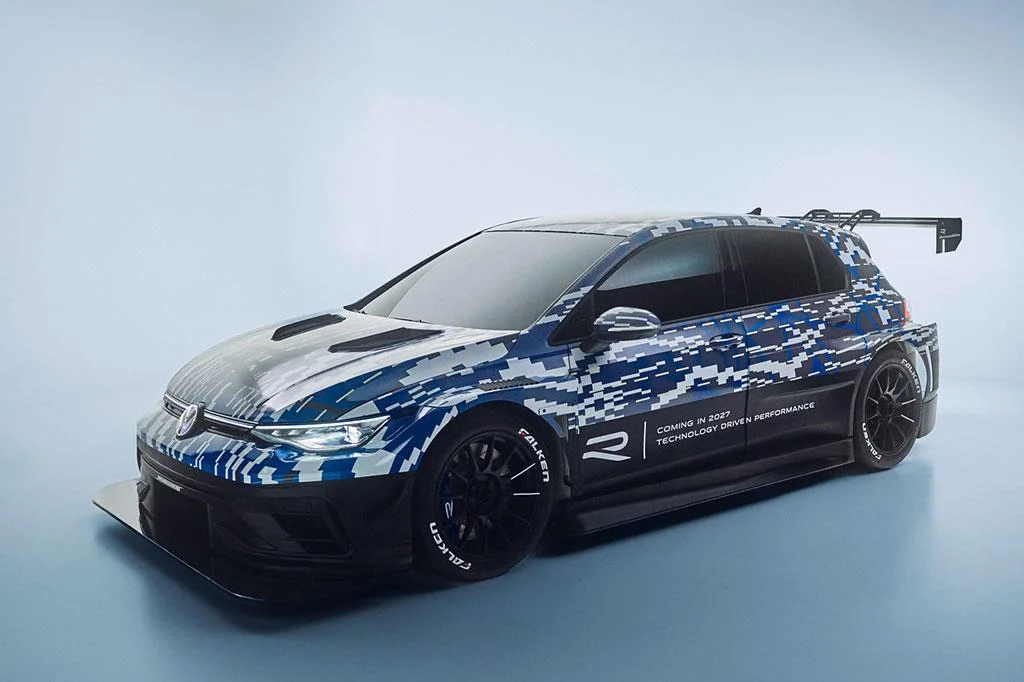
To generate momentum ahead of the 2027 debut, Volkswagen has unveiled the "Golf R 24H" show car. Currently displayed at the Ring Boulevard at the Nürburgring, the concept provides a tantalizing glimpse into the aesthetic and aerodynamic direction of the future race car.
Design and Aerodynamics
The show car features an aggressive, widened stance that differentiates it sharply from the stock Golf 8 R. Key visual elements include:
- Aerodynamic Package: A widened track width accommodated by custom fenders, designed to improve stability at high cornering speeds.
- Downforce Elements: A massive, track-focused rear wing and a prominent front splitter that hint at the immense grip levels required for the Nordschleife’s fast, undulating sections.
- Race-Ready Aesthetics: A deep rear diffuser and a bespoke racing livery that pays homage to the 25-year history of the R brand.
While Volkswagen has yet to confirm if a limited-edition "R 24H" production run will follow, the buzz surrounding the show car suggests an insatiable appetite among enthusiasts for a road-legal version of this track weapon.
Strategic Implications and Future Outlook
The decision to return to the Nürburgring in 2027 serves as a pivot point for the Volkswagen Group. As the automotive world trends toward electrification, maintaining a high-performance internal combustion (or hybrid-assisted) program is a statement of intent. It confirms that Volkswagen remains committed to the "driving experience" as a core pillar of its corporate identity.
Why the Nürburgring Matters
The "Enfer Vert" (Green Hell) remains the ultimate validation for any performance car. Its complexity—featuring over 150 turns and massive elevation changes—tests every aspect of a vehicle’s mechanical and electronic systems. By tackling the 24-hour race, Volkswagen R is not just aiming for a podium; they are aiming for the "badge of honor" that only a successful Nürburgring campaign can provide.
Market Positioning
For the consumer, this program elevates the prestige of the Golf R. In a segment increasingly crowded by premium rivals, having a "factory-backed" racing pedigree adds a layer of authenticity that is difficult to replicate through marketing alone. If the 2027 race proves successful, we can expect to see "Nürburgring-edition" performance upgrades, advanced suspension geometry, and perhaps even a shift in how the R brand markets its next generation of all-electric or plug-in hybrid performance models.
Conclusion: The Road to 2027
The year 2027 will not just be an anniversary celebration; it will be a demonstration of Volkswagen R’s ability to bridge its storied past with its high-tech future. From the modest beginnings of the VR6-powered Golf R32 to the complex, data-driven endurance racing machine of the future, the "R" brand has consistently evolved to meet the demands of the enthusiast driver.
As the team at Max Kruse Racing and Volkswagen R begin the arduous process of track testing and data acquisition, the automotive world will be watching closely. Whether the goal is to set a new lap record or simply to cross the finish line after 24 hours of grueling combat, one thing is certain: the spirit of the "R" is alive and well. The Nordschleife awaits, and for Volkswagen, the race to 2027 has only just begun.
