

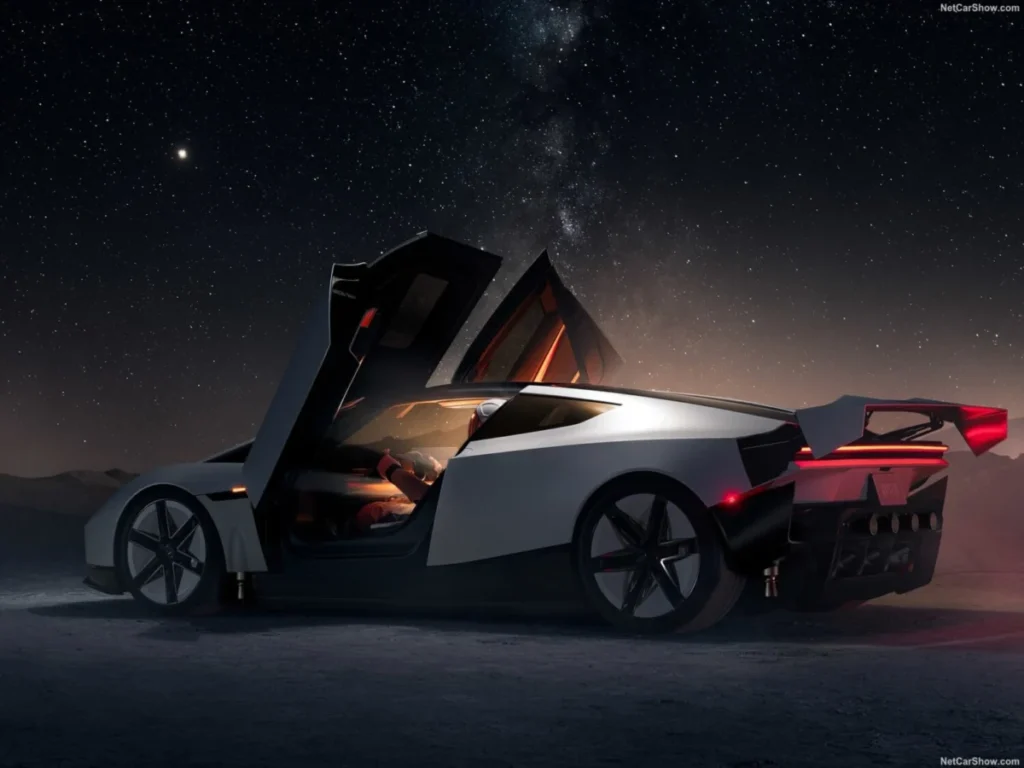
Tesla has once again shattered the boundaries of expectation, turning the automotive world on its head with a demonstration that feels less like a product launch and more like a sequence from a high-budget science fiction epic. The Tesla Roadster, a nameplate that has been in a state of purgatory since its initial unveiling in 2017, has re-emerged with a radical new design and performance claims that challenge the very laws of physics. However, beneath the cinematic glitz of thrusters and airborne maneuvers lies a daunting reality: the chasm between a prototype built for the stage and a production vehicle capable of navigating the complexities of the global automotive market.
The Engineering of Flight: When Physics Meets Fantasy
Tesla’s latest demonstration was, by any measure, audacious. Rather than a traditional stage reveal, the company opted for a display that borrowed heavily from aerospace engineering. In a viral clip, the vehicle is seen navigating a near-vertical ramp, transitioning onto a horizontal surface, and—most remarkably—performing controlled aerial maneuvers before landing safely.
This spectacle was not merely a feat of clever editing. According to official disclosures, the Roadster utilizes a dual-system approach to achieve these "impossible" movements. First, fans mounted beneath the chassis generate a localized low-pressure zone, effectively sucking the vehicle to the tarmac. Tesla claims this system provides a downward force equivalent to twice the acceleration of gravity, allowing the car to maintain grip even at a standstill.
Once the car leaves the ground, a secondary system of cold-gas thrusters—developed in collaboration with SpaceX—takes over. These thrusters are powered by high-pressure air stored in dual 600-liter tanks. Elon Musk has suggested that the system draws from atmospheric air, which can be replenished while the vehicle is in motion. While technologically captivating, the integration of such a system into a road-legal car presents an engineering nightmare: managing weight distribution, safety protocols, and stringent global homologation standards.
Furthermore, the company has teased a 0-to-100 km/h sprint in under one second. Such a figure is, by all traditional metrics, aberrant. Whether this speed is achieved through wheel-driven traction or assisted by the aforementioned thruster package remains a point of intense speculation and skepticism among automotive engineers.
A Chronology of Anticipation: Eleven Years in the Making
To understand the weight of the current hype, one must look at the timeline. The original Roadster prototype was unveiled in November 2017, promising a revolution in electric performance. At the time, Tesla promised a top speed exceeding 400 km/h and an unprecedented range of 1,000 kilometers.
However, the path to production has been fraught with repeated delays. As we enter the latter half of the 2020s, the prospect of a 2028 production start date looms. Should this timeline hold, it will have been 11 years since the world first laid eyes on the concept. This decade-long gestation period has seen the vehicle evolve from the sleek, organic curves of the original 2017 model to the current, aggressive, and angular design. The new silhouette, characterized by sharp edges and tensioned surfaces, draws distinct inspiration from the Tesla Cybertruck, signaling a shift in the brand’s design language toward a more industrial, "Blade Runner" aesthetic.
The chronology of this project serves as a masterclass in the "Muskian" method: announce a groundbreaking vision, capture the global imagination, and then embark on a tortuous, years-long journey to bridge the gap between that vision and reality. For those who placed deposits nearly a decade ago, the wait has been a test of patience that few other manufacturers would have survived.
The Technical Enigma: What Lies Beneath?
Despite the recent spectacle, the technical specifications remain shrouded in ambiguity. While Tesla touts a top speed exceeding 370 km/h, the granular details—battery chemistry, specific motor configurations, and power output—have yet to be disclosed in a format that would satisfy a technical audit.
We do know that the vehicle is set to feature "drive-by-wire" technology, where the steering, acceleration, and braking are entirely electronically controlled, removing mechanical linkages. Additionally, the active rear wing is designed to adjust its aerodynamic profile in real-time, responding to the vehicle’s speed and stability requirements.
Three distinct tiers have been identified on the company’s website:
- Performance: The entry point for the new lineup, requiring a $50,000 deposit.
- Thrust: A $250,000 reservation tier that promises the most extreme performance metrics.
- Rocket: An invitation-only version, presumably integrating the full suite of SpaceX-derived thruster technology.
These deposit structures are unconventional. They serve as a mechanism for Tesla to generate capital and gauge interest, but they do not function as a guarantee of final specifications. As it stands, the "Rocket" configuration remains more of a research project than a confirmed consumer product.
Official Stance and Market Implications
Elon Musk has been characteristically vocal about the challenges ahead. He has acknowledged that bringing the Roadster to life is an "incredibly complex and tedious" process, noting that thousands of modifications are required to ensure the car can safely exist on public roads.
The implications for Tesla are significant. On one hand, the Roadster serves as a halo vehicle—a brand-defining product that elevates Tesla’s prestige in the eyes of enthusiasts and investors alike. It reinforces the narrative that Tesla is not merely a car company, but a technology firm capable of rewriting the laws of physics.
However, the opportunity cost is non-trivial. Resources allocated to the Roadster could have theoretically been directed toward scaling the mass-market fleet or refining the Full Self-Driving (FSD) software stack. Furthermore, the credibility of the brand rests on delivery. With the Cybertruck and the Semi having already faced their own production hurdles, the market’s tolerance for further delays on the Roadster is wearing thin. If Tesla fails to deliver a product that lives up to the "flying" performance promised in the latest demos, the backlash could damage the brand’s reputation for innovation.
The Path Forward: From Spectacle to Showroom
The transition from a prototype that can perform a "kickflip" to a vehicle that can be parked in a garage and driven to the grocery store is the most difficult challenge Tesla has ever faced. The engineering team must solve the issue of heat dissipation for the thrusters, the structural integrity of the chassis under the stress of rapid acceleration, and the legal nightmare of obtaining safety certification for a vehicle that technically possesses the capabilities of a low-altitude aircraft.
Moreover, the competitive landscape has shifted dramatically since 2017. Brands like Rimac, Lotus, and even traditional giants like Porsche have made massive strides in electric hypercar performance. Tesla is no longer the sole contender in the high-performance EV space; it is now entering a crowded market where performance is the baseline, and reliability, build quality, and user experience are the primary differentiators.
In conclusion, the Tesla Roadster is a testament to the power of ambition. Whether it represents the future of transportation or a brilliant, expensive distraction remains to be seen. Elon Musk has succeeded in the "easy" part: he has made the world watch. Now, he must perform the truly difficult feat of turning a piece of science fiction into a machine of steel, glass, and software that can actually be delivered to a customer. The clock is ticking toward 2028, and the automotive world is waiting to see if the Roadster will truly take flight—or if it will remain a high-altitude dream tethered to the ground by the gravity of reality.
