

Main Facts
As the automotive landscape continues its relentless march toward electrification, software-defined mobility, and anonymous crossover design, the appreciation for analog automotive history has never been more fervent. Enter Youngtimers magazine, the definitive French publication dedicated to the cars of our youth—specifically those built from the late 1970s through the early 2000s.
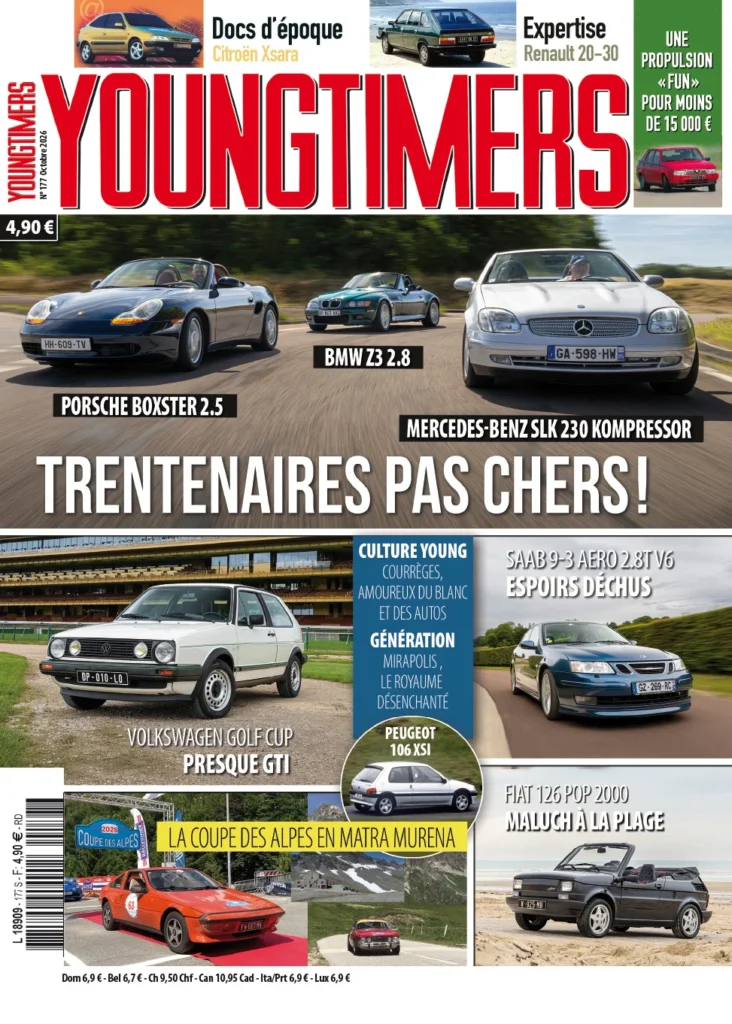
In its landmark October 2026 edition, Issue #177, the editorial team has curated a sweeping lineup that targets the very heart of enthusiast nostalgia. Hitting newsstands on September 30, 2026, this month’s issue leans heavily into the late-1990s roadster renaissance, turbocharged sleepers, motorsport heritage, and quirky daily drivers that defined an era.
At the center of Issue #177 is a heavyweight comparative retrospective celebrating the late-20th-century affordable open-top sports car. In an era when automakers dared to build lightweight, rear-wheel-drive roadsters, the market was electrified by a trio of German heavyweights: the BMW Z3 2.8, the Mercedes-Benz SLK 230 Kompressor, and the Porsche Boxster 2.5. Youngtimers takes a nostalgic yet critical look back at how these three machines captured the imaginations—and financial stretched budgets—of enthusiasts nearly three decades ago.
Beyond the wind-in-the-hair roadster trinity, the October 2026 issue delivers an eclectic mix of performance hatchbacks, executive sleepers, quirky microcars, and grand touring adventures. From the track-bred intensity of the Volkswagen Golf Cup to the devastating turbocharged punch of the Saab 9-3 Aero 2.8T V6, and the grassroots motorsport spirit of the Peugeot 106 XSI, Issue #177 proves that driving passion transcends high price tags.
Furthermore, the magazine embraces automotive diversity by spotlighting the Fiat 126 Pop 2000, revisiting the plush comfort of the executive Renault 20 and Renault 30 duo, examining the unsung everyday utility of the Citroën Xsara, and embarking on an alpine grand tour behind the wheel of a wedge-shaped Matra Murena.
For automotive enthusiasts looking to secure a copy, Youngtimers has made Issue #177 available both in traditional kiosks across France and directly through its online store, offering free shipping at the standard cover price.
Chronology
To understand how Youngtimers magazine arrived at the compelling editorial mix found in Issue #177, it is necessary to trace both the timeline of the vehicles featured within its pages and the publication’s trajectory within the enthusiast press ecosystem.
The Evolution of the Featured Era (1975–2006)
- Late 1970s (1975–1979): The foundation of French executive motoring is laid during this period. Vehicles like the Renault 20 and Renault 30 (introduced in the mid-to-late ’70s) represent France’s bold, albeit complex, foray into large hatchback design, prioritizing plush comfort and avant-garde styling.
- Early 1990s (1991–1993): The dawn of the hot hatchback golden era. The Peugeot 106 XSI debuts in the early ’90s, offering razor-sharp handling and communicative chassis dynamics that teach a generation of drivers the art of momentum driving.
- Mid-to-Late 1990s (1996–1999): The golden age of the modern affordable roadster. Following Mazda’s revival of the segment, Germany responds with a vengeance. The Porsche Boxster 2.5 launches for the 1997 model year (revealed as a concept in 1993 and production-ready in ’96), closely followed by the mechanically aggressive BMW Z3 2.8 and the innovative, supercharged Mercedes-Benz SLK 230 Kompressor. Concurrently, touring car series like the Volkswagen Golf Cup foster intense, accessible motorsport competition.
- Turn of the Millennium (2000): Transition eras produce fascinating oddities. The Fiat 126 Pop 2000 represents the twilight and specialized revival of rear-engine, air-cooled city motoring, while mainstream workhorses like the Citroën Xsara quietly motor millions of families across Europe.
- Mid-2000s (2006): The peak of high-output turbocharged front-wheel-drive sedans. The Saab 9-3 Aero 2.8T V6 arrives with a ferocious Swedish-tuned powerplant, offering executive stealth performance just as the automotive industry stands on the precipice of major regulatory and technological shifts.
The Publication Timeline for Issue #177
- Mid-September 2026: Final layout, proofreading, and printing of Youngtimers Issue #177 are completed, locking in the cover feature focusing on the late-90s roadster trio.
- September 30, 2026: Official release date. Issue #177 hits newsstands nationwide in France, while simultaneous digital marketing campaigns launch via the Youngtimers website and social media channels, announcing online ordering with free shipping.
- October 2026: The active shelf-life of the issue begins, with subscribers receiving their physical copies and digital engagement spiking around community discussions regarding Saab, Peugeot, and roadster valuations.
Supporting Data
The allure of the "youngtimer" segment is rooted not just in sentimentality, but in hard economic and demographic data. As modern cars become heavier, more digitally intrusive, and increasingly expensive, the market for 1980s, 1990s, and early 2000s vehicles has undergone a seismic shift.
Market Valuation and Appreciation Trends (2016–2026)
Over the past decade, vehicles featured in Youngtimers have transitioned from "used cars" to bona fide collector items.
- The German Roadster Trio: In the mid-2010s, models like the BMW Z3 2.8 and Porsche Boxster 2.5 hit rock-bottom depreciation curves, frequently trading hands for modest sums. By 2026, clean, well-maintained examples have experienced steady upward appreciation. The Porsche Boxster 2.5 (the original 204-horsepower iteration with the cable throttle and amber turn signals) has seen particularly strong interest as purists seek out analog Porsche sports cars. Similarly, the Mercedes-Benz SLK 230 Kompressor—praised for its trick vario-roof and punchy supercharged inline-four—has found a dedicated following among collectors looking for reliable 90s drop-top cruising.
- Forgotten Youngtimers & Sleepers: Cars like the Saab 9-3 Aero 2.8T V6 represent a niche investment. With Saab’s demise cementing its status as an automotive cult brand, turbocharged V6 variants in Aero trim have become increasingly difficult to find in un-modified condition.
- Hot Hatchbacks: The Peugeot 106 XSI remains a cornerstone of entry-level classic motorsport and weekend fun. While its older sibling, the 106 Rallye, commands astronomical sums, the XSI offers 90% of the driving dynamics at a historically more accessible price point, though availability of rust-free, un-abused bodies is dwindling rapidly across Europe.
Issue #177 Content Breakdown
To give readers a clear picture of the magazine’s scope, the editorial content spans several distinct categories:
- Feature Comparison: BMW Z3 2.8 vs. Mercedes-Benz SLK 230 Kompressor vs. Porsche Boxster 2.5.
- Motorsport Heritage: Volkswagen Golf Cup history and analysis; La Coupe des Alpes endurance/rally touring in a Matra Murena.
- Performance Saloons & Hatches: Saab 9-3 Aero 2.8T V6; Peugeot 106 XSI.
- Unconventional & Everyday Classics: Fiat 126 Pop 2000; Renault 20 and Renault 30 executive twins; Citroën Xsara daily driver spotlight.
Official Responses
The release of Youngtimers Issue #177 has generated considerable commentary within European automotive enthusiast circles, prompting statements and reflections from automotive historians, club organizers, and the editorial staff themselves.
The Editorial Vision: Preserving the Accessible Era
Speaking on the philosophy behind Issue #177, the editorial board emphasized that the "youngtimer" movement is fundamentally about democratization. Unlike hyper-exclusive supercar collecting, the cars featured in the magazine represent machines that ordinary enthusiasts either owned, aspired to own, or spotted in dealership windows during their formative years.
"We are living through a paradoxical era," notes the editorial collective behind Youngtimers. "Drivers are exhausted by touchscreens, artificial engine soundtracks piped through speakers, and heavy, computerized SUVs. When you step out of a modern daily driver and drop the top on a 1997 Porsche Boxster, or row through the gears of a Peugeot 106 XSI, you are instantly reminded of why driving was once considered an art form rather than a commute. Issue #177 honors the machines that made the turn of the millennium an exciting time to be behind the wheel."
Saab and French Heritage Clubs React
The inclusion of the Saab 9-3 Aero 2.8T V6 and the pairing of the Renault 20/30 have also drawn enthusiastic praise from brand-specific clubs across France and Sweden.
A spokesperson for the French Saab Enthusiasts Club noted: "Saab’s legacy is often reduced to the classic 900, but the GM-era cars—particularly the 9-3 Aero with the 2.8-liter turbocharged V6—delivered incredible, understated performance. Seeing a mainstream enthusiast publication like Youngtimers dedicate deep-dive coverage to these later Swedish machines validates what owners have known for years: these are future classics with immense character."
Similarly, classic French car clubs expressed delight over the spotlight given to the Renault 20 and 30. Long overshadowed by sports coupes and smaller hatchbacks, these large executive hatchbacks represent a uniquely French engineering philosophy that prioritized long-distance cruising comfort over aggressive styling.
Implications
The publication of Youngtimers Issue #177 in October 2026 goes far beyond a simple monthly magazine drop; it highlights broader cultural and economic shifts in how society views automotive history, environmental regulations, and the future of driving culture.
1. The Acceleration of 1990s and 2000s Nostalgia
As vehicles from the late 1990s and early 2000s officially cross the threshold into recognized classic status (many turning 25 to 30 years old), the definition of a "collector car" has permanently shifted. Generation X and Millennials now possess the disposable income to acquire the poster cars of their youth. Articles comparing the BMW Z3, Mercedes SLK, and Porsche Boxster directly fuel this demand, serving as both buying guides and cultural validation for buyers stepping into the classic car market for the first time.
2. The Quest for Analog Engagement in a Digital Age
The vehicles highlighted in Issue #177—ranging from the high-revving naturally aspirated engines of the 90s roadsters to the raw, un-filtered feedback of the Peugeot 106 XSI—underscore a growing consumer backlash against hyper-digitized modern motoring. As new cars become increasingly homogenized by safety regulations, touch interfaces, and autonomous driver-assistance systems, enthusiasts are turning to "youngtimers" as an antidote. These cars offer mechanical transparency: cables, hydraulic steering feel, physical buttons, and engines that communicate directly with the driver’s senses.
3. Preservation of Marginalized Automotive History
By featuring unconventional choices like the Fiat 126 Pop 2000, the Citroën Xsara, and the grand-touring exploits of a wedge-shaped Matra Murena in the Alps, Youngtimers plays a vital archival role. While concours events traditionally favor million-dollar exotics, publications like this ensure that everyday automotive history is recorded, celebrated, and preserved. These cars tell the social history of Europe at the turn of the millennium—what families drove, how young people went racing on a budget, and how manufacturers experimented with design before safety and efficiency regulations flattened the automotive landscape.
Summary
Youngtimers Issue #177 (October 2026) is more than just a magazine; it is a time capsule for an era when engineering dared to be quirky, sports cars were light and accessible, and driving was an unfiltered tactile experience. Whether readers are hunting for a weekend roadster like the Porsche Boxster 2.5, seeking executive boost in a Saab 9-3 Aero, or simply reminiscing about the humble daily drivers of the past, this issue delivers an essential roadmap for the modern enthusiast.
