

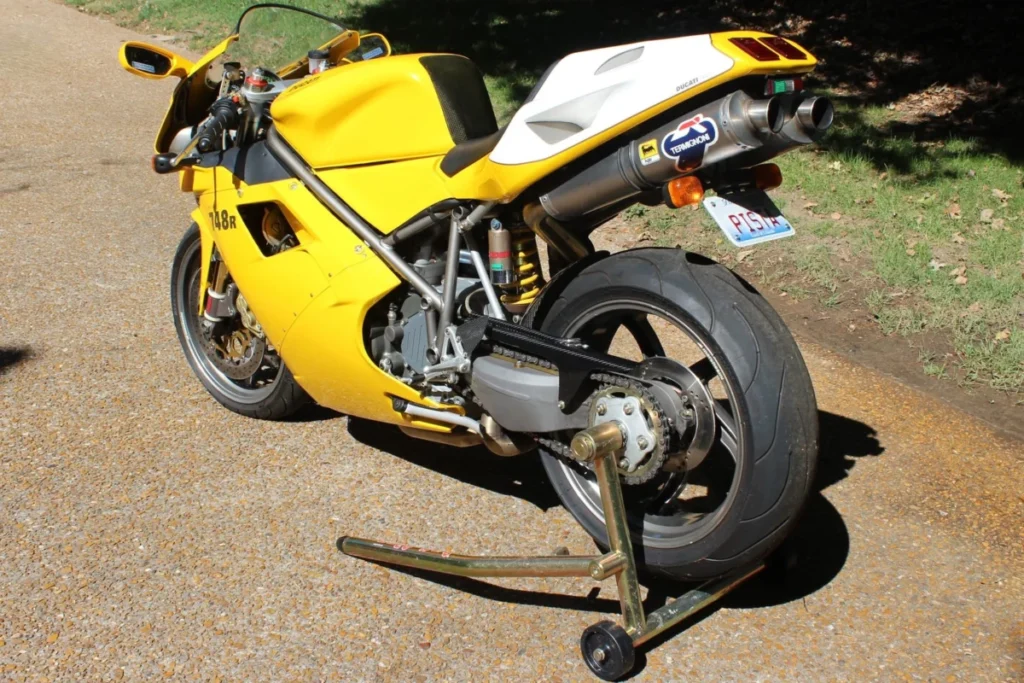
For motorcycle enthusiasts and collectors of Italian exotica, few silhouettes evoke as much raw emotion and reverence as the Tamburini-designed Superbikes of the 1990s and early 2000s. Among them, the homologation-special “R” variants stand as the ultimate expression of track-bred performance. Currently up for acquisition on the collector market is a pristine, highly coveted 2000 Ducati 748R—one of an estimated mere 70 units officially imported to North America for its inaugural production year.
Showing just 2,800 miles on the odometer and equipped with choice performance upgrades, this machine represents a rare opportunity to own a piece of World Superbike heritage. Offered at no reserve with an array of documentation, spare parts, and a clean Illinois title, this motorcycle bridges the gap between static gallery art and a visceral canyon carver.

Main Facts: Anatomy of a Homologation Special
The 2000 Ducati 748R is not merely a standard 748 with upgraded stickers; it is a finely honed racing thoroughbred built to satisfy FIM homologation requirements for World Supersport competition.
At the heart of this machine beats a liquid-cooled 748cc Desmoquattro DOHC L-twin engine. Unlike the base models, the "R" specification features four desmodromically actuated valves per cylinder housed in deeply revised cylinder heads, a deeper magnesium oil pan, and Pankl titanium connecting rods. Fuel is fed via sophisticated Marelli electronic fuel injection, augmented on this particular example by a Ducati Performance ECU chip and a sonorous Termignoni exhaust system that allows the signature dry-clutch rattle and deep L-twin pulse to sing unhindered.

Power is channeled through a heavy-duty dry clutch and a close-ratio six-speed transmission, transferring force to the tarmac via a robust drive chain.
The chassis is equally purposeful. The bike is built around Ducati’s iconic red-painted steel trellis frame, mated to a single-sided aluminum swingarm. Suspension duties are handled by fully adjustable Showa components, featuring an inverted 43mm front fork and a piggyback-reservoir rear monoshock, complemented by a piston-style steering damper mounted below the upper triple clamp. Stopping power is exceptional, courtesy of triple Brembo disc brakes utilizing dual 320mm drilled rotors with four-piston calipers up front and a single 220mm rotor with a two-piston caliper out back.

Aesthetically, the Massimo Tamburini-crafted bodywork is finished in classic Ducati yellow and white, accented by genuine carbon-fiber elements including a chain guard. It features dual headlamps, an integrated windscreen, fairing-mounted mirrors, rear-set foot controls, a 4.5-gallon fuel tank, and a race-derived monoposto (single-seat) tail section finished with a black solo pad. To improve ergonomics for real-world riding, the current owner has fitted HeliBars handlebar risers, alleviating some of the punishing wrist angle inherent to the aggressive factory clip-ons.
Chronology: The Lifecycle of Chassis #748R
To fully appreciate the significance of this motorcycle, it is helpful to look at the timeline of the Ducati 748 lineage and the specific history of this North American-market example.

- 1994: Ducati introduces the 748 as a smaller-displacement sibling to the legendary 916, utilizing the same groundbreaking design language by Massimo Tamburini but featuring a higher-revving, short-stroke engine character.
- 2000: Ducati unleashes the 748R. Built strictly for homologation purposes, it receives significant mechanical upgrades over the standard 748 SPS and Biposto models. Production is severely limited, with only an estimated 70 units finding their way to North America for this debut year.
- 2020: Demonstrating diligent mechanical upkeep, the motorcycle receives replacement timing belts to ensure the integrity of its complex desmodromic valve train.
- 2022: The current seller acquires the motorcycle, adding approximately 200 miles to the odometer during their tenure, bringing the lifetime total to a remarkably low 2,800 miles.
- Present Day: The motorcycle is prepared for public auction. It is offered at no reserve, accompanied by its original owner’s manual, detailed service records, a dyno sheet confirming its power output, spare parts, and an Illinois title featuring a “Mileage Not Required” notation.
Supporting Data and Specifications
For the data-driven collector, the specifications of the 2000 Ducati 748R highlight its race-oriented DNA:
- Manufacturer: Ducati
- Model: 748R (Homologation Special)
- Year of Production: 2000
- Market Allocation: Estimated 70 units imported to North America
- Engine Type: 748cc liquid-cooled Desmoquattro DOHC 90-degree L-twin
- Valvetrain: Desmodromic, 4 valves per cylinder
- Fuel Delivery: Marelli electronic fuel injection with Ducati Performance ECU tune
- Exhaust: Termignoni full system
- Transmission: Six-speed manual paired with a dry multi-plate clutch
- Frame: Tubular steel trellis with single-sided aluminum swingarm
- Suspension: Fully adjustable Showa inverted 43mm front fork; adjustable rear monoshock with piggyback reservoir
- Brakes: Dual 320mm floating rotors with 4-piston Brembo calipers (Front); Single 220mm rotor with 2-piston Brembo caliper (Rear)
- Wheels & Tires: 17-inch 5-spoke Marchesini alloy wheels wrapped in Michelin rubber
- Odometer Reading: 2,800 miles (~200 added under current ownership)
- Modifications: HeliBars handlebar risers, Termignoni exhaust, Ducati Performance ECU, rear fender eliminator kit
- Included Items: Owner’s manual, service records, dyno sheet, spare parts package
Official Documentation and Logistics
Transparency is paramount when acquiring vintage and rare motorcycles, and this 748R comes thoroughly documented. The sale includes comprehensive service records outlining maintenance milestones—including the crucial 2020 timing belt replacement—alongside the factory owner’s manual. Furthermore, a dyno sheet is included in the gallery, providing empirical data on how the Termignoni exhaust and ECU tune optimize the L-twin’s power delivery.

The vehicle is sold on a clean Illinois title. Prospective buyers should note that the title carries a "Mileage Not Required" notation due to the vehicle’s age, though the 2,800 miles shown on the five-digit odometer are supported by the overall condition of the machine and its accompanying history.
Regarding logistics, online auction platforms like Bring a Trailer provide shipping estimator tools, but buyers should keep in mind that these estimates typically apply strictly to the motorcycle itself. Because this sale includes an array of valuable spare parts and documentation accessories, the winning bidder will need to coordinate independently with the seller regarding the safe transit of these extra items.

Implications: The Collector Market for Homologation Ducatis
The offering of a 2000 Ducati 748R at a "no reserve" auction carries significant implications for the vintage motorcycle market. As modern classics from the late 1980s and 1990s experience a massive surge in popularity among Gen-X and millennial collectors, homologation specials occupy the apex of desirability.
While standard Japanese and Italian sportbikes of the era were produced in the tens of thousands, ultra-low-production homologation bikes like the 748R represent rolling investments. With only 70 units originally allocated to North America—many of which were subsequently crashed on race tracks or modified beyond recognition—finding an unblemished, low-mileage example is increasingly difficult.

The modifications present on this bike—specifically the Termignoni exhaust and Ducati Performance ECU—are considered "holy grail" upgrades by enthusiasts, as they unlock the true auditory and performance character that factory noise regulations muffled in period. Meanwhile, the inclusion of the original HeliBars (which ease the notoriously aggressive ergonomics) makes the bike slightly more approachable for a weekend ride, should the new owner choose to exercise the machine rather than park it in a climate-controlled living room.
Ultimately, this 2000 Ducati 748R represents a rare convergence of industrial design, racing pedigree, and collectible scarcity. Whether it serves as the centerpiece of a private collection or is uncorked on a twisty backroad to echo the glory days of World Superbike racing, it remains an uncompromising tribute to Bologna’s golden era.
