

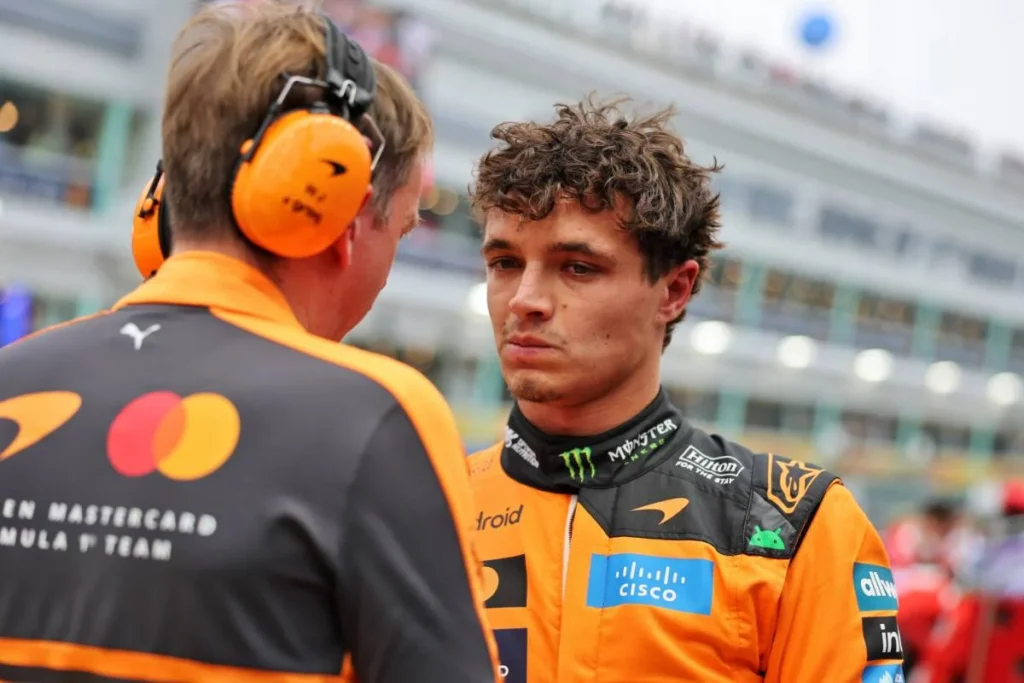
The Formula 1 paddock is often described as a pressure cooker, but rarely does the heat reach the boiling point within a single garage as rapidly as it did following the Sprint race at the Singapore Grand Prix. For McLaren, a team currently embroiled in a high-stakes development war against the likes of Red Bull, Ferrari, and Mercedes, the sight of its two drivers—Lando Norris and Oscar Piastri—colliding in the final lap was more than just a racing incident; it was a strategic catastrophe that drew an immediate, icy rebuke from Team Principal Andrea Stella.
The Anatomy of a Self-Inflicted Wound
The Sprint race in Singapore, often a tactical precursor to the main event, was supposed to be a damage-limitation exercise for McLaren. Facing a track where their car struggled to find the peak performance required to challenge for the win, the Woking-based outfit had settled into a rhythm, occupying fourth and fifth positions. It was a solid, if unspectacular, points-gathering effort.
However, the race turned into a disaster on the final lap. As the two papaya-liveried MCL38s navigated the technical sections of the Marina Bay Street Circuit, Lando Norris, seemingly sensing an opportunity to improve his standing, attempted an aggressive overtake on his teammate, Oscar Piastri, at Turn 5.
The maneuver, executed with narrow margins, went awry. The two monocoques made contact, triggering a chain reaction that sent both cars into a spin. The result was instantaneous: what should have been a double-points finish disintegrated. Norris managed to limp his car across the line in eighth place, while Piastri’s race ended in the gravel, classified fourteenth without completing the distance. The collision not only deprived the team of crucial Constructors’ Championship points but also served as a visual manifestation of a growing, albeit simmering, rivalry that the team hierarchy is now desperate to contain.
A Chronology of the Tension
The Singapore incident did not occur in a vacuum. It was the latest in a series of brushes between the two drivers, which have gradually increased in intensity throughout the 2024 and 2025 seasons.
- The Early Stages: The Sprint began with both drivers managing their tires and pace, keeping a watchful eye on the cars ahead. The McLaren pit wall had signaled for a steady performance, aiming to secure the fourth and fifth spots.
- The Final Lap Push: As the race reached its conclusion, Norris, eager to maximize his personal result, initiated an aggressive line into Turn 5.
- The Collision: Piastri, holding his racing line, did not yield, resulting in side-to-side contact. Both drivers lost control, effectively throwing away the positions they had held for the majority of the race.
- The Immediate Aftermath: While the cars were being recovered, the team radio crackled with frustration. The post-race atmosphere in the McLaren hospitality suite was notably somber, a stark contrast to the usual camaraderie expected of a team fighting for the top of the standings.
Official Responses: The Stella Doctrine
Andrea Stella, a man known for his calm, analytical demeanor, did not mince words when addressing the media. His intervention was swift and served as a clear warning that the era of "letting them race" without guardrails may be coming to a close.
Speaking to Sky Sports F1, Stella articulated a vision of the team where individual ego is strictly subordinate to the collective goal. "The Sprint was meant to be a moment to secure points when we aren’t quite at the level to win," Stella explained. "To see two McLarens collide in such a way is simply unacceptable. We are not here to see our own cars take each other out."
Stella’s message was a direct challenge to the drivers’ current mindset. He emphasized that while competitive spirit is a prerequisite for any F1 driver, it must be tempered by the reality of the team’s investment. "We will have private discussions. We need to remind them that the interests of the team are significantly more important than the interests of any single individual. No ego, no single person, is above the interest of McLaren."
When pressed on whether this would lead to formal team orders in the future, Stella remained coy but firm. He acknowledged that while he wants his drivers to race, the "rules of engagement" would be tightened. The implication was clear: if the drivers cannot manage their rivalry on the track, the pit wall will be forced to dictate the order from the command center.
Lando Norris: A Reflection on Shared Responsibility
In the hours following the race, Lando Norris took a more conciliatory tone. Recognizing the gravity of the team principal’s displeasure, the Briton, who currently maintains a slight advantage in their internal battle, sought to de-escalate the situation.
"Nobody is happy with how that ended," Norris remarked. "Oscar and I have already spoken. It wasn’t the result either of us wanted." When asked about the specifics of the contact, Norris admitted that both drivers could have approached the corner with more caution. "There are things we both could have done better. We’ve had the conversation, and we are moving on."
Despite this attempt at public reconciliation, the underlying tension remains. Norris, a veteran of the team, and Piastri, a rapidly maturing talent, are both fighting for their reputations. For Norris, the challenge is maintaining his status as the team’s lead driver; for Piastri, it is proving he has the speed to dictate the pace of the team.
The Broader Implications for McLaren
The incident at Singapore is a microcosm of a larger strategic challenge facing McLaren. As they pivot from being "best of the rest" to a legitimate championship contender, the luxury of allowing drivers to compete freely without consequence is diminishing.
The Cost of Competition
Every point lost due to an internal collision is a point handed to their rivals. With Red Bull’s Max Verstappen maximizing his championship lead and Ferrari showing renewed vigor on street circuits, McLaren cannot afford a "broken window" policy regarding their driver lineup. The Constructors’ Championship is decided by the accumulation of points, and as the 2025 season progresses, the gap between the top four teams is narrowing.
The Culture of the Team
McLaren has historically prided itself on being a "driver-friendly" environment, avoiding the toxic teammate dynamics seen at Mercedes during the Hamilton-Rosberg era or Red Bull’s internal struggles. However, Stella’s firm stance indicates a pivot toward a more disciplined, corporate-led racing structure. The team is effectively transitioning from a group of individuals racing for glory to a professionalized unit where the "team first" mantra is not just a slogan, but a mandate.
Future Outlook
The coming races will be a litmus test for the relationship between Norris and Piastri. Can they maintain their aggression while respecting the proximity of their teammate? Or will the "Stella Doctrine" necessitate a permanent change in how they approach wheel-to-wheel battles?
For the fans, the prospect of an unfiltered, aggressive battle between two of the sport’s most exciting talents is enticing. For the McLaren board and the engineers at Woking, it is a liability. As the team prepares for the next round of the championship, all eyes will be on the first lap, the first corner, and, most importantly, the first time the two papaya cars find themselves in close proximity. The message from Andrea Stella has been sent: another collision like the one at Singapore will not just be a disappointment—it will be a failure of professionalism that the team cannot afford to ignore.
In the high-stakes world of Formula 1, the fastest car is only as good as the discipline of the drivers behind the wheel. McLaren is currently learning that the hardest part of building a championship-winning car isn’t just the aerodynamics or the engine—it’s managing the human ambition that drives it.
