

Main Facts
In the rarefied air of collector-grade air-cooled Porsches, few badges carry the lightweight, track-focused mystique of the "RS." Currently offered on dealer consignment through the Avant Garde Collection—a Bring a Trailer Local Partner based in Arizona—a remarkably preserved, Italian-market 1992 Porsche 911 Carrera RS (964) has emerged onto the market. Boasting an illustrious chain of ownership that includes world-renowned comedian and automotive connoisseur Jerry Seinfeld, this black-on-black-and-gray specimen presents a rare opportunity for serious marquee collectors.
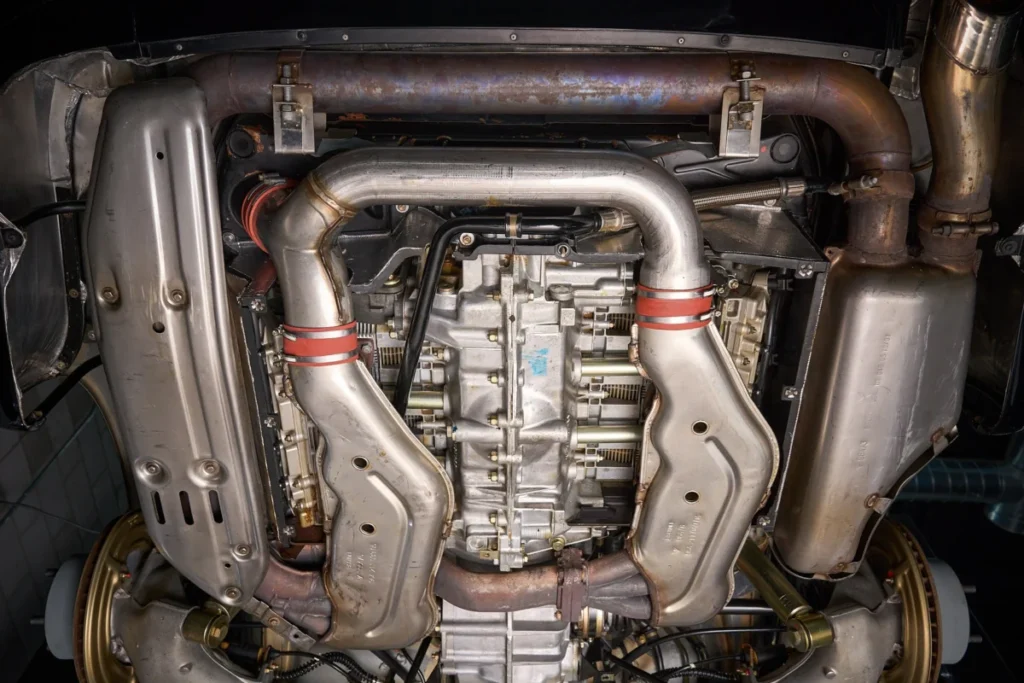
Showing a scant 13,000 kilometers (approximately 8,000 miles) on its six-digit odometer, the car remains an extraordinarily pure iteration of Porsche’s lightweight philosophy. Beneath its sleek Black (700) exterior lies a 3.6-liter M64/03 naturally aspirated flat-six engine, mated to a close-ratio G50 five-speed manual transaxle equipped with an asymmetrical limited-slip differential.
Far from a standard Carrera, this 964-generation RS is defined by the absence of modern conveniences and deadening materials in the pursuit of unadulterated performance. It features a factory seam-welded chassis, an aluminum front trunk lid, thinner side and rear window glass, and magnesium 17-inch Cup wheels wrapped in Michelin Pilot Sport tires (measuring 205/50 up front and 255/40 out back). Inside, occupants are held firmly in place by fixed-back Recaro bucket seats upholstered in multi-tone black and gray leather, complemented by striking red seat belts and matching door-pull straps.

The vehicle is accompanied by comprehensive documentation, including a Porsche Certificate of Authenticity validating its numbers-matching drivetrain and factory specifications, service records, a clean Carfax report free of any accident or damage entries, and a clean Florida title.
Chronology
Genesis of the 964 Carrera RS (1991–1992)
The Carrera RS moniker harks back to the legendary 1973 911 Carrera RS 2.7, a homologation special built to dominate motorsport. When Porsche resurrected the RS badge for the Type 964 generation, engineers sought to distill the essence of the Porsche Cup race cars into a road-legal package. Introduced to European markets for the 1992 model year (and notably withheld from official importation to the United States due to federalization hurdles), the 964 Carrera RS was a masterclass in weight reduction and chassis tuning.
European Delivery and Early History
This specific chassis was built to Italian-market specifications in 1992. Delivered new in striking black over a stripped-out, driver-focused interior, it spent its early life traversing European roads. Given the low-production nature of the 964 RS—where every gram shed was a victory for lap times—early European owners typically utilized these vehicles for spirited weekend drives and occasional track excursions, though this particular example was driven remarkably sparingly.

The Seinfeld Era and Recent Custodianship
At some point in its journey across the Atlantic, the car entered the collection of American comedian and legendary Porsche collector Jerry Seinfeld. Known for curating some of the rarest, most historically significant air-cooled and water-cooled Porsches on the planet, Seinfeld’s former stewardship adds an undeniable layer of provenance and collectibility to the vehicle’s history.
The current owner acquired the car in 2020. Over the last four years, approximately 500 kilometers have been added to the odometer, bringing the total reading to just 13,000 kilometers. In meticulous preparation for its current sale, the consigning dealer performed a comprehensive service regimen, which included an oil change, cylinder compression testing, and the replacement of both the fuel pump and the DME relay to ensure mechanical readiness.
Supporting Data
To truly understand the engineering significance of the 1992 Porsche 911 Carrera RS, one must examine the meticulous measures Porsche took to strip away excess weight and enhance dynamic capability compared to a standard 964 Carrera.

Technical Specifications & Performance Hardware
- Engine Type: 3.6-liter M64/03 naturally aspirated air-cooled flat-six
- Induction & Management: Sport-tuned Bosch engine-management system with a lightened single-mass flywheel and a single-belt cooling fan
- Transmission: G50 five-speed manual transaxle featuring steel synchronizers, close-ratio gearing, and an asymmetrical limited-slip differential
- Chassis & Body: Seam-welded bodyshell for increased torsional rigidity, aluminum front trunk lid, rolled fenders, and thinner automotive glass for side and rear windows
- Suspension: Factory-lowered ride height compared to the standard 964, stiffer springs, and adjustable anti-sway bars paired with adjustable Bilstein coilovers
- Braking System: Anti-lock braking system (ABS) utilizing four-piston fixed aluminum calipers and cross-drilled ventilated rotors at all four corners
- Wheels & Tires: Magnesium 17-inch Cup wheels mounted with Michelin Pilot Sport tires (205/50ZR17 front, 255/40ZR17 rear)
Interior & Weight-Saving Deletions
In keeping with the "Rennsport" ethos, the cabin was systematically purged of non-essential weight. Factory omissions on this specification include:
- Air conditioning
- Airbags (retaining a classic four-spoke, leather-wrapped steering wheel)
- Carpeting and heavy sound-deadening insulation
- Rear seats
- Power steering (though power-assisted setups varied by market, the focus remained on pure mechanical feedback)
Retained interior features include manual roll-up windows, a functional cabin heater, fixed-back Recaro bucket seats with multi-tone black and gray leather, and vibrant red door-pull straps and seat belts.
Official Responses
While private collector cars do not typically warrant press statements from corporate entities, the legacy of the 964 Carrera RS is deeply embedded in Porsche’s official corporate history. Upon the model’s release, Porsche’s motorsport and engineering divisions emphasized that the 964 RS was designed as a purist’s machine—a bridge between road car comfort and the uncompromising brutality of the Carrera Cup racing series.

In historical retrospective literature published by Porsche AG, the 964 RS is frequently cited as the turning point that reintroduced raw, analog driver engagement to a modern 911 lineup that was otherwise steadily growing more refined, luxurious, and heavy. Porsche engineers noted that the decision to utilize a seam-welded chassis—a technique borrowed directly from endurance racing—was intended to give drivers absolute confidence and immediate steering response at the limit.
Regarding the vehicle’s current market offering, representatives from the Avant Garde Collection emphasize the rarity of finding a European-market 964 RS with documented provenance, exceptionally low mileage, and a clean, accident-free history report. "Cars of this caliber rarely surface with this level of pedigree," notes the consigning team, highlighting the thorough pre-sale mechanical inspection and compression testing as proof of the car’s turn-key readiness for its next discerning owner.
Implications
The public offering of this 1992 Porsche 911 Carrera RS carries several notable implications for the high-end collector car market, particularly within the air-cooled Porsche segment.

1. The Undiminished Appeal of Analog Supercars
In an era dominated by heavy hybrid powertrains, digital driver-assistance systems, and lightning-fast dual-clutch transmissions, automobiles like the 964 Carrera RS represent a rapidly vanishing mechanical frontier. The intense demand for analog, lightweight sports cars underscores a broader cultural shift among collectors: driving purity, tactile feedback, and mechanical communication are increasingly valued over raw horsepower figures.
2. The Celebrity Provenance Premium
The association with Jerry Seinfeld introduces a fascinating psychological and economic factor to the vehicle’s valuation. While celebrity ownership alone does not make a mediocre car great, when attached to an already ultra-desirable, low-production homologation special like a 964 RS, it acts as a badge of validation. It suggests that the vehicle was hand-picked and appreciated by one of the world’s most sophisticated and discerning automotive tastemakers.
3. Market Resilience for Homologation Specials
The market for low-production, driver-centric 911s—specifically the 964 and 993 RS variants—has historically demonstrated strong resilience against broader economic fluctuations. Because these cars were built in limited numbers and cannot be replicated, pristine examples with low kilometers, numbers-matching drivetrains, and clean histories continue to serve as blue-chip alternative assets.

As this black 964 RS prepares to find a new home, its sale will undoubtedly be watched closely by auction houses, brokers, and enthusiasts alike, serving as yet another barometer for the health and trajectory of the air-cooled Porsche collecting hobby.
