

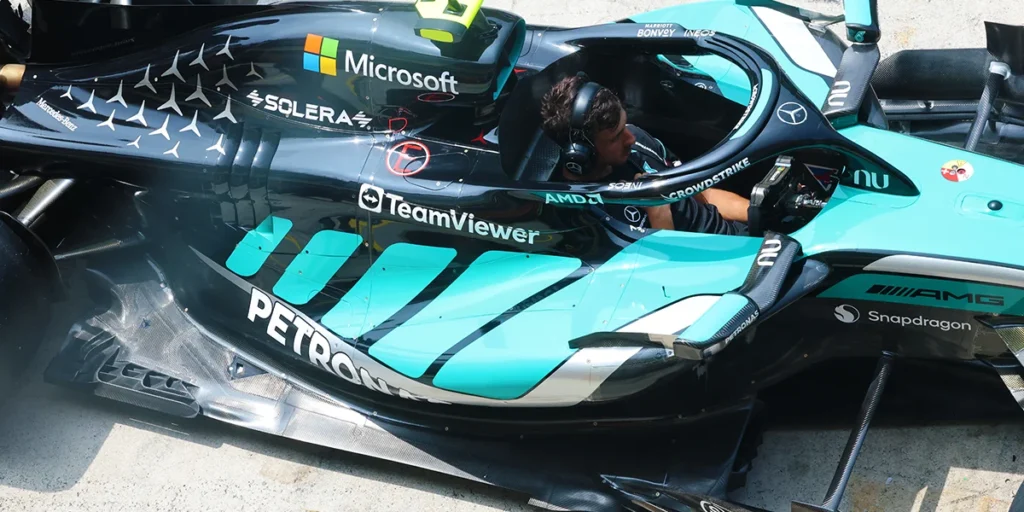
The world of Formula 1 is often described as a game of millimeters and milliseconds, but for the Mercedes-AMG Petronas F1 team, the current challenge is measured in a much more daunting dimension: confusion. Following a disappointing outing at the Sepang International Circuit, the Silver Arrows find themselves at a critical crossroads. Faced with doubts regarding their latest technical overhaul, the Brackley-based outfit is now considering a radical, high-stakes decision: running a comparative test between their old-spec and new-spec configurations during the upcoming Singapore Grand Prix.
The situation is as frustrating as it is puzzling. Mercedes had arrived in Malaysia with high hopes, anticipating a performance gain of three-tenths of a second from a comprehensive aerodynamic package. Instead, the team is grappling with the haunting possibility that their W17 has actually regressed.
The Genesis of the Crisis: Expectations vs. Reality
The technical upgrade package introduced at the Bahrain-hosted Sepang event was anything but a minor tweak. It represented a fundamental redesign of the W17’s philosophy. The floor was completely re-engineered, from the leading edge to the diffuser, accompanied by significant revisions to the elements situated ahead of the rear wheels. Furthermore, the sidepods underwent a drastic reshape, necessitating a complete internal reorganization of the cooling and packaging architecture.
On paper, the data looked promising. Preliminary wind tunnel and CFD (Computational Fluid Dynamics) testing suggested that the team had successfully unlocked the targeted aerodynamic load. Even on the track, the W17 displayed tangible improvements in high-speed and medium-speed corners, confirming the theoretical gains in downforce. However, in the unforgiving world of Formula 1, more downforce does not always equate to a faster lap time.

The contrast at the Sepang weekend was stark. Drivers Kimi Antonelli and George Russell endured one of their most challenging race weekends of the 2026 season. While Max Verstappen commanded the field with a dominant display in his Red Bull, the Mercedes drivers struggled for pace, balance, and tire management. Toto Wolff, the team principal, was visibly troubled, even suggesting that the car might have lost three, four, or perhaps even five-tenths of a second compared to the team’s internal performance projections.
Chronology of a Disappointing Weekend
The deterioration of performance wasn’t immediate, but rather a slow realization throughout the Malaysian Grand Prix weekend.
Friday Practice: Initial data gathering seemed to validate the aero-map. The car felt stable in high-speed sections, but feedback from the drivers indicated a lack of confidence under braking and a mysterious inability to rotate the car in slower, tighter sections of the track.
Saturday Qualifying: The reality check arrived. Both cars struggled to find the "sweet spot" for the tires, resulting in a disappointing qualifying position. The team realized that the balance of the car was no longer behaving in a linear fashion relative to their simulations.

Sunday Race: The race was the final blow. The W17 was significantly slower in a straight line compared to the Red Bull. Furthermore, the drivers reported a persistent understeer in the slow-speed corners—most notably at the entry to Turn 2—a behavioral trait that had been largely absent from the car’s repertoire earlier in the season.
Decoding the Data: The "Three-Dimensional" Problem
Mercedes’ technical director and senior engineering staff are currently performing a deep dive into the telemetry to understand why the added downforce resulted in a net loss of performance. Bradley Lord, speaking on behalf of the team, characterized the issue as a "three-dimensional problem." According to the team’s analysis, the aerodynamic upgrade, the ambient temperatures, and the unique characteristics of the Sepang asphalt all seem to have interacted in a way that the simulations failed to predict.
The Drag Penalty
One of the most glaring issues observed in Malaysia was the lack of top-end speed. While the new aero package was designed to increase downforce, it appears to have brought with it a significant penalty in aerodynamic drag. In modern F1, a team can tolerate a small amount of extra drag if it is offset by superior cornering speeds. At Sepang, however, the gain in the corners was insufficient to compensate for the massive time lost on the straights.
The Understeer Conundrum
The second issue is the shift in the car’s aerodynamic balance. The new bodywork was designed to optimize the airflow to the diffuser and the beam wing. While this achieved the goal of increased rear-end grip in medium and fast corners, it inadvertently compromised the car’s balance at low speeds. When the rear end is locked into the tarmac, the front end often becomes the weak link, resulting in the heavy understeer that hampered Antonelli and Russell. To combat this, the drivers were forced to use aggressive throttle inputs to "rotate" the car, which in turn caused the tires to overheat, further degrading performance.

Official Responses: Cautious Analysis
Toto Wolff has been uncharacteristically measured in his public comments, refusing to label the upgrade a complete failure. "It would be a mistake to condemn such a significant evolution too early," he noted. "We have the data that shows the downforce is there. The question is why it is not manifesting into lap time. We have to look at the interaction between the car’s new characteristics and the specific demands of the track surface."
The team is also looking at external factors. The aging, highly abrasive surface at Sepang is notoriously difficult on tires. Antonelli noted that Mercedes has struggled on similar surfaces earlier in the season, such as at Zandvoort. This raises a crucial question: was the upgrade actually a step backward, or did the unique conditions of Malaysia simply expose a pre-existing weakness in the W17’s design that had been masked by more favorable circuits?
Implications for the Future: The Singapore Test
The lack of a "control group" is the primary source of the team’s current uncertainty. Because both W17s were fitted with the full upgrade package, there was no baseline to compare against during the Malaysian weekend.
To rectify this, Mercedes has committed to an unprecedented move for the Singapore Grand Prix. The team will transport components of the previous, pre-upgrade specification to the Marina Bay circuit. The intention is to run a direct, side-by-side comparison during the practice sessions.

The Challenges of the Sprint Format
This task is made exponentially more difficult by the fact that Singapore is a Sprint weekend. With only one free practice session before the start of the competitive proceedings, the window for testing is incredibly narrow. The team has not yet finalized whether this comparative exercise will be limited to that single practice hour or if they will take the risk of running divergent setups into the qualifying phase—a move that could jeopardize their championship points haul.
The Competitive Landscape
Furthermore, Mercedes must account for the progress of their rivals. While the W17 may have struggled with drag, there is strong evidence that Red Bull has made a significant leap in straight-line efficiency. Mercedes’ internal analysis suggests that some of the deficit to Verstappen was not necessarily due to a slower Mercedes, but a much faster Red Bull.
Conclusion: A Turning Point
The upcoming race in Singapore is no longer just about points; it is a vital diagnostic exercise. If the old-spec car proves to be more competitive than the upgraded version, the team will face a difficult decision: roll back their development or attempt a rapid mid-season redesign.
The paradox remains: Mercedes found the downforce they were looking for, but they lost the efficiency that made the W17 a championship contender. As the engineers in Brackley crunch the numbers, the clock is ticking. The "three-tenths" they hoped to gain have effectively become a mystery they must solve before the championship slips through their fingers. The coming weekend will likely dictate the trajectory of Mercedes’ 2026 campaign—either as a story of a technical recovery or a warning of a failed developmental path.
