

By: Editorial Staff, Motorsports Inside
Date: June 30, 2026
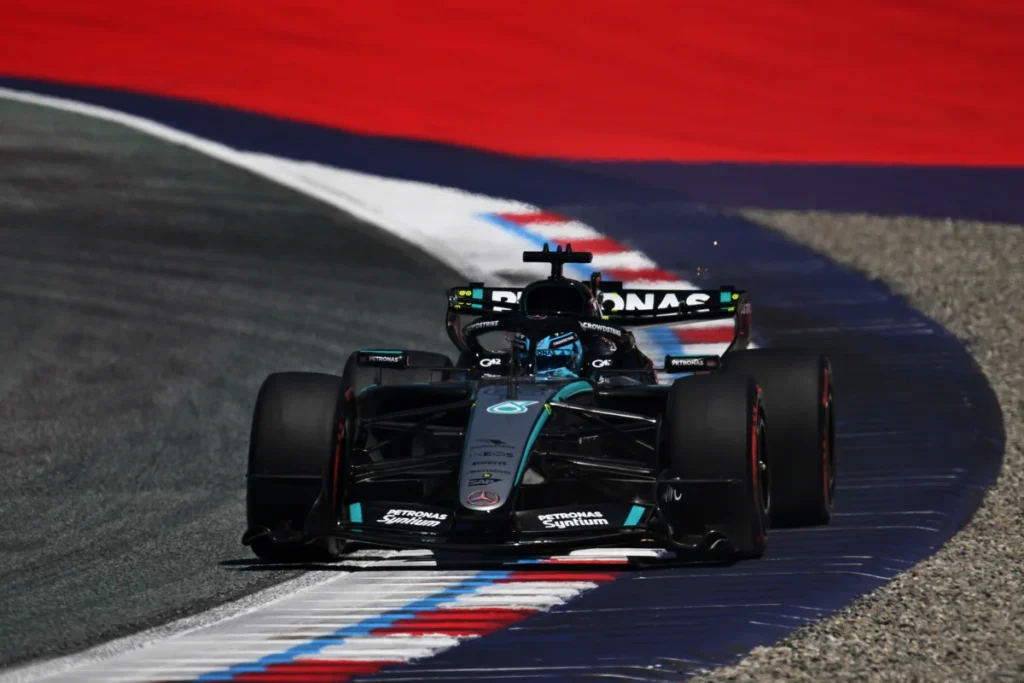
The 2026 Formula 1 season has seen its fair share of tactical shifts, but as the paddock gathers for the Austrian Grand Prix at the iconic Red Bull Ring in Spielberg, the narrative is firmly controlled by the Brackley-based Mercedes-AMG Petronas team. In a display of overwhelming pace and technical synergy, Mercedes concluded the final practice session (EL3) by locking out the top two spots, signaling a ominous warning to their rivals ahead of qualifying.
George Russell emerged as the man to beat, setting a blistering pace of 1:07.096 in the closing moments of the session. He was closely trailed by his teammate, the prodigious Kimi Antonelli, who has been the revelation of the weekend thus far. With Mercedes having topped every single free practice session, the Austrian circuit—a track that historically favors high-downforce, power-sensitive machines—has become a fortress for the Silver Arrows.
The Chronology: A Session Defined by Heat and Mercedes Momentum
The ambient temperatures at the start of the final practice session were a sweltering 31°C, placing significant thermal stress on the Pirelli compounds. As the track opened, the mood was one of tactical preparation rather than outright speed.
Cadillac, looking to recover from a dismal Friday performance that left them struggling for balance, was the first team to send their drivers, Sergio Perez and Valtteri Bottas, onto the tarmac. The team was clearly prioritizing long-run data accumulation, logging 29 and 24 laps respectively, though their pace remained near the bottom of the timesheets, indicating that their technical woes are far from resolved.
Twenty minutes into the hour, Lando Norris momentarily topped the timing screens with a 1:07.832. However, the McLaren driver’s session was hampered by a mechanical issue, as he reported his left-side mirror was "completely broken" and flapping in the wind, a nuisance that compromised his aero balance through the high-speed corners of the Spielberg circuit.
As the session progressed, the internal battle within Mercedes took center stage. Kimi Antonelli, who had been the pacesetter in EL1 and EL2, continued to push the boundaries, lowering the benchmark to 1:07.134 at the halfway point. It was not until the final ten minutes, as teams bolted on fresh sets of soft tires for qualifying simulations, that George Russell found the extra three-hundredths of a second needed to eclipse his teammate.
Max Verstappen, the local favorite, waited until the final stages to mount his serious charge. While he managed a competitive lap to secure sixth, his radio communications revealed a frustrated driver dealing with "strange, constant interference" in his headset, a bizarre technical anomaly that forced the Dutchman to request a change of earplugs mid-session. His teammate, Isack Hadjar, spent the duration of the session on a split program, focused heavily on race-pace simulations on the hard compound tires, a strategy that left him eighth overall.
Technical Analysis: Performance Gaps and Track Dynamics
The delta between the top teams remains razor-thin, yet the hierarchy is becoming increasingly distinct. Mercedes’ performance advantage currently lies in their chassis’ ability to maintain tire temperature without overheating the rubber—a crucial skill in the hot Austrian conditions.
Ferrari showed glimpses of potential with Lewis Hamilton securing third, just 0.115 seconds off the pace. However, the Scuderia struggled with consistency. Charles Leclerc, in particular, had a messy session; he suffered a significant lock-up at Turn 3, which flat-spotted his tires and compromised his ability to put together a clean sector analysis. He finished seventh, a position that likely does not reflect the true potential of the Ferrari package, but certainly highlights the difficulty of managing the Red Bull Ring’s narrow operating window.

McLaren appears to be the third force this weekend, with Oscar Piastri and Lando Norris locking out the fourth and fifth positions. Their deficit to the Mercedes duo is roughly two-and-a-half tenths, a gap that they will hope to bridge with aggressive setup changes before the start of the qualifying hour.
The Mid-Field Scramble
Further down the order, the competition was fierce. The Racing Bulls, led by Liam Lawson and Arvid Lindblad, showed strong mid-field form, finishing inside the top ten. Conversely, the Williams team had a difficult morning. Carlos Sainz, struggling with the balance of his car, received a formal reprimand in the form of a black-and-white flag for driving unnecessarily slowly, a result of his frustration as he drifted wide at the final corner, damaging his confidence and his rhythm.
Official Team Responses and Radio Dramas
The radio waves at the Red Bull Ring were busier than usual this morning, providing a window into the frustration inherent in the high-stakes world of F1.
Max Verstappen’s complaints about communication interference were perhaps the most notable, as the Red Bull pit wall scrambled to rectify the technical glitch. When asked about his car’s balance, the reigning champion was tight-lipped, focusing instead on the "strange distractions" that hampered his rhythm.
At the other end of the pit lane, the mood was jubilant at Mercedes. Despite his lead, George Russell remained grounded in his post-session debrief. "The car is in a great window," he told reporters, "but the track temperature is shifting constantly. What works now might be useless in an hour when the clouds roll in or the sun hits the track surface differently."
Ferrari’s leadership, represented by their senior race engineers, acknowledged that while the pace is there, the "operating window" for the SF-26 is proving to be a moving target. They emphasized that Leclerc’s errors were a direct result of the car being on a knife-edge, a setup gamble they took to try and chase down the Mercedes advantage.
Implications for Qualifying and the Grand Prix
As the paddock turns its attention to the qualifying session, the data from EL3 provides several critical takeaways:
- Mercedes’ Front-Row Lockout Potential: With both drivers showing consistent pace across different tire compounds, Mercedes is the clear favorite for pole position. The team has managed to neutralize the straight-line speed of the Ferraris and the cornering grip of the McLarens.
- The Red Bull Struggle: Despite the support of the home crowd, Red Bull is currently lacking the top-end speed to challenge for the win on pure pace. Verstappen’s ability to "overdrive" the car will be their only hope to disrupt a Mercedes 1-2.
- Tire Degradation: With temperatures nearing 32°C, graining on the front-left tire is expected to be a major factor in the race. Teams like Cadillac, who prioritized high-fuel running, may have a hidden advantage if they can maintain their tire integrity over the 71-lap distance.
- Weather Uncertainty: Meteorological reports indicate a 40% chance of showers during the qualifying session. If the track becomes "green" or damp, the entire balance of power could shift, favoring drivers with superior car control rather than those with the most downforce.
As the sun beats down on the Styrian mountains, the stage is set for a dramatic showdown. Mercedes has fired the first, second, and third shots of the weekend, but in the unforgiving world of Formula 1, the only timing that matters is the one that stops the clock during Q3. The fans in Spielberg are braced for a spectacle, and if the free practice sessions are any indication, we are in for a qualifying thriller that could redefine the championship standings.
The question remains: Can anyone stop the Mercedes juggernaut, or will the Silver Arrows continue their march toward a historic victory in the heart of the Red Bull territory? We will have our answer in just a few hours.
