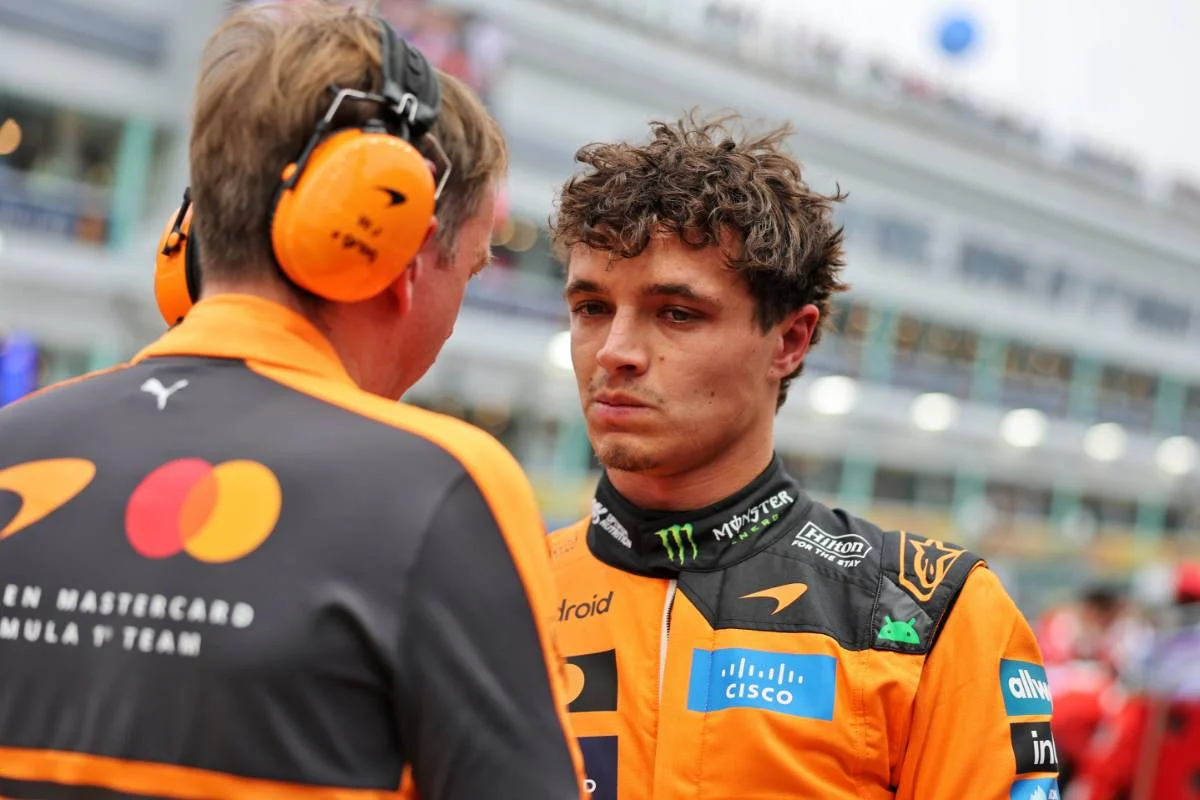
In the high-stakes theater of Formula 1, where milliseconds define legacies and championship standings can shift on the turn of a single steering wheel, internal friction is the ultimate enemy. Following the Sprint race at the Singapore Grand Prix, McLaren found itself grappling with a self-inflicted wound: an avoidable collision between Lando Norris and his teammate, Oscar Piastri. While initially defensive regarding his aggressive driving, Lando Norris has since issued a formal mea culpa, acknowledging that his decision-making in the heat of battle jeopardized not just his own race, but the hard-earned progress of the entire Woking-based team.
The Anatomy of an Incident: A Chronology of the Collision
The incident unfolded during the dying moments of the Singapore Sprint, a short-format race where every position carries significant weight in the tight mid-field and upper-tier battles. As the race neared its conclusion, the two McLaren MCL40s were locked in a tense scrap for fourth and fifth place.
The sequence began at Turn 5. Oscar Piastri, navigating the technical Marina Bay street circuit, encountered a slight hesitation in his exit phase, creating a momentary gap. For a driver of Norris’s caliber, the instinct to capitalize is reflexive. The British driver attempted to dive down the inside, aiming to snatch the position. However, the move was fraught with peril. Piastri, unaware of the proximity of his teammate due to the inherent limitations of the cockpit’s sightlines and the specific geometry of the turn, closed the racing line.
The resulting contact was sharp and decisive. Both cars were sent into a spin, effectively ending Piastri’s race on the spot. While Norris managed to recover and salvage a lowly eighth-place finish, the damage—both mechanical and strategic—was done. The visual of two McLaren cars spinning out of contention in the final lap served as a stark reminder of the dangers of intra-team rivalry when the stakes are at their zenith.
The Shift in Perspective: From Defiance to Accountability
Immediately following the checkered flag of the Sprint, the atmosphere in the paddock was thick with tension. Norris, still adrenaline-fueled, initially pushed back against criticism. He maintained that the gap was legitimate and that he was simply exercising his right to race.
However, as the dust settled and the telemetry data was scrutinized, a more sober reality emerged. Following a candid debriefing with the team and a period of personal reflection, the tone from the Briton shifted dramatically. Gone was the defensive rhetoric; in its place was a transparent admission of failure.
"It’s quite simple," Norris stated during the post-Grand Prix media session, following his fourth-place finish on Sunday. "I cannot attempt what I did. I should never have tried that maneuver, even if the overtaking opportunity was theoretically there. I need to think more about the team I represent than about my own ambition in that specific moment."
This shift in tone is significant. In Formula 1, drivers are often conditioned to be selfish, to view their teammate as their first and most important rival. Yet, Norris’s public admission signals a maturation in his role as the lead driver for a team currently fighting to re-establish its dominance in the Constructor’s Championship.
Official Responses: The View from the Pit Wall
The internal reaction at McLaren was swift and stern. Andrea Stella, the team principal, did not mince words when addressing the media. He labeled the incident as "unacceptable" and "grave." For Stella, the issue was not necessarily the aggressive driving, but the lack of situational awareness that led to a collision between teammates.
"A collision between two MCL40s in the final moments of a race represents an unnecessary risk with no potential benefit for the team," Stella noted. The Italian strategist has long emphasized the importance of a unified team front, and the Singapore incident served as a primary test of his leadership.
By taking full responsibility and apologizing to the team staff, Norris has effectively attempted to cauterize the wound before it could fester. The apology was not merely a PR exercise; it was a recognition that, in the modern era of F1, the engineering, logistics, and strategy teams work thousands of hours to provide a car capable of points, and a driver’s error can erase that effort in a fraction of a second.
The Strategic Fallout: Eight Points Lost in a Tightening Vise
To understand the severity of the incident, one must look at the math. The collision cost McLaren a potential nine-point haul (the combined result of a fourth and fifth-place finish). Instead, the team walked away with only the single point Norris scraped together for his eighth-place finish in the Sprint.
This eight-point deficit is a massive blow in the context of the current Constructor’s Championship standings. Red Bull, long the dominant force in the hybrid era, has found a new wind in their sails, bolstered by the relentless consistency of Max Verstappen. Verstappen’s victory in the Singapore Sprint and the subsequent Grand Prix have effectively clawed back the advantage that McLaren had worked so hard to build.
As of the latest standings, the gap between McLaren and Red Bull has narrowed to a precarious seven points. Every point is now a commodity, and with Ferrari and Mercedes also lurking in the wings, waiting to capitalize on any further instability, McLaren cannot afford a repeat of the Singapore incident.
Implications for the Future: A New Philosophy of Engagement
The overarching theme following the Singapore weekend is one of "learning through pain." Norris has publicly committed to changing his approach, promising that he will prioritize the team’s collective interests in future wheel-to-wheel battles.
"I’ve let the team down," Norris admitted. "I owe them these apologies, and I’ve made them clear internally. We will do better next time."
This commitment to change will be tested in the upcoming races. The McLaren MCL40, while competitive, has shown signs of losing relative ground to the refined machinery of Mercedes and Ferrari. This technical fluctuation means that the margin for error has vanished. If McLaren is to retain its trajectory, the synergy between its two drivers must be absolute.
The Psychological Aspect of Team Dynamics
The relationship between teammates in F1 is a delicate balance of cooperation and competition. Norris and Piastri have generally enjoyed a professional rapport, but the incident in Singapore served as a reminder that the pressure of a championship chase can erode even the strongest professional boundaries.
Moving forward, McLaren management will likely implement stricter protocols for intra-team combat. While the team has historically avoided "team orders" in favor of allowing their drivers to race, the financial and competitive reality of the current season may force a shift toward more rigid control.
Conclusion: The Road to Redemption
The incident in Singapore will likely be viewed as a pivotal moment in the 2024 season. For Lando Norris, it represents a lesson in maturity. For McLaren, it serves as a wake-up call regarding the fragility of their championship lead.
As the F1 circus moves to the next venue, all eyes will be on the McLaren garage. Can they maintain their performance levels while ensuring that their drivers remain assets rather than liabilities? The answer to that question will define their season. Norris has made his promises; now, he must deliver the results on track. In the unforgiving world of Formula 1, redemption is not found in apologies, but in the calculated, precise execution that wins races and championships—without crashing into one’s own teammate.
The seven-point buffer is thin, but it is still a lead. Whether they defend it or surrender it will depend on the lessons learned in the aftermath of Singapore. For Lando Norris, the road ahead is clear: race hard, but race for the team.