

By Romain Thomas | Adapted for International Publication
Main Facts
The narrative of twentieth-century French automotive history is inextricably bound to bold entrepreneurial ventures that gambled on technological audacity and visionary creativity. Among these, few brands loom as large—or capture the public imagination quite as intensely—as Matra. Founded in 1941 by Marcel Chassagny, the firm initially forged its reputation in the fiercely demanding defense sector. However, its leadership quickly recognized the necessity of diversification, charting a course toward consumer markets that would permanently alter the landscape of French car manufacturing.
At the absolute center of this legendary industrial epic lies the historic factory at Romorantin. Long before it echoed with the high-revving screams of mid-mounted engines and the scent of curing polyester, this site was the beating heart of a completely different empire: the Normant textile manufacture.
Today, the transformation of Romorantin from a 19th-century wool-weaving stronghold into a cradle of automotive avant-garde stands as a masterclass in industrial adaptation. By fusing pioneering civil engineering—courtesy of reinforced-concrete visionary François Hennebique—with postwar military contracts, aerospace ambitions, and avant-garde sports car production, the Romorantin plant became a symbol of French ingenuity.
Chronology: A Century of Industrial Metamorphosis
1. The Woolen Foundations: The Normant Era
Long before the advent of Matra, the town of Romorantin possessed a formidable industrial foundation structured around the Normant textile mills. The origins of this enterprise trace back to the early 19th century, when the Normant family established their workshops in the Saint-Roch district.

Initially, operations were dedicated exclusively to the production of woolen cloth. Textiles served as a primary economic pillar for provincial French towns during this era. The manufacture expanded rapidly, establishing itself as a principal local employer and shaping the economic and social fabric of the region.
This expansion culminated in 1902 with the construction of a striking, modern complex designed by pioneering engineer François Hennebique (1842–1921). Hennebique utilized reinforced concrete—a revolutionary material at the time—to construct the facility. This pioneering choice allowed architects to design vast, sunlit workshops capable of housing hundreds of mechanical looms, perfectly optimized for mass textile production. Neither Hennebique nor the Normant family could have foreseen that this architectural monument, today partially classified as a French Monument Historique, would one day transform into a temple of high-performance automotive engineering.
2. Postwar Decline and the Genesis of the GAP
The twentieth century proved turbulent for the Normant enterprise. The decline became acutely palpable after the Second World War. Shifting consumer habits and the gradual obsolescence of traditional regional markets triggered a slow wave of deindustrialization. The Romorantin manufacture, whose primary clients had historically included the military, public administrations, and institutional buyers requiring standardized uniforms, watched its order books wither away.
As financial pressures intensified throughout the 1950s, Normant took decisive action in 1961. The company carved up its sprawling facility, establishing a real estate vehicle—the SCI Romorantin Sauldre (in which industrialist Marcel Chassagny held a stake)—and subleasing a portion of the premises to the Générale d’Application Plastique (GAP), a firm where Chassagny was also a shareholder. This crucial real estate pivot opened the gates for the arrival of Matra.
3. Marcel Chassagny and the Birth of Matra (1941)
Who was the man behind this industrial pivot? Marcel Chassagny was a discreet yet visionary industrialist. Before the war, he served as the young director of the Compagnie Anonyme de Production Aéronautique (CAPRA), which primarily supplied components to the state-owned SNCASE. However, the outbreak of war and the subsequent German occupation forced a radical strategic rethink, compelling Chassagny to pivot his company toward civil applications.

In 1941, CAPRA officially transformed into MATRA (Mécanique, Aviation, TRAction). The company survived the occupation years, notably evading collaboration charges by manufacturing hundreds of specialized barges for Allied forces in record time—vessels critical for crossing the Rhine in 1944.
4. From Rockets to Missiles and Automobiles
With peace restored, Matra plunged into defense manufacturing, developing rocket launchers for the French Air Force by 1950. This marked the true inception of a massive industrial expansion that soon encompassed guided missiles.
By 1957, Chassagny—affectionately dubbed "Monsieur Matra" by his workforce—crossed paths with Sylvain Floirat. Floirat had amassed a fortune in motorcoaches and commercial aviation through Aigle-Azur. Through a major capital injection, Floirat became Vice President of Matra, providing the financial muscle required for ambitious new ventures.
Automobiles entered the picture soon after. A passionate car enthusiast, Chassagny personally invested his own capital into the sports car manufacturer Deutsch-Bonnet (DB) in 1958. Joining forces with institutional investors such as the Prince of Bourbon-Parma, the Automobile Club de l’Ouest, and the oil giant BP, these backers enabled René Bonnet to wrest 90% control of DB from his partner Charles Deutsch, setting the stage for Matra’s total immersion in motorsports and production vehicles.
Supporting Data & Technical Milestones
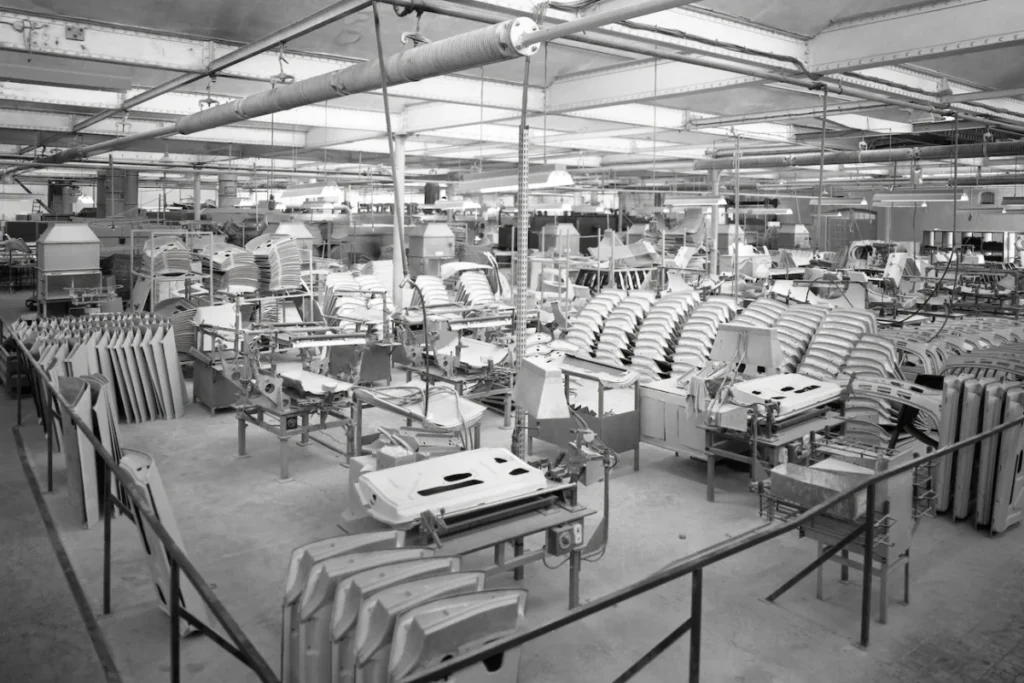
The relocation of Matra’s automotive operations to Romorantin was not merely a logistical shift; it was a technological revolution. The factory became the proving ground for advanced composite materials in European volume car manufacturing.

- The Polyester Revolution: Long before carbon fiber entered mainstream consciousness, Matra mastered the use of fiberglass-reinforced polyester. Utilizing the expertise acquired through GAP, the Romorantin plant developed lightweight, rust-proof body panels affixed to robust steel spaceframes.
- Key Models Born at Romorantin:
- Matra 530 (1967–1973): The pioneering mid-engine sports car with a removable targa roof, powered by a Ford Taunus V4 engine.
- Matra-Simca Bagheera (1973–1980): A revolutionary mid-engine coupe featuring an innovative three-abreast front seating arrangement, achieving massive commercial popularity.
- Matra Murena (1980–1983): The sleek successor to the Bagheera, featuring a fully galvanized chassis to combat corrosion issues that plagued its predecessor.
- Renault Espace (Generations 1 to III, 1984–2002): Although conceptualized alongside Peugeot, it was at Romorantin that Matra industrialized and assembled the world’s first successful mass-market monovolume (minivan), utilizing a galvanized steel frame wrapped in composite body panels.
Official Responses and Industry Perspectives
At the time of Matra’s automotive expansion, the French industrial establishment viewed the Romorantin enterprise with a mixture of skepticism and awe. Traditional manufacturers like Renault and Peugeot operated massive, highly automated stamping presses working with sheet steel. Matra’s reliance on hand-laid fiberglass and low-volume, flexible manufacturing processes was initially dismissed as artisanal eccentricity.
However, industry analysts soon changed their tune. In internal corporate retrospectives, executives from the PSA Group and Renault acknowledged that Matra’s agility at Romorantin solved a major riddle in the French automotive landscape: how to profitably produce niche, lifestyle vehicles without tying up multibillion-franc primary assembly lines.
When Matra partnered with Renault to launch the Espace in 1984, official statements from Renault management highlighted Romorantin as a "laboratory of future manufacturing." Jean-Luc Lagardère, who succeeded Chassagny and steered Matra through its golden age of Formula 1 championships and Le Mans victories, frequently emphasized that Romorantin was the soul of the company—where engineers, racers, and factory workers shared a common roof.
Implications: The Legacy of Romorantin
The closure of the Romorantin manufacturing plant in 2003—following the commercial failure and termination of the Renault Avantime—sent shockwaves through the Loir-et-Cher region. It marked the definitive end of an era where independent French boutique manufacturing could survive under the crushing weight of platform-sharing global conglomerates.
Yet, the legacy of the Romorantin factory endures on multiple fronts:

- Technological Precursor: The composite body construction techniques perfected at Romorantin paved the way for modern lightweight material applications in niche electric vehicles and hypercars.
- Industrial Archaeology and Preservation: Today, the former Hennebique-designed textile mills and Matra assembly halls are celebrated as architectural landmarks. The Musée Matra de Romorantin preserves the physical memory of the site, displaying dozens of racing cars, military prototypes, and production models that emerged from its gates.
- Socio-Economic Shift: The transition from wool to fiberglass, and finally to a post-industrial heritage economy, mirrors the broader trajectory of provincial French manufacturing in the late twentieth century.
The story of Romorantin is ultimately a testament to human adaptability. From weaving warm cloth for 19th-century infantrymen to assembling space-age sports cars and pioneering the modern minivan, this historic site remains an immortal monument to French industrial creativity.
