

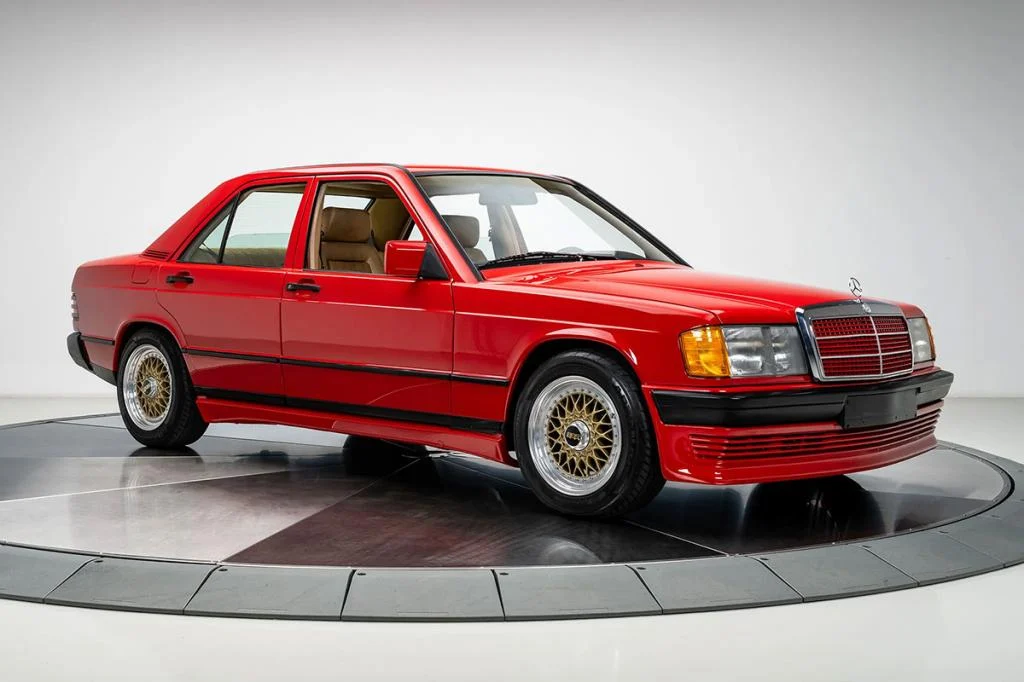
October 27, 2026 — In the pantheon of automotive tuning, few names evoke as much raw, unapologetic American horsepower as Callaway Cars. Famed globally for taking iconic Chevrolet Corvettes and transforming them into twin-turbocharged, high-speed legends that could trade blows with Europe’s finest supercars, the Connecticut-based engineering firm is a temple of mechanical audacity. Yet, hidden deep within the annals of its storied history lie unexpected treasures—experiments that bridge the gap between American forced-induction mastery and European chassis dynamics.
Among these elusive footnotes is a true unicorn of the 1980s tuning scene: a one-off, highly modified 1984 Mercedes-Benz 190E Turbo Callaway. Originally serving as a rolling showcase of trans-Atlantic technical collaboration, this singular "Baby Benz" recently resurfaced on the auction circuit, sending shockwaves through the youngtimer collecting community. Having recently emerged from a meticulous, six-figure restoration, this legendary machine offers a fascinating glimpse into a wild era when independent tuners ruled the performance landscape.
Main Facts: Anatomy of a Trans-Atlantic Mutant
At first glance, the Mercedes-Benz W201—affectionately known as the "Baby Benz"—was an unlikely canvas for a high-performance American tuner. Introduced in the early 1980s, the compact executive sedan was engineered with bulletproof German durability and conservative luxury in mind. However, beneath its understated exterior lay a chassis just begging to be unleashed. Enter Reeves Callaway and his team, who took the modest four-door and turned it into an absolute weapon.
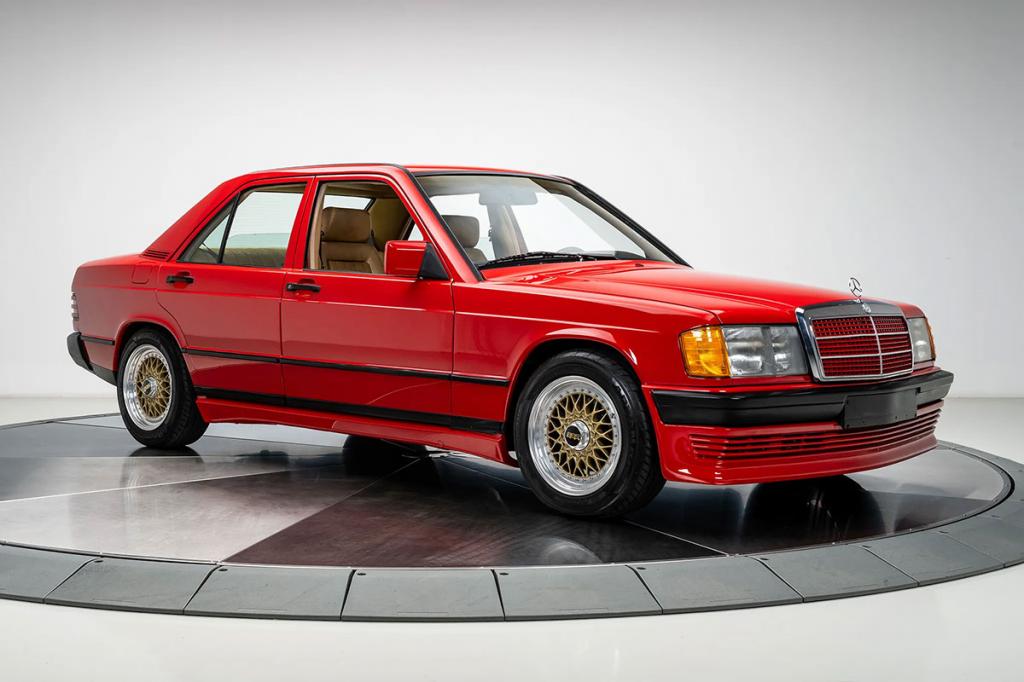
This 1984 prototype was far from a solo endeavor; it reads like a 1980s automotive who’s-who of elite aftermarket performance:
- The Wheels: Iconic 15-inch, three-piece modular BBS mesh wheels wrapped in aggressive 205/55 performance rubber.
- The Suspension: Custom-valved Bilstein B8 dampers paired with lowered, performance-tuned H&R springs, transforming the plush cruiser into a corner-carving machine.
- The Interior: Bespoke Recaro bucket seats seamlessly integrated into an upscale cabin draped in rich "Palomino" leather.
- The Controls: Pure functional theater. The traditional horn button on the steering wheel was replaced by a custom MOMO boost pressure gauge, while an AEM air/fuel ratio (AFR) monitor was discreetly housed in the glovebox.
Underneath the hood lies the crown jewel of the build. Callaway took the naturally aspirated 2.3-liter inline-four engine—the very same architectural foundation that Cosworth would famously use to build the legendary 190E 2.3-16—and completely re-engineered it for forced induction.
Following a comprehensive $100,000 mechanical and cosmetic restoration completed in 2022, the extent of Callaway’s intricate engineering became fully apparent. The powerplant features:

- A completely rebuilt Garrett turbocharger fed by a custom-fabricated exhaust manifold.
- A bespoke intercooler system engineered specifically for the W201 engine bay.
- Internal engine upgrades, including performance camshafts and heavy-duty valve springs.
- Modernized engine management courtesy of a standalone MicroSquirt electronic control unit (ECU).
- A heavy-duty SPEC performance clutch designed to harness the massive surge in torque.
- A custom exhaust system culminating in a throaty Sebring rear muffler.
Power is channeled to the rear wheels via a traditional five-speed manual transmission, making this sedan an analog driver’s dream.
Chronology: From 1980s Cover Star to Modern Collector’s Holy Grail
The journey of this Mercedes-Benz 190E Turbo Callaway spans over four decades of automotive history, tracking the evolution of the tuning industry from wild, analog experimentation to high-dollar historical preservation.
1984–1985: Genesis and Press Stardom
The car was born during the mid-1980s golden age of turbocharging, a time when aftermarket developers were experimenting with forced induction to extract supercar-slaying power from modest displacement engines. Once completed, Callaway’s engineering exercise quickly caught the attention of automotive journalists. Its high-water mark of early fame came in November 1985, when the car was featured prominently in Road & Track magazine, cementing its status as a legitimate engineering marvel rather than just a cosmetic styling kit.

The Decades in Obscurity
Following its initial media blitz, the 190E prototype slipped quietly into the collector shadows. For years, its whereabouts were largely unknown to the general public, preserved only in enthusiast archives and dusty back-issues of automotive magazines. It eventually found a home within the esteemed "Tons of Gas Auto" collection in North Carolina, where its historical significance was carefully guarded.
2022: The $100,000 Renaissance
Recognizing the deteriorating state of the car’s mechanical systems and cosmetics after racking up 136,000 miles (approximately 218,871 kilometers), a major restoration effort was undertaken in 2022. Valued at roughly $100,000, this exhaustive overhaul breathed new life into the aging classic. The bodywork was stripped and sprayed in a stunning, factory-correct "Signal Red" (Code 568) finish. Concurrently, the engine bay was completely revitalized: the Garrett turbo was rebuilt, the intercooler and plumbing were refreshed, and the MicroSquirt ECU was integrated to ensure reliable, modern-day drivability while retaining the car’s vintage character.
Present Day: The Auction Block
Re-emerging into the spotlight, the car was offered for sale accompanied by its official Callaway certificate of authenticity and the original November 1985 Road & Track issue featuring its review. Despite its rich pedigree, extensive recent restoration, and singular status in automotive history, the car commanded a winning bid of just $31,750. For a vehicle of this caliber, industry insiders have noted that the hammer price represented an incredible bargain for a slice of tuning history.

Supporting Data: Specifications at a Glance
To truly understand the uniqueness of the Callaway 190E, examining the technical specifications reveals the sheer depth of engineering invested into a platform long before factory performance variants like the 190E 2.5-16 Evolution became household names.
| Specification Category | Details & Components |
|---|---|
| Make / Model | Mercedes-Benz 190E (W201) Callaway Turbo Prototype |
| Year of Production | 1984 |
| Engine Type | 2.3-Liter Inline-4 (Naturally aspirated base, heavily modified) |
| Aspiration System | Custom Garrett Turbocompresseur with bespoke intercooler |
| Engine Management | MicroSquirt Standalone ECU |
| Transmission | 5-Speed Manual with SPEC Performance Clutch |
| Suspension | Bilstein B8 custom-valved dampers & H&R lowering springs |
| Wheels & Tires | 15-inch 3-piece BBS mesh wheels / 205/55 performance tires |
| Interior Appointments | Palomino leather, Recaro bucket seats, MOMO boost gauge steering wheel |
| Odometer Reading | ~136,000 miles (approx. 218,871 km) |
| Restoration Date / Cost | 2022 / Estimated at $100,000 (includes Signal Red paint & engine rebuild) |
| Final Auction Price | $31,750 (Excluding premiums) |
Official Responses and Industry Perspective
While Mercedes-Benz in the 1980s was fiercely protective of its corporate engineering ethos—relying heavily on its official motorsport partner, Cosworth, to develop the high-performance engines for the W201 chassis—independent firms like Callaway operated in a wild-west environment of unbridled creativity.
Callaway Cars has historically viewed its non-Corvette projects as important milestones of engineering capability. Reeves Callaway’s philosophy was never about merely slapping badges on cars; it was about thermodynamic efficiency, turbocharger integration, and pushing mechanical boundaries.

Speaking anonymously, vintage Porsche and Mercedes-Benz specialist restorers remarked on the sale:
"Projects from this era represent a time when tuning was an art form driven by trial, error, and sheer mechanical genius. To see an American tuner tackle a German chassis with such meticulous integration—like embedding the boost gauge directly into the steering wheel hub—shows a level of whimsy and technical depth that modern computer-designed cars simply lack."
Implications: The Rising Value of 1980s Youngtimers
The modest final sale price of $31,750 for such a historically significant prototype underscores a fascinating dichotomy in the collector car market. While pristine, factory-original homologation specials like the Mercedes-Benz 190E 2.3-16 and Evolution II routinely command six-figure sums at elite houses like RM Sotheby’s or Gooding & Company, aftermarket tuner specials from the same era often fly under the radar.

However, industry experts predict a shifting tide. As Gen X and younger millennial collectors—those who grew up drooling over tuning magazine centerfolds in the 1980s and 90s—gain greater purchasing power, the appreciation for period-correct tuner cars is skyrocketing.
This 1984 Callaway 190E Turbo is more than just a used sedan with high mileage; it is a historical artifact. It represents the collision of American forced-induction audacity and German engineering rigidity. For the lucky buyer who secured this red wedge of automotive history for the price of a mundane modern daily driver, they haven’t just bought a car—they have acquired a irreplaceable piece of tuning folklore that will undoubtedly turn heads at every cars and coffee and historic concours event it attends for decades to come.
