

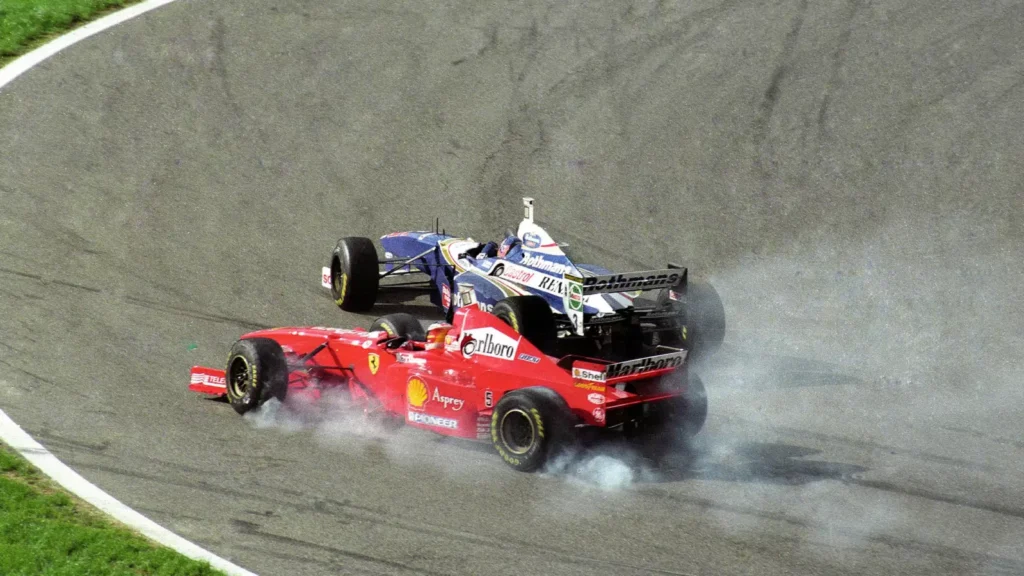
The date was October 26, 1997. The venue was the Circuito de Jerez in Andalusia, Spain. It was the final round of the Formula 1 World Championship, a season-long duel between the established titan, Michael Schumacher, and the spirited challenger, Jacques Villeneuve. What unfolded over those 69 laps did not merely decide a title; it etched a permanent scar into the history of motorsport. It was a day of calculated aggression, mechanical survival, and a final, bitter courtroom verdict that would define an era of ruthless competition.
The Collision: A Calculated Maneuver
The atmosphere in the paddock was suffocating, thick with the tension of a winner-takes-all showdown. Schumacher, leading the championship by a single point, knew his path to the finish ahead of the Williams, or ensure that neither of them reached the checkered flag.
The pivotal moment arrived on the 48th lap. As the field approached the Dry Sack hairpin, Villeneuve, in his Williams FW19, saw a sliver of an opening. He braked late, throwing his car down the inside line. Schumacher, caught off-guard, initially took the racing line, but as the Williams drew alongside, the German made a move that would live in infamy. He sharply flicked his steering wheel to the right, steering his Ferrari F310B directly into the side of the Williams.
The impact was sickening—a metallic crunch of carbon fiber meeting Goodyear rubber. The Ferrari was sent bouncing into the gravel trap, its rear wheels spinning helplessly in the air. Schumacher, realizing he had beached his car, climbed out and leaned against the safety rail. He looked on with cold, calculated expectation. He had successfully taken his rival out of the race. If Villeneuve retired, Schumacher would be champion. But he had fundamentally miscalculated the resilience of the machine—and the man—he had just struck.
The Invisible Battle: A Battery on a Thread
While the world watched the gravel trap, the real drama was unfolding inside the cockpit of the Williams. The telemetry monitors in the pit lane, overseen by the legendary engineering duo of Patrick Head and Adrian Newey, showed a chaotic data stream.
Initial reports suggested the Williams had suffered punctured radiators or bent suspension geometry. The truth was far more precarious. The Ferrari’s front-right wheel had slammed into the Williams’ left sidepod with such violence that it shattered the carbon-fiber housing holding the car’s battery.
The heavy lead-acid battery was no longer fixed to its chassis mount; it was effectively dangling, suspended only by its electrical wiring. Every time Villeneuve accelerated, braked, or hit the brutal curbs of Jerez, the battery swung violently within the sidepod. For twenty laps, the Canadian was driving a ticking time bomb. If a single wire frayed against a sharp edge of broken carbon, or if a terminal snapped, the ignition would cut out instantly. The V10 Renault RS9 engine would fall silent, and with it, Villeneuve’s championship hopes would dissolve into the Spanish dust.
The Masterclass of Survival
Villeneuve did not need a radio confirmation to know his car was wounded. The steering felt disconnected, the aerodynamics were compromised, and the car’s handling had deteriorated into a nervous, unpredictable beast. He knew the math: he didn’t need to win the race. He needed only to finish in the points—specifically, sixth or higher—to secure the crown.
The final twenty laps were a masterclass in controlled, defensive driving. Villeneuve entered a state of heightened awareness, surgically avoiding the painted curbs that could trigger a terminal failure. He rounded his lines, sacrificing speed for mechanical preservation. Behind him, the McLaren duo of Mika Häkkinen and David Coulthard closed the gap, sensing the vulnerability of the wounded Williams.
Villeneuve refused to engage in a reckless defense. As the final lap approached, he realized that a podium finish was within reach, but the risk of a secondary collision was too great. With a pragmatic flourish, he yielded the track, allowing the two silver McLarens to pass. Häkkinen claimed the first victory of his career, with Coulthard securing a McLaren one-two. As Villeneuve crossed the line in third, he raised his arms in a mix of relief and triumph. He had done it: he was the 1997 Formula 1 World Champion.
The Legal Aftermath: A Historic Sanction
The podium ceremony in Jerez was muted, marred by the shadow of the collision. Initially, the race stewards, overwhelmed by the spectacle, classified the incident as a "racing accident." The paddock erupted in outrage. The images were clear: Schumacher had turned into his opponent.
The FIA, under immense pressure from the media and the public, convened an extraordinary meeting of the World Motor Sport Council in Paris on November 11, 1997. After a grueling examination of the telemetry data, which confirmed that Schumacher had veered toward the Williams despite it being established at the apex, the verdict was delivered.
In an unprecedented move, the FIA disqualified Michael Schumacher from the entire 1997 World Championship. He was stripped of his second-place standing, a punishment that sent shockwaves through the sport. While the Scuderia was permitted to keep its points in the Constructors’ Championship and Schumacher retained his individual race wins, his name was struck from the record books as a title contender for that year. It was a firm signal that the "win at all costs" mentality would no longer be tolerated at the highest level of motorsport.
Historical Context: The Triple Pole
The 1997 finale remains unique for reasons beyond the collision. The event had been electrified during Saturday’s qualifying session, which saw one of the most remarkable statistical anomalies in the history of the sport. For the first time since the introduction of millisecond-precision timing, three drivers—Jacques Villeneuve, Michael Schumacher, and Heinz-Harald Frentzen—set the exact same lap time: 1 minute, 21.072 seconds.
Per the regulations, the pole position was awarded to Villeneuve, as he had set the time first. This set the stage for the tension that would dominate the race. It was a weekend where the margins were razor-thin—where three cars were separated by zero time, and a championship was separated by a single, desperate, and ultimately failed act of aggression.
Conclusion: A Legacy of Integrity
The 1997 Jerez Grand Prix remains a defining moment in the history of Formula 1. It serves as a reminder that even the most calculated strategies can be undone by the mechanical reality of the car and the resolve of the driver. Schumacher’s attempt to end the season with a collision remains one of the most controversial chapters in the sport, but it was countered by Villeneuve’s disciplined, intelligent defense of his championship.
Looking back, the image of a damaged Williams limping across the finish line with a dangling battery stands as a testament to the endurance of the sport. It was the day that arrogance crashed into reality, and the day that the integrity of the World Championship was saved by a driver who refused to be pushed off the track—no matter the cost.
