

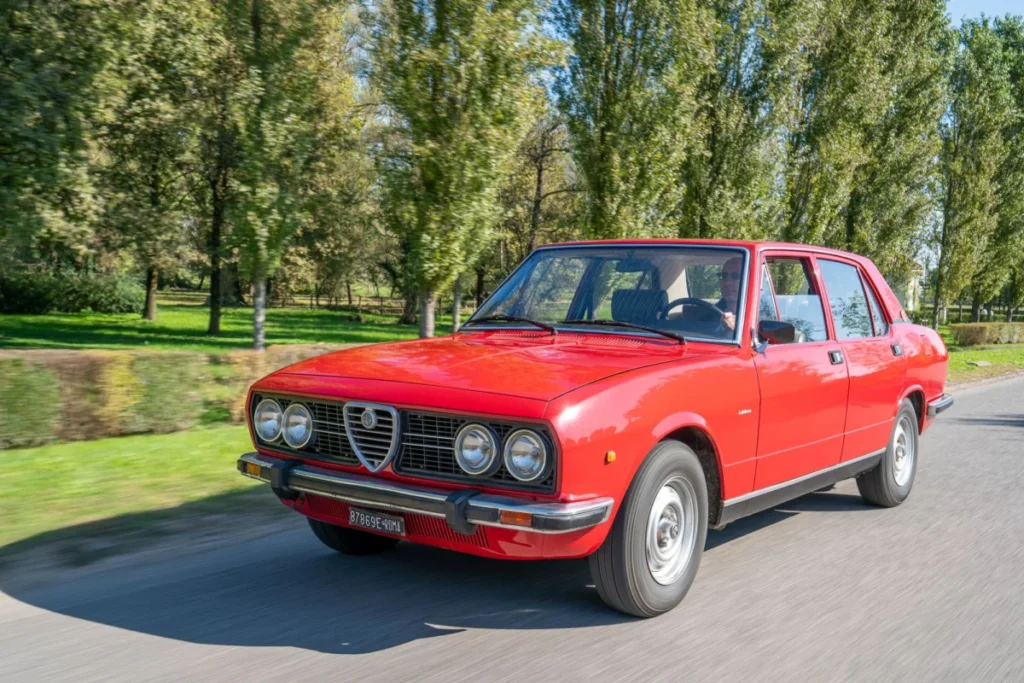
Main Facts: An Exotic Italian Odyssey in South America
For automotive enthusiasts, the name Alfa Romeo evokes a very specific set of images: high-revving twin-cam engines, lightweight bodies carving through alpine passes, timeless Italian styling, and an unmistakable exhaust note that speaks to a rich racing pedigree. Yet, the history of the Milanese marque extends far beyond the borders of Europe. Just as American automakers tailored distinct models for domestic consumption, and European giants built regional variants for the Mexican, Argentinian, and Brazilian markets, Alfa Romeo once maintained a fascinating, lesser-known South American chapter.
At the center of this exotic transatlantic story is the Alfa Romeo 2300—and its elusive variant, the Rio. Conceived in Italy specifically for the Brazilian market, this large executive sedan bore striking visual resemblances to European stablemates like the Alfetta and the Alfa 6, yet it rested securely upon mechanical underpinnings borrowed directly from the 1950s Alfa Romeo 1900. After a dedicated production run in South America, a small handful of these exotic sedans even found their way back across the Atlantic, marketed—largely without commercial success—in select European countries.
Automotive journalists Marco Visani and the photography team at IsolaPress recently tracked down one of these ultra-rare Brazilian-born Alfas originally sold new in Germany. More focused on plush long-distance comfort than razor-sharp track performance, the 2300 Rio offers an alternative interpretation of Italian motoring luxury—one born of economic protectionism, industrial partnerships, and engineering pragmatism.
Chronology: From Aircraft Engines to the "Imported Car Made in Brazil"
To understand how an Alfa Romeo with 1950s roots came to be built in Rio de Janeiro in the 1970s, one must trace a complex industrial timeline spanning nearly four decades.

1942–1960: The Birth of FNM
The story begins with the creation of the Fábrica Nacional de Motores (FNM), established in 1942 in Xerém, near Rio de Janeiro. Initially founded to manufacture aircraft engines and heavy trucks—first under an Isotta Fraschini license and later partnering with Alfa Romeo—FNM was a state-owned enterprise. Because both the Italian automaker and the Brazilian factory shared deep industrial ties to state governance, commercial collaboration was a natural evolution. By 1960, these agreements expanded into passenger car production.
1961–1967: The JK Era
The first FNM passenger car rolled off the assembly line in 1961, assembled using components shipped directly from Milan. Named the "JK" in honor of Juscelino Kubitschek, the visionary Brazilian president who championed the industrial partnership, the car was a near-identical clone of the Alfa Romeo 2000. The angular European sedan had succeeded the glorious 1950s Alfa Romeo 1900, inheriting almost all of its mechanical architecture. However, to cope with local Brazilian gasoline—which suffered from a much lower octane rating—the JK featured a reduced volumetric compression ratio.
1968–1973: The 2150 Transition
In 1968, Alfa Romeo acquired a controlling majority of FNM shares. That same year, the company introduced the 2150. Essentially a modernized evolution of the JK, the 2150 featured a displacement increased to 2,132 cc (achieved by extending the stroke from 88 to 94.5 mm) and a five-speed manual transmission, pushing output to 110 horsepower. Exterior updates were modest: the prominent central bulge on the hood—which previously housed the upper section of the Alfa Romeo badge—was eliminated. The badge itself was shrunk, rounded, and integrated directly into the grille. Additional updates included rectangular auxiliary lights and bumpers fitted with rubberized protective strips.
1974–1986: The All-New 2300 and the European "Rio" Experiment
March 1974 marked a watershed moment for Brazilian Alfas. The FNM brand name was permanently retired from corporate communications and vehicle badging. More importantly, unlike its predecessors, the new 2300 sedan was 100% unique in its styling—designed in Italy but sharing zero body stampings with cars produced at the Arese plant in Milan.

Launched with the clever advertising tagline "O importado fabricado no Brasil" ("The imported car made in Brazil"), the 2300 bridged styling cues from the 1972 Alfetta and the upcoming Alfa 6 (which, though launched in Europe in 1979, had been finalized years earlier).
Seeking to capture a slice of the European market during a sluggish economic period, a lightly modified version designated the Rio was exported to Europe in small numbers. However, European buyers accustomed to modern transaxle layouts and sharp handling were left cold by the car’s dated dynamics. The European experiment was short-lived, making survivors like the German-market model discovered by Gazoline exceptionally rare collector items today.
Supporting Data: Specifications and Engineering Compromises
A deep dive into the engineering sheet of the Alfa Romeo 2300 reveals a fascinating mix of cutting-edge styling and mechanical conservatism.
- Dimensions & Weight: Spanning 4.69 meters in length, the 2300 was a massive car by European standards—stretching a full 46 centimeters longer than an Alfetta. This placed it squarely in a higher executive class, underscored by a cavernous 600-liter trunk.
- Platform & Suspension: While the wheelbase was stretched by 10 centimeters to 2.72 meters, the floorpan shared basic pressings with the older 2150. Suspension layout was a hybrid compromise: independent double wishbones with coil springs up front, and a rigid rear axle with a central locating arm derived from the 105-series family (Giulia). Unlike the contemporary Alfetta, it lacked a rear-mounted transaxle gearbox.
- The Engine: Power came from a direct descendant of the legendary 1900 engine—Alfa Romeo’s first post-war twin-cam inline-four. Featuring a cast-iron block with the bore expanded from 84.5 to 88 mm, displacement peaked at 2,310 cc. Producing 130 horsepower, it propelled the heavy sedan to a top speed of 170 km/h (approx. 106 mph).
- The Fuel Tank: A testament to the vast and often remote expanses of Brazilian roadways in the 1970s—where fuel stations could be sparse—the 2300 was fitted with a gargantuan 100-liter fuel tank.
Official Responses and Industry Context
At the time of its release, leadership at Alfa Romeo positioned the 2300 as a bold statement of industrial self-sufficiency in South America. Brazil’s strict protectionist import tariffs in the 1970s made bringing fully built European cars into the country nearly impossible and prohibitively expensive. By designing an authentic Italian luxury vehicle tailored specifically to local manufacturing laws, local supply chains, and low-octane fuels, Alfa Romeo hoped to cement its foothold in the booming Latin American market.

Yet, corporate headquarters in Milan viewed the export of the 2300 (and the Rio variant) to Europe with mixed enthusiasm. Privately, European engineers recognized that while the styling penned in Italy was handsome and modern, the underpinnings were fundamentally outdated. Grafting a 1950s-derived cast-iron engine and a rigid rear axle onto a large 1970s executive body could not compete with the sophisticated handling and engineering sophistication of domestic European offerings like the BMW 5 Series or Mercedes-Benz W114.
Implications: A Forgotten Footnote in Transatlantic Motoring
The story of the Alfa Romeo 2300 Rio carries deep implications for how automotive heritage is viewed today. It stands as a monument to a bygone era of protectionist trade barriers, when multinational car companies could not simply ship global platforms worldwide. Instead, they had to reinvent themselves locally, fusing Italian design sensibilities with rugged, regional engineering.
For modern collectors, cars like the 2300 Rio represent the ultimate conversation piece—a vehicular chimera that looks like an Alfetta, drives with the mechanical DNA of a 1950s Giulia-precursor, and was built under the tropical sun of Rio de Janeiro before living a quiet life on European tarmac. Though it failed to conquer the European market in period, its sheer rarity and bizarre genealogical tree ensure that its legacy is finally getting the appreciation it deserves in enthusiast circles worldwide.
(For the complete, unabridged feature on this rare find, see Gazoline No. 352).
